


Weekly: China national CEA market trades review (Aug 17- Aug 21)
- Price
- Sales
- Carbon Offset
- Emissions Trading
- Carbon
sxcoal.com507 words76 reads


China's national carbon market saw trading volumes rebound sharply last week (August 17- August 21), with prices holding steady near 97 yuan/t amid a flurry of new energy policy documents.
The benchmark carbon emission allowance (CEA) price ranged between 98.60 yuan/t and 97.10 yuan/t during the week of August 17-21, closing at 97.97 yuan/t on August 21, down 0.24% from the previous week's final trading day (August 14).
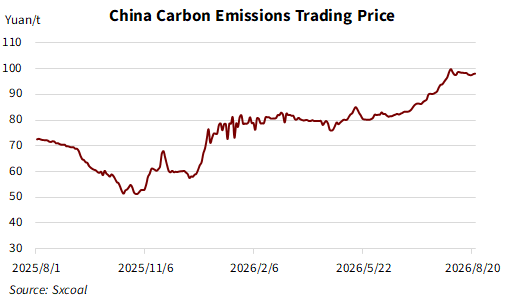
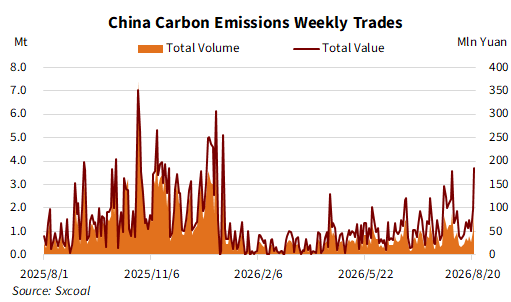
Total CEA volume reached 4.80 million tonnes last week, up 104.62% week on week, boosted by a low base in the prior week and heavy buying on Friday as market participants built positions ahead of the weekend.
Listed contract volumes rose 37.07% week on week to 1.30 million tonnes, while bulk contract volumes surged 150.36% to 3.51 million tonnes. No one-way bidding transactions were recorded.
Total transaction value climbed 104.96% week on week to 466 million yuan ($68.69 million), with listed contracts up 36.20% at 127 million yuan and bulk contracts up 152.65% at 340 million yuan.
Daily volumes ranged from a weekly low of 531,200 tonnes (52 million yuan) on August 19 to a weekly high of 1.89 million tonnes (185 million yuan) on August 21.
Cumulative CEA volume since January 1 reached 83.00 million tonnes, with transaction value of 6.84 billion yuan. Since the market's inception, cumulative volume stood at 947.87 million tonnes, with total value of 64.51 billion yuan.
China Certified Emission Reduction (CCER) prices fluctuated within a narrower range last week, peaking at 96.34 yuan/t and bottoming at 93.54 yuan/t, with volumes continuing to shrink as the narrowing price gap with CEA weakened incentives for compliance through CCER.
Policies in Focus
On the policy front, the National Development and Reform Commission and the National Energy Administration on August 17 released the 15th "Five-Year Plan" for oil and gas development, targeting domestic oil and gas supply of 440 million tonnes of oil equivalent by 2030, a national long-distance pipeline network of 220,000 km, LNG receiving capacity of 200 million tonnes per annum, and cross-border pipeline gas import capacity of 114 billion cubic meters per year.
The plan also calls for annual carbon dioxide injection of 10 million tonnes through carbon capture, utilization and storage (CCUS) projects, and promotes the transformation of cities including Dongying and Yulin toward low-carbon development.
On August 18, three government agencies jointly issued an updated catalog for carbon emission measurement capacity building, expanding key measurement parameters from 39 to 58, testing standards from 82 to 169, and measuring instruments from 108 to 229, while adding CCUS measurement capabilities.
An APEC seminar on CCUS/CCS promoting clean fossil energy development was held in Dalian on August 20, with China proposing three pillars of cooperation: policy dialogue, low-cost technology research and cross-industry demonstration.
On August 21, the National Energy Administration outlined measures to improve energy-saving and carbon-reduction mechanisms, including establishing minimum renewable energy consumption targets, expanding the green certificate market with a price index, and incorporating nuclear power and CCUS projects into the voluntary emission reduction system.


 No Content
