


Review: China Nov pig iron & crude steel output drops further; Hebei leads decline
- Production
- China
- Steel
- Pig Iron
- Crude Steel
sxcoal.com631 words30 reads


China's pig iron production fell 8.7% year on year (YoY) and 4.9% month on month (MoM) to 62.34 million tonnes in November, marking the sixth consecutive month of decrease and hitting a new low since March 2024, showed data from the National Bureau of Statistics (NBS).
The average daily output was calculated at 2.08 million tonnes in the month, 1.7% lower than in October.
China's top five provinces in pig iron production – Hebei, Jiangsu, Shandong, Liaoning, and Guangxi – churned out 32.12 million tonnes of the product in the same month, accounting for 51.5% of the country's total, shrinking 1.6 percentage points MoM, official data showed.
Notably, Shanxi fell beyond the top five producing provinces last month, replaced by Guangxi.
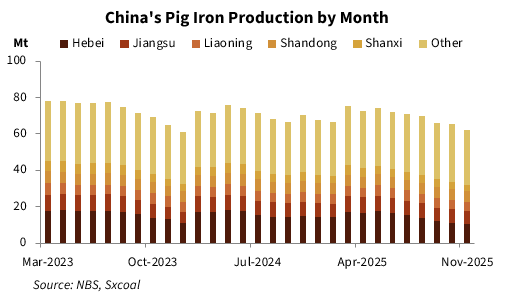
In November, Hebei, Jiangsu, Shandong, Liaoning, and Guangxi respectively contributed 16.9% (10.53 Mt, -7.1% MoM), 11.3% (7.04 Mt, -4.6% MoM), 9.4% (5.84 Mt, -0.8% MoM), 8.3% (5.20 Mt, -1.0% MoM), and 5.6% (3.51 Mt, 11.3% MoM) of the total pig iron output, NBS data showed. Shanxi's output slid 14.4% MoM to 3.39 million tonnes.
In November, only the first six provinces reported their respective pig iron production exceeding 3 million tonnes. Hubei ranked seventh with its production at 2.39 million tonnes.
Nearly 70% of the 28 provinces and regions registered MoM drops in November's pig iron output, of which the largest decrement was seen in Hebei with 808,000 tonnes, and the sharpest decline rate of 24.2% was observed in Shaanxi.
The biggest MoM increment was recorded in Guangxi, at 357,000 tonnes, and Chongqing grabbed the largest growth rate of 29.7%.
China produced 770 million tonnes of pig iron in the first 11 months, down 2.3% YoY. The combined output of Hebei, Jiangsu, Shandong, Liaoning, and Shanxi contributed 430 million tonnes, taking up 55.2% of the total.
China's crude steel output in November also dived for the sixth month in a row, down 10.9% YoY and 3.0% MoM to 69.87 million tonnes, also the lowest point since March 2024. The daily output averaged 2.33 million tonnes, ticking up by 0.3% MoM.
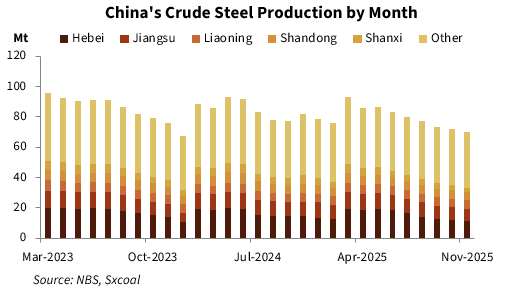
Shanxi also slipped to sixth place in November's crude steel output, outpaced by Guangxi. The top five provinces – Hebei, Jiangsu, Liaoning, Shandong, and Guangxi – produced a total 34.47 million tonnes of crude steel in November, accounting for 49.3% of China's total, expanding 0.3 pp MoM. Notably, Hebei led the reductions.
The top seven provinces each produced over 3 million tonnes of crude steel in November. Guangdong produced 3.05 million tonnes of crude steel, while all remaining regions reported output below 3 million tonnes.
In November, the top five producers respectively contributed 16.3% (11.41 Mt, -6.7% MoM), 11.7% (8.18 Mt, -2.5% MoM), 7.7% (5.39 Mt, -2.8% MoM), 7.7% (5.36 Mt, 0.2% MoM), and 5.9% (4.13 Mt, 59.9% MoM) of the total crude steel output, NBS data showed.
On a monthly basis, almost 70% of 28 provinces and regions reporting crude steel production registered falls, with the biggest decrement of 825,000 tonnes in Hebei and the sharpest decline rate of 32.1% in Xinjiang.
Among provinces and regions with rises against October, November's crude steel production recorded the largest increment of 1.55 million tonnes and the steepest increase rate of 59.9%, both in Guangxi.
China's crude steel production over January-November dropped 4.0% YoY to 890 million tonnes, of which 460 million tonnes or 51.9% were contributed by the top five provinces – Hebei, Jiangsu, Shandong, Liaoning, and Shanxi.
The traditional slack season for steel consumption in November, combined with relatively high input costs, compressed steelmaking margins, and capped production enthusiasm at mills. This was further compounded by routine maintenance and environmental restrictions.
Looking ahead to December, with the off-season deepening, end-user demand for steel products appears to remain under downward pressure. Steel production is less likely to increase due to constrained profitability and sustained environmental curbs.


 No Content
