


China Apr hydropower output sees YoY drop amid shrinking demand, uneven rainfall
- Opinion
- Production
- China
- Hydropower
- Power
sxcoal.com606 words58 reads


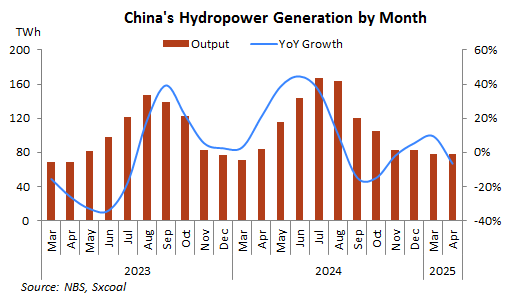
China's hydropower generation reversed its months-long year-on-year growth to a decline in April, underscoring the mounting challenges posed by erratic precipitation patterns and softening electricity demand.
Hydropower output reached 78.62 TWh for the month, down 6.5% from a year ago, showed data from the National Bureau of Statistics, which contrasts sharply with a 9.5% increase in March.
Data from the China Meteorological Administration revealed that April's national average rainfall was 37.0 mm, 11.4% below the seasonal norm.
April, positioned just before the major flood season (June-August), saw continued regional disparities in rainfall along the Yangtze River Basin. Several river basins remained in drought, with some areas experiencing worsening water scarcity. These conditions complicated reservoir operations and curtailed water availability for power generation.
Industry analysts noted that the Yangtze River Basin will experience unusually intense early-season rainfall during the plum rain period (June-July) followed by a drier-than-average main flood season this year. Precipitation in the middle and lower reaches of the basin is expected to fall more than 20% below normal levels during the main flood season.
In response to lower water inflows of the Yangtze River Basin, government agencies and power producers made joint efforts. From April 8 to 14, China Yangtze Power optimized flow through a coordinated operation of six major reservoirs, raising average daily outflows to 10,000 cu.m/s.
Performance among major power firms varied. China Suntien Green Energy saw a notable gain in hydropower output during April, while CHN Energy Changyuan Electric Power registered a decline due to insufficient inflows.
Nationwide power consumption rose 7.0% year on year in the month, retreating 1.33 percentage points compared to the same period last year, tempering demand for overall electricity to a certain degree.
Specifically, Sichuan still saw the highest hydropower output in April of 22.98 TWh (10.7% YoY), contributing to 29% of the nation's hydropower generation. Yunnan followed with an output of 17.87 TWh (15.4% YoY), constituting 23% of the total.
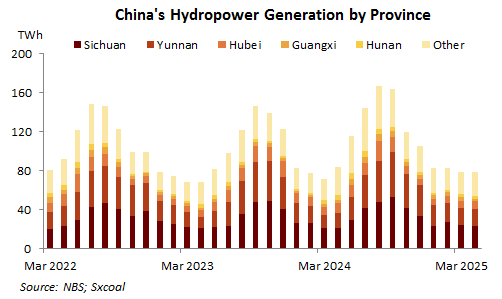
On a national scale, 16 provinces and regions witnessed year-on-year rises in hydropower generation in April, accounting for about 52% of the total number, while 15 represented a decrease.
Among provinces with yearly growths, the biggest increases were recorded in Beijing (92.0%), Jiangsu (79.1%), and Inner Mongolia (47.3%). Provinces with significant year-on-year declines included Jiangxi (-52.4%), Hunan (-45.2%), and Guangdong (-44.5%).
Eighteen provinces saw flat or increased hydropower output in April compared with the month prior, especially notable in Heilongjiang (88.9%) and Ningxia (45.5%).
In the first four months, China's hydropower generation amounted to 301.24 TWh, up 2.2% from the previous year. The leading provinces during this period were Sichuan, Yunnan, Hubei, Qinghai, and Guizhou.
These provinces generated 91.13 TWh, 69.99 TWh, 29.21 TWh, 12.34 TWh, and 12.28 TWh of hydropower, respectively. The figures corresponded to year-on-year changes of 8.4%, 18.4%, -15.1 %, 14.8%, and 13.9 %.
Looking ahead, weather forecasts for May and June suggest that northern China is expected to receive above-average precipitation, some by as much as 20-50%, while southern and southeastern China are likely to see lower rainfall, raising concerns of intermittent droughts.
Within the Yangtze River Basin, the overall climate outlook for the flood season remains unfavorable. While upstream areas are expected to experience near-normal rainfall, the middle and lower reaches may see marked decreases, particularly along the main course near Hankou and Datong stations.
Despite these uncertainties, the improved hydrological conditions upstream may lend some support to hydropower output over the second quarter. However, the growing volatility underscores the need for enhanced coordination of water resources across the basin. Authorities are being urged to refine the integration of hydropower with thermal and renewable sources, in order to maintain grid stability.


 No Content
