


China's hydropower generation fades in Aug as drought and heatwave persist
- Production
- China
- Hydropower
- Power
sxcoal.com683 words175 reads


Hydropower output in China experienced a downturn in August after four consecutive months' notable growth, dragged down by lower-than-average rainfall and persistent high temperatures, particularly in southern China where major hydro plants are concentrated.
The nation's total power generation reached 907.4 TWh in August, with hydropower contributing 163.47 TWh or 18% of the total. Despite a 10.7% year-on-year rise, hydropower generation fell 1.8% from July, leading to a greater reliance on thermal power, which accounted for 68% of the total electricity supply, according to the latest data from the National Bureau of Statistics (NBS).
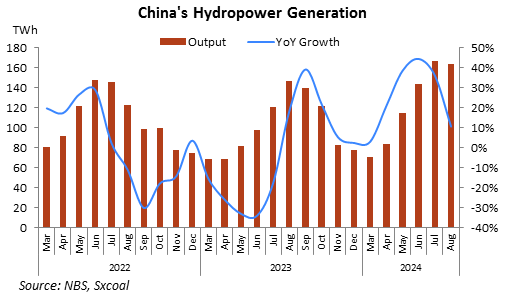
Water outflows and water levels have diverged in medium- and large-sized reservoirs since August, with lower levels in downstream regions and higher upstream. This led to a decline in hydropower generation in the mid-lower reaches while the upper reaches performed better.
The August temperature averaged 22.6 degrees Celsius in China, 1.5 degrees Celsius higher than the average for the same period, with temperatures in some parts of northern and southern China being 2-4 degrees Celsius higher than usual, according to China Meteorological Administration (CMA).
CMA data also showed there were 16-20 days with temperatures over 35 degrees Celsius in the middle and lower reaches of the Yangtze River, rising 8-15 days compared to the corresponding month in history.
These factors further boosted cooling demand and put additional pressure on the power grid, highlighting the backup role of thermal power in meeting the hydroelectricity shortfall.
Additionally, the August precipitation averaged 95 mm, 9.3% lower than normal. This, coupled with sustained drought in hydropower-heavy regions in southern and southwestern China, pressured hydropower output.
Sichuan, known for its substantial contribution to national hydroelectricity, saw the average temperature reach 26.3 degrees Celsius, 2.8 degrees Celsius higher than the long-term average, hitting the second-highest level for the same month in history.
However, Sichuan's average precipitation came in at 82.8 mm in August, 53% lower than normal, ranking the second-lowest on record. The number of rainy days also significantly declined to the lowest level. Prolonged heat waves and insufficient rainfall exacerbated electricity loads and negatively impacted on hydro output.
CHN Energy Changyuan Electric Power Co., Ltd. also reported a 64.63% slump in hydropower generation, while its coal-fired power generation jumped d by 43.05%.
Based on the NBS data, most hydro-rich provinces experienced varying degrees of year-on-year growth in hydropower output in August thanks to expanded hydropower installations but saw broad declines compared to July.
Specifically, Sichuan saw the highest hydropower output in August despite sustained drought, amounting to 53.12 TWh (10.1% YoY), contributing to 32% of the nation's hydropower generation. Yunnan followed with an output of 45.5 TWh (11.7% YoY), constituting 28% of the total. Yet, third-ranked Guizhou saw hydro generation tumble 42.7% from a month ago to 4.84 TWh, accounting for 3% of the total.
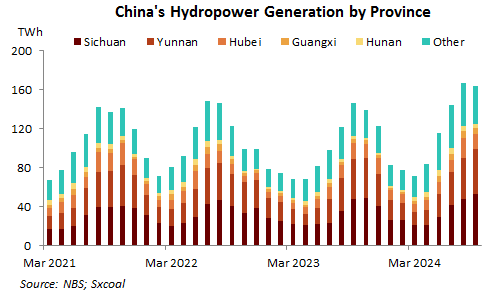
On a national scale, 21 provinces and regions witnessed year-on-year gains in hydropower generation in August, accounting for about 72% of the total number, 7 percentage points lower than the month-ago level, while eight represented a decrease.
Among provinces with yearly growths, the biggest increases were recorded in Jilin (151.5%), Shanxi (107.1%), and Hainan (104.4%). Provinces with significant year-on-year declines included Guizhou (-23.2%) and Hebei (-11.6%).
12 provinces, mainly in northern and northeastern China, experienced month-on-month growth in hydropower generation in the same month, especially notable in Shanxi (27.8%).
In January-August, China's hydropower generation amounted to 882.2 TWh, indicating a 21.7% year-on-year rise. The leading provinces during this period were Sichuan, Yunnan, Hubei, Guizhou and Guangxi.
These provinces generated 255.56 TWh, 203.71 TWh, 95.88 TWh, 38.85 TWh, and 37.14 TWh of hydropower, respectively. The figures corresponded to year-on-year increases of 17.4%, 14.8%, 27.0%, 55.7% and 47.1%.
Looking ahead to September, the CMA forecasts indicate that abundant rainfall in the south of the Yangtze River and further south regions affected by typhoons during late September to early October may favor hydropower generation.
However, some experts anticipated hydropower output to further decrease, given predicted higher-than-normal temperatures in most parts of China and continuously severe drought in southwestern regions in September, in addition to the end of the peak summer power demand.


 No Content
