


Most Chinese provs see pig iron and crude steel output rise MoM in May
- Production
- Steel Products
- Pig Iron
- China
- Steel
sxcoal.com756 words43 reads


China's total pig iron production increased 6.3% month on month yet declined 1.2% year on year to 76.13 million tonnes in May, showed data from the National Bureau of Statistics (NBS). Whereas, the average daily output estimated at 2.46 million tonnes was 2.9% higher than in April.
China's top five provinces in pig iron production – Hebei, Jiangsu, Shandong, Liaoning and Shanxi – produced 44.24 million tonnes of the product in the same month, accounting for 58.1% of the country's total, official data showed.
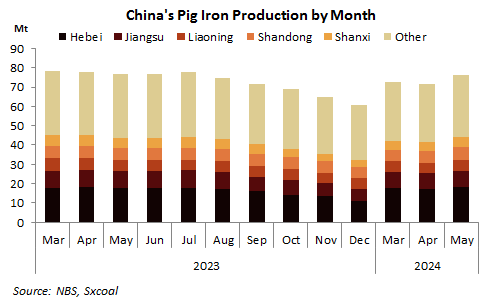
In May, Hebei, Jiangsu, Shandong, Liaoning and Shanxi respectively contributed 23.8%, 11.0%, 8.5%, 7.7% and 7.1% of the total pig iron output. Hebei churned out more than twice as much pig iron as Jiangxi.
In May, the first five provinces reported their respective pig iron production exceeded 5.0 million tonnes, and production in each of the remaining provinces was lower than 3.0 million tonnes.
Guangxi ranked sixth in China with its pig iron production reaching 2.85 million tonnes in May, representing 3.7% of China's total.
Over 90% of the 28 provinces and regions witnessed month-on-month growth in pig iron output in May, of which the biggest increment of 1.07 million tonnes was seen in Hebei, and the largest increase posting 237.8% occurred in Ningxia.
Only two provinces witnessed a decrease in their pig iron production from the previous month. Tianjin's output declined by 4.3% or 76,600 tonnes on the month, and Gansu fell by 2.7% or 15,600 tonnes.
China produced 360 million tonnes of pig iron in the first five months, down 3.7% year on year. The combined output of Hebei, Jiangsu, Shandong, Liaoning and Shanxi contributed 210 million tonnes, taking up 58.0% of the total.
Crude steel
China's crude steel output hit 92.86 million tonnes in May, up 8.1% from a month ago and 2.7% from the prior year, marking the highest level since March this year. The average daily output estimated at 3.00 million tonnes increased by 4.6% compared with the month before.
The top five provinces – Hebei, Jiangsu, Shandong, Liaoning and Shanxi - produced a total of 49.35 million tonnes of crude steel in May, accounting for 53.1% of China's total. These provinces all presented monthly growth in crude steel output.
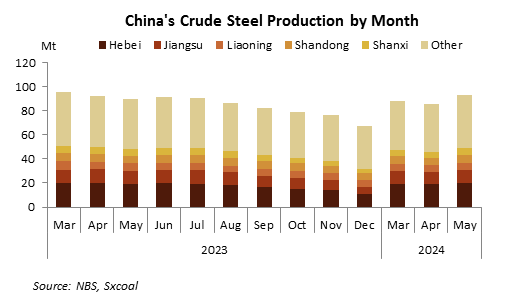
Hebei, Jiangsu, Shandong and Liaoning's crude steel production reversed to climb in May, and Shanxi extended the upward trend in crude steel output. The first four provinces saw their output surpass 6 million tonnes. In particular, the top Hebei's output was 1.9 times than that of the second Jiangsu.
Excluding these five provinces, all the remaining provinces saw crude steel production of less than 5 million tons in May, of which production of Guangxi ranged from 4 million to 5 million tonnes, with four provinces standing at 3-4 million tonnes and 18 provinces lower than 3 million tonnes.
About 80% of the total 28 provinces and regions registered gains in crude steel production on the monthly basis, with the biggest increment observed in Hebei and the largest growth rate of 36.9% in Ningxia.
Among the remaining provinces, crude steel production recorded the most decrement and sharpest decline in Tianjin at 95,000 tonnes and 6.3%.
China's crude steel production over January-May fell 1.4% year on year to 440 million tonnes, of which 230 million tonnes or 53.1% were contributed by the top five provinces.
In May, favorable macroeconomic policies bolstered the bullish sentiment. Finished steel prices fluctuated upwards amid steadily rebounded steel demand as a whole, despite seasonal factors affecting the steel sector. Higher-than-expected demand encouraged steelmakers to lift output, and those mills undergoing maintenance also restarted operations gradually. Steel output hence increased accordingly.
However, high temperatures and heavy rainfall curbed end buyers' steel consumption in the run-up to the off-season. Recent talks about reducing crude steel output also posed negative impacts on production.
Nevertheless, steel mills were running at high capacity since June, contributing to an unexpected hike in molten iron output last week.
Daily crude steel output at key member firms of the China Iron and Steel Association reached 2.25 million tonnes in early June, rising 3.30% from ten days ago. The daily output of pig iron averaged 1.99 million tonnes, up 3.03% from ten days earlier, the CISA data showed.
During the same period, the daily output of crude steel in China was estimated to be 2.94 million tonnes, a 2.32% rise from ten days earlier. That of pig iron was 2.44 million tonnes, up 2.42% compared to the previous ten days. Steel output in June is likely to remain high amid plans to resume production of blast furnaces.


 No Content
