


Three Gorges Dam water outflow surges 50% MoM in May
- Production
- Hydropower
- China
- Power
sxcoal.com598 words122 reads


Hydropower output has been bolstered during the flood season, particularly in southern regions of China, posting uncertainty to thermal power generation and daily coal burn at power plants.
Water outflow from Three Gorges Dam averaged 14,914 cubic meters per second (cu.m/s) each day over May 1-22, jumping 50% from a month ago and 37% year on year, Sxcoal's data showed.
The outflow increased to around 15,000 cu.m/s from May 7, while water inflow during the same period varied slightly.
Recent outflow at the dam experienced rising volatilities due to factors such as upstream water inflow and reservoir operation plans. On May 18, water outflow at Three Gorges Dam peaked at 18,100 cu.m/s, hitting the highest since early October 2023, Sxcoal data showed. The figure fell to 11,100 cu.m/s on May 19 before a rise to 15,700 cu.m/s on May 22.
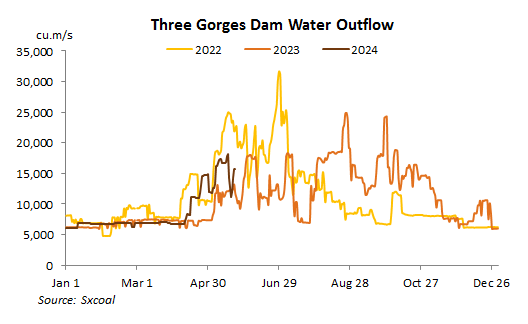
The significant fluctuation in outflow may be attributed partly to the artificial adjustment. According to China Three Gorges Corporation, the joint ecological scheduling test between Xiangjiaba Dam and Three Gorges Dam officially commenced on May 18, 2024. It aims to promote the natural reproduction of driftable fish eggs downstream of Xiangjiaba and Gezhouba.
As per the plan, Xiangjiaba Dam initiated the trial on May 18 and Three Gorges Dam started on May 19 considering the propagation time.
It is understood that during the later stages, these two dams will manage to maintain a relatively high water outflow based on forecasted and actual inflows. Water temperature, hydrology, and fish spawning monitoring will be conducted simultaneously.
Comparatively, water inflow at Three Gorges Dam saw slower growth than the outflow. Since mid-April, the inflow into the dam has hovered around 11,000 cu.m/s impacted by increased precipitation. This level was relatively average compared to the same period in the past five years and showed an approximate 30% increase from the previous year.
The daily average of inflow was 11,259 cu.m/s from May 1 to 22, up 25% month on month and 34% on the year.
Overall, May's rainfall has mainly concentrated in southern China and regions south of the Yangtze River, with relatively less precipitation in the western areas. Combined with below-average rainfall in the past two years and limited glacial and snow meltwater, the increase in upstream water inflow has been limited.
The faster outflow and pre-discharged plan of water for the approaching peak flood season has led to a continuous decrease in the water level of Three Gorges Dam. As of May 22, the water level declined to 153 meters, down 5 meters compared to the beginning of the month.
According to the State Flood Control and Drought Relief Headquarters, Three Gorges Dam gradually releases water from January to the main flood season and vacates reservoir capacity, reaching a flood control limit of around 145 meters by June 10, in preparation for upcoming floods.
The latest data showed the declined water level at the dam has resulted in the release of nearly 17.5 billion cubic meters of flood storage capacity, accounting for about 79% of the total.
Most of the southern regions are forecast to experience various degrees of precipitation in the following two weeks, which could continue to improve the local hydropower generation.
The relatively dry and rain-deficient Yunnan province, especially the Jinsha River Basin upstream of the Yangtze River, is expected to see noticeable rainfall, which will contribute to an improvement in hydropower.
As hydropower generation continues to climb, its squeeze on thermal power generation is expected to become increasingly obvious, possibly leading to lower-than-expected demand for coal at power plants.


 No Content
