


Review: S Korea's Oct coal imports at record low; Russia becomes the largest supplier
- Import
- International
- Thermal Coal
- Coking Coal
- PCI
- Anthracite
- Coal
- Indonesia
- South Korea
- Russia
- Australia
sxcoal.com646 words281 reads


South Korea's thermal coal imports continued to fall in October and hit a record low since January 2014. In the month, Russia surpassed Australia becoming the largest coal supplier to the country.
The country's coal imports totaled 8.16 million tonnes in October, falling 12.45% from the preceding year and 22.9% from September, customs data showed.
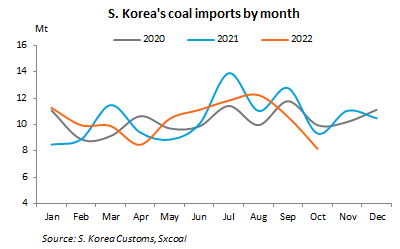
The power demand in South Korea remained low as the temperature was relatively comfortable. Most power utilities have completed stock buildups for winter heating after previously centralized purchases.
Power consumers waited further price cuts amid continued declines of seaborne coal prices.
South Korea's coal-fired power generating capacity fell from a month ago after the temperature started cooling down in October. In addition, most power utilities have completed restocking following previous purchases.
The operational power generating capacity in the country in October totaled 86 GW, up 4.42% on the year but falling 6.34% on the month, and the electricity demand peak reached 72.5 GW, down 4.17% from the year prior and 11.66% from September.
POSCO, the company that took a heavy blow from the Super Typhoon Hinnamnor in early-September, found some production lines still focused on drainage and mud cleaning and are expected to restart in three-six months. This led South Korea's October coking coal imports linger low also.
The import value reached $1.87 billion in October, increasing 41.46% year on year but falling 12.5% month on month. The average import price was calculated at $228.57/t, rising 61.61% from the year prior and up 13.49% month on month.
Total coal imports in South Korea came in at 103.9 million tonnes during the first ten months, ticking down 0.21% from a year ago, reversing the upward trend in January-September. Import value jumped 123.8% from a year ago to $23.79 billion.
By type The country's thermal coal imports totaled 6.09 million tonnes in the month, down 7.09% on the year and 20.3% on the month, with share at 74.66% of the total. Imports of coking coal reached 1.51 million tonnes, down 10.69% on the year and 18.95% on the month, a share of 18.45%.
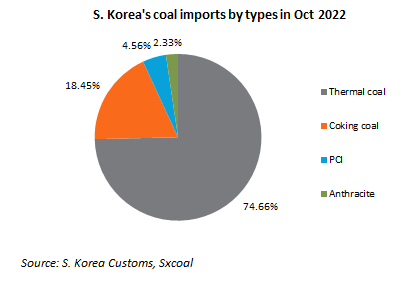
The country's anthracite intakes slumped 63.09% on the year and 56.99% on the month to 190,400 tonnes in October, and PCI coal imports dropped 33.81% on the year and 41.91% on the month to 372,100 tonnes.
By source Russia, Australia, Indonesia, South Africa and Canada were the top five suppliers to South Korea in October, accounting for 91.82% of the total coal imports, basically unchanged from September's 91.86%.
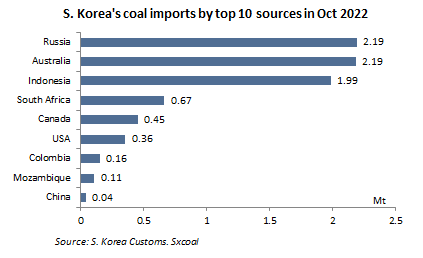
South Korea's coal imports from Russia were at 2.19 million tonnes, up 25.71% year on year but down 20.86% month on month, a share of 26.89%. Coal deliveries from Australia slumped 46.39% on the year and 22.21% from September to 2.18 million tonnes in October, a share of 26.79%.
The import decline from Australia was mainly attributable to over high prices of its coal. Most buyers were inclined to South African coal with higher cost effectiveness. In addition, some power utilities invited more tenders for low-CV coal due to high prices.
South Korea bought 1.99 million tonnes of coal from Indonesia in October, falling 2.54% on the year and 24.95% on the month.
Coal imports from South Africa and Canada respectively totaled 667,800 tonnes (+66.78% YoY, +15.82% MoM) and 454,400 tonnes (-51.14% YoY, -50.13% MoM).
South Korea imported 17,900 tonnes of coke in October, slumping 48.71% year on year and 45.59% month on month. South Korea spent $8.03 million for coke imports, diving 53.65% year on year and 45.72% month on month. The import price therefore averaged $448.38/t, down 9.64% year on year and 0.24% month on month.


 No Content
