


Weekly: China national CEA market trades review (Aug 31- Sep 4)
- Price
- Sales
- Carbon Offset
- Emissions Trading
- Carbon
sxcoal.com572 words41 reads


China's national carbon market saw its first notable price pullback last week (Aug 31- Sep 4) after a period of high-level consolidation, with prices testing resistance at the upper range amid cautious market sentiment.
The benchmark CEA price hit a weekly high of 98.80 yuan/t and a low of 92.70 yuan/t, closing at 93.66 yuan/t on September 4, down 5.17% from the previous week's final trading day on August 28.
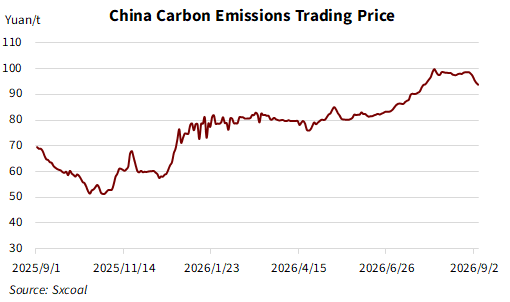
Trading volumes fell sharply from the previous week, with bulk agreement transactions seeing the steepest decline as market sentiment cooled entering September.
Total weekly trading volume of national carbon emission allowances reached 7.31 million tonnes, down 21.28% week on week. Listed agreement transactions totaled 1.62 million tonnes, up 1.56% from a week earlier, while bulk agreement transactions fell 26.03% to 5.68 million tonnes. No one-way bidding transactions were recorded.
Weekly turnover reached 670 million yuan ($98.83 million), down 22.86% week on week. Listed agreement turnover fell 1.10% to 155 million yuan, while bulk agreement turnover dropped 27.67% to 514 million yuan.
September 1 recorded the week's lowest daily volume and turnover at 509,500 tonnes and 49 million yuan respectively, while August 31 posted the highest at 3.55 million tonnes and 323 million yuan.
Cumulative national carbon allowance trading from January 1 to September 4 reached 99.59 million tonnes, with turnover of 8.38 billion yuan. Since the market's inception, cumulative volume stood at 964.45 million tonnes with total turnover of 66.05 billion yuan as of September 4.
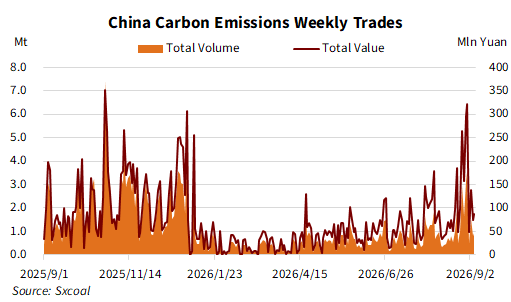
CCER prices fluctuated sharply last week, ranging between a high of 96.62 yuan/t and a low of 89.49 yuan/t, with the closing price again falling below CEA levels. Volumes continued their downward trend as sellers concentrated on distribution, pressuring the price center lower.
Policies in Focus
On August 31, China's market regulator, the National Development and Reform Commission and the Ministry of Ecology and Environment jointly issued the 2026 edition of guidelines for carbon emission measurement capacity building. The document addresses measurement gaps in the steel and cement sectors, adds standards for total carbon and sulfur content determination, and outlines forward-looking measurement capacity for carbon capture, utilization and storage (CCUS), alongside voluntary emission reduction methodologies including afforestation carbon sinks and mangrove restoration.
On September 1, the Ministry of Industry and Information Technology approved 674 industry standards, including those covering carbon management in cement curing, carbon capture accounting for cement kiln flue gas, continuous CO2 monitoring, greenhouse gas online monitoring, product carbon footprint accounting and battery material recycling. Most standards take effect March 1, 2027.
On September 2, the Ministry of Ecology and Environment released the national carbon market allowance allocation plan for the power sector for 2025-2026 and for the steel, cement and aluminum smelting sectors for 2026. This marks the first cross-sector unified allowance management plan since the market's expansion, using an emissions intensity benchmark approach for the power sector and an emissions intensity coefficient method for the other three industries. The expansion brings CO2 emissions covered by the national carbon market to over 60% of the national total.
The 2026 Taiyuan Energy Low-Carbon Development Forum was held in Taiyuan, Shanxi province, from September 4-5 under the theme of carbon goals leading energy transition and innovation accelerating a green future. The forum featured five international conferences and seven parallel sessions, including a forum on electricity-carbon-computing synergy that drew over 200 experts to discuss the national carbon market's development path.


 No Content
