


S Korea's KOSPO seeks nearly 3 Mt thermal coal in new five-yr tender
- Import
- International
- South Korea
- Thermal Coal
- Coal
sxcoal.com534 words161 reads


Korea Southern Power Co., Ltd. (KOSPO), one of the major power utilities in South Korea, has invited bids for long-term supply of thermal coal to its power stations, seeking close to 3 million tonnes over five contract years under a single tender covering two coal grades, according to a bid notice dated September 3, 2026.
The tender, designated ELT10 and ELT11, is open only to KOSPO's existing suppliers.
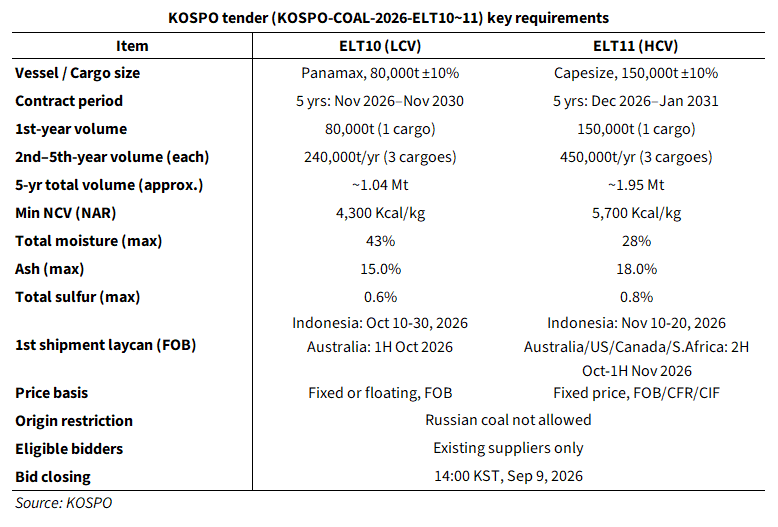
ELT10 covers lower-CV coal with a guaranteed minimum net CV of 4,300 Kcal/kg NAR, to be delivered in Panamax cargoes of 80,000 tonnes with a tolerance of plus or minus 10%.
The first contract year, beginning November 2026, calls for a single 80,000-tonne cargo, to be loaded on a FOB basis from Indonesia between October 10-30 or from Australia in the first half of October. Volumes then rise to three cargoes, or 240,000 tonnes, per year for the second through fifth contract years, running through November 2030.
ELT11 covers higher-CV coal with a guaranteed minimum CV of 5,700 kcal/kg NAR, delivered in Capesize cargoes of 150,000 tonnes on the same tolerance.
The first contract year, beginning December 2026, calls for a single 150,000-tonne cargo, to be loaded FOB from Indonesia between November 10-20, or from Australia, the United States, Canada or South Africa in the second half of October and first half of November, or delivered on a CFR basis in the first half of December. Volumes then rise to three cargoes, or 450,000 tonnes, a year for the second through fifth contract years, running through January 2031.
Coal of Russian origin is excluded from both grades, as is coal or entities subject to United States sanctions, the notice showed.
Bidders may offer either a single fixed price or an index-linked floating price for ELT10 on an FOB basis, and a single fixed price for ELT11 on an FOB, CFR or CIF basis, the notice said.
KOSPO operates coal-fired plants at Hadong and Samcheok among its generation assets and is one of five state-run generation companies under KEPCO, along with KOEN, KOMIPO, KOWEPO and EWP, that together account for the bulk of South Korea's thermal coal imports.
South Korean utilities have increased their reliance on coal this year as weaker nuclear generation and high LNG prices have reshaped the power-generation mix. Coal-fired generation rose 26.6% year on year in the first quarter, while nuclear output fell 23.1% and gas-fired generation increased only 2.2%, according to Independent Commodity Intelligence Services.
Prolonged heatwave last month drove cooling demand and kept thermal capacity, including KOSPO's coal-fired fleet, running at high utilization through the peak summer months.
Data from South Korea's Electric Power Statistics Information System (EPSIS) showed that the peak national power demand reached 95.32 GW on August 7, hitting its highest level of the year and marking the fifth highest in history. Demand remained elevated later in August, reaching 94.02 GW on August 25 and 92.78 GW on August 26, before easing as temperatures moderated.
EPSIS's data showed that the total power generation in South Korea reached 634.47 TWh in 2025. Of this, generation from steam power — essentially coal-fired generation in the utility power system — was 165.66 TWh, equivalent to 26.1% of total generation.


 No Content
