


India's Jan coal imports rise MoM, yet extend yearly decline
- Import
- International
- India
- Coal
sxcoal.com706 words41 reads


India's coal imports rose in January from the previous month but continued to edge lower on an annual basis, as stronger demand from the power and cement sectors was offset by robust domestic output.
The country imported 19.94 million tonnes of coal in January, down 1.68% year on year (YoY) but up 8.41% month on month (MoM), according to data from iEnergy.
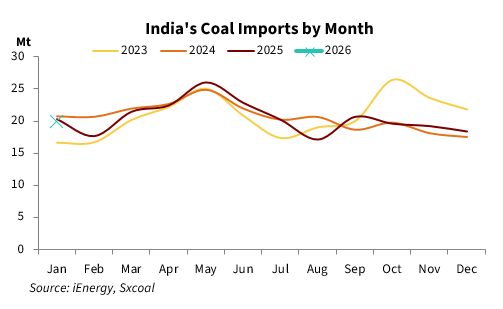
Global coal markets showed regional divergence last month, with benchmark prices firming slightly. Supply from Indonesia and South Africa tightened due to weather and logistics disruptions, while shipments of premium Australian coking coal were constrained by adverse weather, lending support to Asia-Pacific prices. In the U.S., some coal grades found price support amid fuel substitution trends.
Domestically, India's coal production rose to 108 million tonnes in January, up 3% YoY and 6% MoM. Despite the strong output, imports climbed to a four-month high, reflecting a restocking demand release at the start of the year.
In breakdown by type, the South Asian nation imported 12.76 million tonnes of non-coking coal in January, down 3.21% YoY but up 13.1% MoM, while anthracite imports slumped by 62.81% YoY but rebounded 18.35% MoM to 117,200 tonnes. This was driven by demand from cement and sponge iron producers, as well as substitution effects due to higher petroleum coke prices.
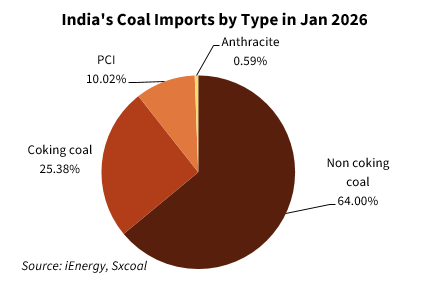
Imports of coking coal reached 5.06 million tonnes during the month, down 4% YoY and 6.94% MoM, as higher international prices dampened spot buying interest and some steel mills turned to direct purchases of metallurgical coke. Imports of PCI coal totaled 2 million tonnes, up 32.57% YoY and 27.32% MoM, supported by steady demand from the steel sector.
India imported 565,000 tonnes of met coke in January, surging 67.67% YoY and 108.25% MoM, while petroleum coke imports slumped 40.4% YoY and 17.65% MoM to 882,100 tonnes.
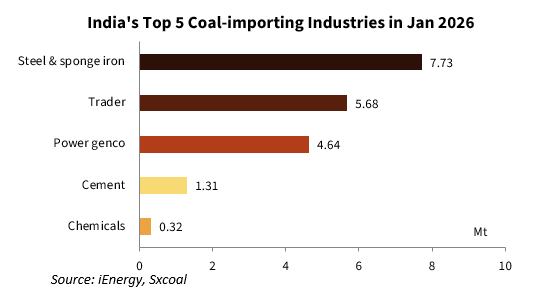
India's steel and sponge iron industries imported most coal in January, reaching 7.73 million tonnes, ticking up 0.32% YoY but down 2.05% MoM, as per iEnergy data.
India and Brazil recently signed a memorandum of understanding to strengthen strategic cooperation in mining and steel, aiming to enhance raw material security and technological collaboration. Against this backdrop, India's major steelmakers are expected to benefit from improved supply security and capacity expansion plans.
India's steel output rose 10% year on year in January, as the country continued to expand capacity to meet rising infrastructure and industrial demand, underscoring the importance of stable and diversified raw material supplies.
In January, India's power sector imported 4.64 million tonnes of coal, up 10.61% YoY and 48.6% MoM; the cement sector imported 1.31 million tonnes, surging jumping 118.27% YoY and 22.55% MoM; and the chemical industry received 324,200 tonnes, diving 53% YoY and 48.33% MoM.
A prolonged cold spell pushed India's peak power demand to a record 245 GW on January 9, with total electricity consumption up 4.5% YoY. However, coal consumption for power generation fell nearly 3% from a year earlier, indicating that rising renewable generation is gradually displacing coal-fired output.
Renewable power generation increased 10% YoY in January, with non-fossil fuel capacity now exceeding thermal power capacity and serving as the main driver of electricity growth. Meanwhile, the cement sector entered a seasonal recovery phase, with output up 11% YoY, lifting coal and petcoke procurement, although high petcoke prices prompted some substitution toward thermal coal.
By origin, Indonesia remained India's largest coal supplier in January, shipping 7.79 million tonnes, down 2.35% YoY yet up 14.46% MoM. Australian coal arrivals fell 6.01% YoY and 2.8% MoM to 3.43 million tonnes.
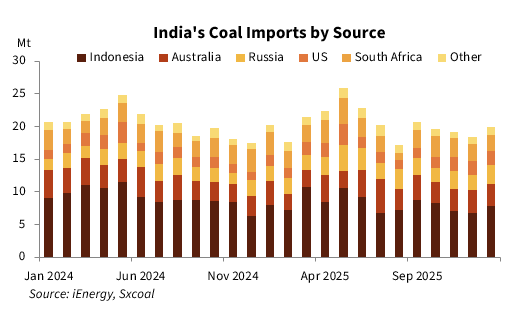
Imports from Russia rose 25.9% YoY and 25.93% MoM to 2.89 million tonnes, and U.S. coal imports rose 28.57% YoY and 1.73% MoM to 2.13 million tonnes. Coal intakes from South Africa dropped 31.96% YoY and 6.46% MoM to 2.49 million tonnes.
Overall, India's domestic coal production continued to expand steadily in January, while imports remained elevated. As renewable energy accelerates its penetration, the role of coal-fired power is gradually weakening.
Looking ahead, coal demand is expected to remain resilient amid economic expansion and infrastructure investment, though greater emphasis may be placed on coal quality and cost control. If supply disruptions persist among major exporters and restocking cycles continue in the Asia-Pacific, seaborne coal prices could retain upward momentum.


 No Content
