


Weekly: China's coking coal prices mixed on structural imbalance
- Price
- China
- Coking Coal
- Coal
sxcoal.com1073 words25 reads


China's domestic coking coal prices experienced mixed movements last week. Some low-stocked coking plants moderately increased restocking, pushing up prices for certain premium grades. However, some high-priced resources saw further declines, albeit narrowing, amid muted sales and expectations for coke price cuts.
The Index
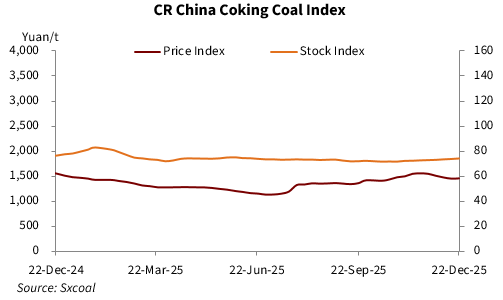
The CR China Coking Coal Price Index (CRCP) was 1,462.8 yuan/t on December 22, down 0.34% week on week. The CR China Coking Coal Stock Index (CRCS) was 73.8 points, 0.54% higher than the week-ago level.
Lately in the market
Although some coking coal mines resumed operations after longwall moves, the overall supply continued to contract as more mines reduced output upon fulfilling annual tasks.
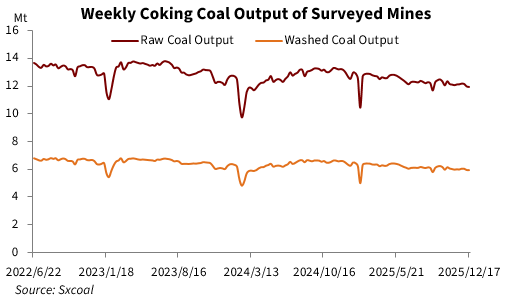
Raw coking coal output at Sxcoal-surveyed 363 mines dipped 0.33% from a week ago to 11.93 million tonnes in the week ending December 17. The capacity utilization at these mines averaged 82.97%, down 0.27 percentage point on the week.
Coking plants, whose raw material arrivals were disrupted by earlier snowfall in several production regions, saw their feed coal inventories decline further to relatively low levels. As of December 17, coking coal stocks at 108 surveyed coking plants could sustain 6.47 days of usage, down 0.23 day from the previous week.
Some low-stocked coking plants made essential purchases, boosting sales for certain coking coal grades following sustained price drops. Certain premium grades secured good orders due to regional tightness. However, sales pressure remained for blending grades like meager lean coal. Coupled with snowfall-induced transport disruptions, mine inventories further ramped up.
Sxcoal's data showed that raw coking coal stocks at surveyed 363 mines stood at 2.50 million tonnes as of December 17, up 3.96% week on week, while washed coal stocks increased by 6.23% on the week to 2.03 million tonnes.
Despite operation resumptions at some Luliang-based mines following longwall moves, coking coal supply in Shanxi province still diminished slightly as output reductions increased in multiple areas amid completed annual targets. Buying enthusiasm improved from some low-stocked coking plants, combined with scarce availability of certain high-quality feed coal cargoes, contributing to price rebounds. However, meager lean coal faced continued headwinds from offtakes, experiencing sustained price slides.
Anze low-sulfur primary coking coal (S 0.5%, GRI 80-85) raised 100 yuan/t to 1,600 yuan/t, mainly backed by substantial rebounds for similar grades nearby and sustained supply constraints. However, local high-sulfur fat coal (A 11%, S 3.7%, GRI 92) extended losses, falling 10-15 yuan/t on the week to 1,090 yuan/t on December 18.
Partial Luliang-sourced coking coal supplies retreated by another 40 yuan/t. High-sulfur lean coal (A 8.5%, S 2.8%, GRI 60) dropped to 1,010 yuan/t, taking the total decline to 190 yuan/t since the downtrend started. Spot transactions slightly improved post-reductions.
In Changzhi, major miners lowered blending coal prices by 50-120 yuan/t on December 17, with washed meager lean coal (S 0.4%, GRI 10-15) down 50 yuan/t to 1,030-1,070 yuan/t. Conversely, downstream restocking for premium lean coking coal pushed up prices for low-sulfur lean coal (A 8%, S 0.5%, GRI 65) by 180 yuan/t from a week ago to 1,590-1,595 yuan/t.
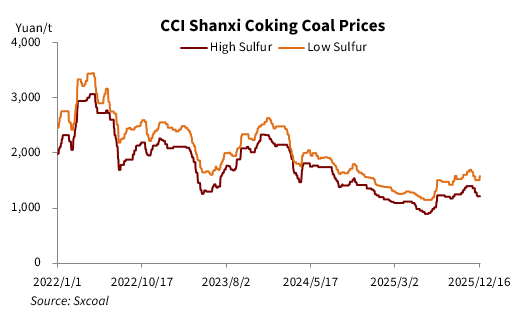
On December 19, the CCI index for Shanxi low-sulfur primary coking coal was assessed at 1,575 yuan/t, ex-washplant with VAT, jumping 79 yuan/t week on week; the index for Shanxi high-sulfur coal remained unchanged at 1,219 yuan/t.
In Inner Mongolia, moderate restocking from end users boosted trading liquidity. One major miner in Qipanjing put low-sulfur and high-ash fat coal (A 15%, S 0.8%) for auction at 1,010 yuan/t on December 18, climbing 20 yuan/t from December 11. A handful of miners followed with minor increases. With raw coal output still constrained, regional prices are expected to be range-bound in the short run.
In Shandong, washed gas coal (S 0.5%, GRI 75) prices temporarily stabilized at 1,050-1,060 yuan/t. Downstream buyers sat on the sidelines and mostly bought as needed, in light of potential coke price cuts. Miners hence faced mounting inventory accumulation, further weighing on the feed coal market.
Import market
Overseas coking coal supplies contracted further, thereby driving up Australian transaction prices. Australian Goonyella PMV coking coal was traded at about $238/t CFR India, netting back to about $220/t FOB, which gained $10.1/t week on week. This translated to around 1,902 yuan/t ex-stock North China ports with VAT, still higher than domestic equivalents. On-demand overseas buys and supply-demand mismatch would continue to favor Australian prices.
Futures rallies and mid-week restocking by some low-stocked downstream users bolstered market sentiment at ports. Portside traders mostly lifted their offers, while a few slightly cut prices to clear stocks. Spot offers for Australian PMV grades rose 30-50 yuan/t from a week ago to about 1,450-1,490 yuan/t.
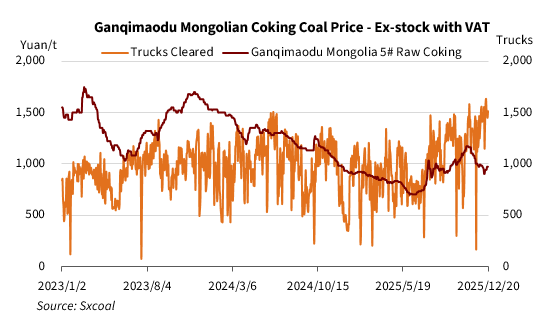
Daily customs clearance of Mongolian coal at Ganqimaodu border port averaged 1,559 trucks over December 15-18, climbing 101 trucks week on week. Market sentiment warmed up along with rebounding futures prices, prompting traders to raise offers. Mongolian 5# raw coal was traded at around 970-980 yuan/t, ex-stock Ganqimaodu with VAT, up 40 yuan/t on the week. However, end-user demand failed to recover substantially, capping actual transaction volumes.
Ceke border port let in 801 trucks of Mongolian coal each day on average from December 15 to December 18, slumping 330 trucks from the week-ago level, which returned to regular levels after customs clearance pressure tests. Modestly improved procurement interest in inland markets increased inquiries at the border port, but participants exercised caution in actual purchases, keeping overall prices stable. Spot offers for MAK A raw coal, South Gobi A raw coal, and MAK West raw coal remained unchanged at 530-540 yuan/t, 630 yuan/t, and 640 yuan/t, respectively.
Mandula border port saw a daily average of 333 trucks of Mongolian coal arrivals over December 15-18, gaining 25 trucks from a week ago. Despite high crossing volumes, pricier grades were hard to find buyers, leading to continuous inventory builds at the border port. Traders, facing growing sales pressure, had to lower offers slightly, with room for negotiation even after price drops. Primary coking coal was offered at 780-790 yuan/t, falling 50-70 yuan/t from a week ago.
Forecast
China's domestic coking coal prices are expected to remain range-bound this week, supported by moderate restocking from downstream users and potential supply constraints approaching the year-end. Yet, several grades with sufficient supplies may face additional downward pressure.


 No Content
