


Review: Chinese top 3 coal provs' output picks up in Aug on peak season demand
- Opinion
- Production
- China
- Coal
sxcoal.com725 words63 reads


China's coal production bounced back in August, as the priority of ensuring stable supply during the peak season outweighed the impact of disruptions such as rainfall and inspections.
China produced 390.40 million tonnes of raw coal in August, down 3.2% year on year (YoY) but up 2.5% month on month (MoM), according to data released by the National Bureau of Statistics (NBS).
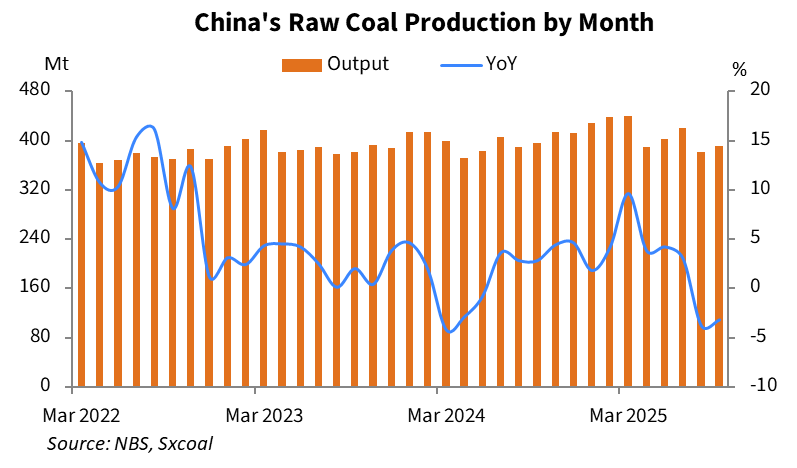
The combined output totaled 3.17 billion tonnes from January to August, rising 2.8% from the year prior.
Shanxi maintained its position as the nation's top coal producer in August, with an output of 107.71 million tonnes, a 6.7% decrease YoY but a 0.67% rise MoM.
Inner Mongolia ranked second and churned out 103.34 million tonnes of raw coal in August, up 0.3% YoY and 3.56% MoM. Third-ranked Shaanxi produced 66.06 million tonnes, up 1.1% YoY but dipping 0.49% MoM. The top three provinces' production combined increased 1.44% from July, primarily due to a recovery in Shanxi and Inner Mongolia and a less pronounced decline in Xinjiang.
This rebound came despite constraints, including persistent heavy rainfall, military parade-related restrictions, overproduction inspections, safety and environmental checks, and weak sales. Yet, strong seasonal demand and high fulfillment rates of long-term supply contracts helped stabilize and even boost output in a bid to secure energy supply.
The cumulative output of Shanxi, Inner Mongolia, and Shaanxi totaled 277.11 million tonnes last month, down 1.53% YoY, which took up 70.98% of the country's total output, expanding by 0.01 percentage point compared with the previous year. The mild change in the proportion indicates the increasing concentration of China's coal production.
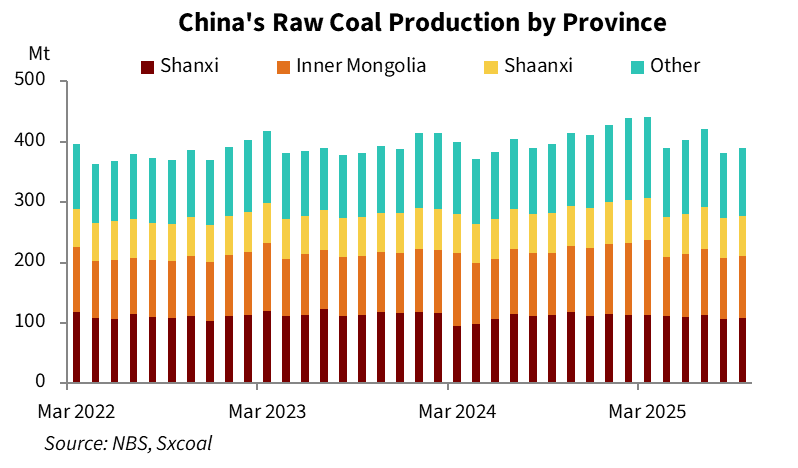
In August, the number of provinces reporting MoM increases and decreases in output was roughly balanced. However, most of the declines were registered in provinces with relatively low production levels, while major coal-producing provinces generally saw growth.
Fourth-ranked Xinjiang churned out 42.20 million tonnes of coal in August, down 10.5% YoY yet up 14.51% MoM, NBS data showed. Guizhou, taking the fifth place, registered production of 12.16 million tonnes, down 3.7% YoY and 1.43% MoM.
The number of provinces with production exceeding 10 million tonnes remained at five in August compared to the same month last year. Inner Mongolia, Shanxi, Shaanxi, Xinjiang, and Guizhou cumulatively produced 331.48 million tonnes of coal, falling 1.62% YoY. This accounted for 84.91% of China's total output, narrowing by 0.06 pp YoY.
In terms of YoY changes, eight provinces and regions reported increases, with three recording two-digit increases in raw coal production in August. Notable gains came from Yunnan (23.7%), Guangxi (21.1%), Qinghai (20%), and Heilongjiang (5%).
Provinces that registered remarkable declines included Jiangxi (43.4%), Sichuan (18.6%), Hubei (12.8%), Liaoning (12.4%), and Jiangsu (12%).
Notably, provinces with strong YoY growth in coal output have a higher proportion of renewable energy in their power mix. During the peak season for power consumption, the intermittent nature of green electricity boosted the need for coal-fired electricity to ensure grid stability.
Shanxi, Inner Mongolia, and Shaanxi remained the top three producers over January-August. Shanxi churned out 862.57 million tonnes of raw coal, up 5.2% YoY, accounting for 27.25% of the total output. Inner Mongolia contributed 26.54% or 840.01 million tonnes of raw coal, down 0.3% YoY. The cumulative output of Shaanxi increased 2.2% YoY to 518.63 million tonnes, making up 16.39% of the total.
The three provinces combined produced 2.22 billion tonnes of coal during the first eight months, rising 2.90% YoY and constituting 70.18% of China's total.
From January to August, Shanxi, Inner Mongolia, Shaanxi, Xinjiang, and Guizhou, each producing over 100 million tonnes, collectively supplied 2.68 billion tonnes or 84.65% of the national total, expanding 0.31 pp from last year. The cumulative volume was up 4.08% YoY.
With the continuous release of advanced production capacity in major coal-producing regions, aided by intelligent mining technologies and the phase-out of outdated capacity, changes in output from these key producing areas will more directly drive fluctuations in the country's overall raw coal production.
On a yearly basis, ten provinces posted increases in cumulative production in the January-August period, with Heilongjiang jumping 29.6% to 41.56 million tonnes. This is followed by Yunnan's 10.4% growth, reaching 47.14 million tonnes.
Yunnan's steady growth is likely to stem from the expansion of energy-intensive industries such as aluminum smelting. Rising electricity demand, combined with the volatility of green power output, has strengthened thermal coal consumption.


 No Content
