


Weekly: Mongolian coking coal prices face lingering pressure at Chinese border ports
- Opinion
- Price
- Import
- Ports
- International
- Mongolia
- China
- Ganqimaodu
- Ceke
- Coking Coal
- Coal
sxcoal.com717 words289 reads


China's imported Mongolian coking coal market observed improved trading activities at key border crossings, driven by a moderate demand recovery from both domestic coke and steel ectors.
Over the past week, higher domestic molten iron output fueled demand for coke, encouraging coking plants to consider their first round of price hikes. This has boosted sales of domestic coking coal and lifted sentiment of the imported Mongolian coal market, leading to higher outbound shipments and a moderate drawdown of coal inventories at supervision warehouses.
However, prices remained under pressure due to comparatively high stockpiles, anticipated contract price cuts in the second quarter, and looming policy uncertainties about potential tariff adjustments.
Market dynamics
Ganqimaodu Inquiries and trading volumes picked up at Ganqimoadu border port last week amid warmer sentiment, causing a further decline in inventories at supervision warehouses. Yet, prices remained weighed down by sustained surplus inventory and bearish expectations.
On April 3, Ganqimaodu Mongolian 5# raw coking coal was around 855 yuan/t, down 10 yuan/t week on week, ex-stock with VAT, while Jinquan Mongolian 5# washed coal remained flat from late last week at 1,080 yuan/t.
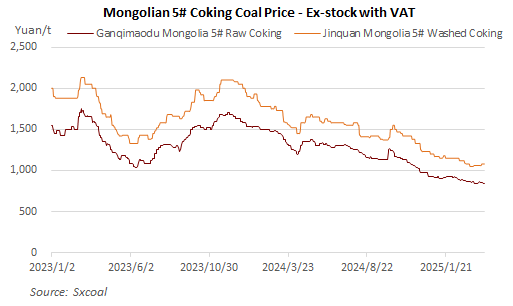
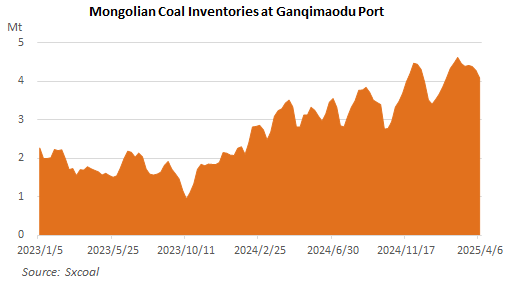
As of April 6, coal inventory at Ganqimaodu supervision warehouses stood at 4.09 million tonnes, a 4.7% drop from the previous week, Sxcoal's tracking data showed.
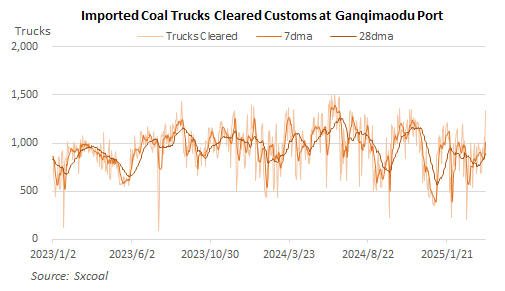
Key Chinese border ports were closed for one day on April 4 due to the Qingming Festival and resumed normal operations on April 5. From March 31 to April 5, the average daily clearance at the port was 1,008 trucks, up 17.2% week on week. The decrease in stocks and rise in customs clearances reflected an improvement in end-user demand.
In addition, the short-haul trucking rates from Tsagaan Khad to Ganqimaodu came in at 60 yuan/t exclusive of VAT on April 3, steady week on week, as per Sxcoal data.
Ceke and Mandula High transportation costs continued to erode the price competitiveness of imported Mongolian coal, which, combined with only rigid restocking demand from Chinese steelmakers, curtailed sales at Ceke border crossing. Following offer price cuts by Mongolian miners, traders adjusted their offers accordingly.
As of April 3, MAK A raw coal and MAK West raw coal were around 550 yuan/t and 600 yuan/t, respectively, both down 20 yuan/t week on week, ex-stock Ceke with VAT. South Gobi A raw coal fell 30 yuan/t to 590 yuan/t.
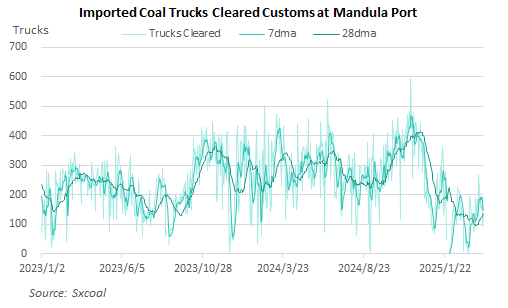
At Mandula port, a slight easing in mine-mouth offer prices in Mongolia reignited some interest among traders, though imported coal still lacked a marked price edge. With domestic molten iron production on the rise and raw material demand strengthening, better end-user buying made traders a bit more optimistic.
On April 3, the price for washed primary coal stood at 800 yuan/t, down 20 yuan/t on the week, ex-stock Mandula with VAT, while raw 1/3 coking coal was up 10 yuan/t to 580 yuan/t.
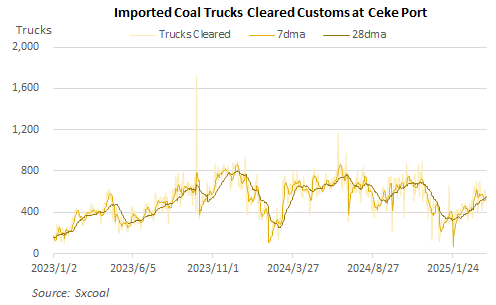
In terms of customs clearances, Ceke posted an increase, while Mandula recorded a decline. Over March 31-April 5, Ceke's daily truck clearance averaged 551, climbing 2.4% from the previous week, but the daily average at Mandula dropped 18.3% to 147 trucks during the same period.
Mongolian coking coal e-auctions
Energy Resources LLC, an indirect wholly-owned subsidiary of Mongolian Mining Corporation, put 38,400 tonnes of Mongolian 3# washed hard coking coal (S 0.85%, A 11%, GRI 75) for sale in three auctions, each with 12,800 tonnes starting at the same price of 800 yuan/t on the Mongolian Stock Exchange last week.
The miner only successfully concluded one auction of them at 800 yuan/t, DAP Ganqimaodu and exclusive of Chinese VAT.
Four auctions of a cumulative 57,600 tonnes of Mongolian 1/3 washed coking coal (S 0.85%, A 9.5%, GRI 65) fully settled at an average of 618.75 yuan/t after Erdenes Tavantolgoi JSC started them at 600 yuan/t, DAP Ganqimaodu and exclusive of VAT. The average hammer price was 13.75 yuan/t higher than the last week's average.
Forecast
Looking ahead, the Chinese imported Mongolian coal market is expected to receive support from continued gains in molten iron output and the potential realization of coke price increases domestically. Nevertheless, the sustainability uncertainty of steel sector growth and the ongoing tussle between coke and steel firms may still limit the upbeat strength.


 No Content
