


Review: most Chinese provs realize daily coke output increase in Nov
- Opinion
- Production
- China
- Coke
sxcoal.com592 words31 reads


China's top five coke-producing provinces – Shanxi, Inner Mongolia, Shaanxi, Xinjiang and Hebei – produced 22.80 million tonnes of coke in November, down 1.6% month on month and accounting for 56.0% of China's total, according to data released by the National Bureau of Statistics (NBS).
During the period, China churned out 40.68 million tonnes of coke, a 1.3% drop month on month yet 0.6% higher than a year ago. The daily production was calculated at 1.36 million tonnes, up 2.0% on the month.
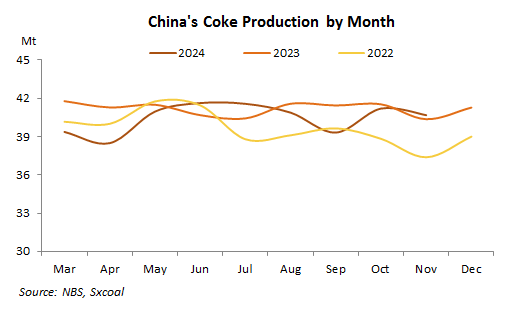
More than 70% of provinces and regions registered month-on-month increases in November's daily coke output, indicating actual improvements in production levels. However, the limited growth was not enough to make up for the impact of one day shorter than October, resulting in a monthly decline in overall production in the month.
Of the top five provinces, Shanxi ranked first with production 1.8 times that of second-ranked Inner Mongolia, and Hebei dropped to fifth place.
Coke production in Shanxi exceeded 7 million tonnes, while that in Inner Mongolia surpassed 4 million tonnes. Shaanxi, Xinjiang and Hebei managed to produce over 3 million tonnes of coke, while the remaining provinces all failed to meet the threshold.
The sixth-ranked Shandong produced 2.50 million tonnes of coke in November.
Shanxi and Hebei's coke output reversed increase to decline during the same period, while Inner Mongolia and Shaanxi posted a two-month sequential growth and Xinjiang climbed for the fourth straight month.
Shanxi produced 7.98 million tonnes of coke in November, edging down 0.3% from the month before and accounting for 19.6% of China's total. Inner Mongolia reported an output of 4.43 million tonnes, rising 3.0% on the month, making 10.9% of China's total.
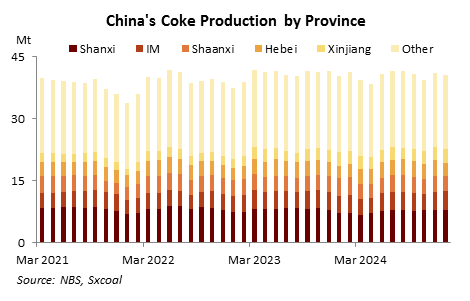
Shaanxi's coke production came in at 3.83 million tonnes, up 2.1% from the month prior and constituting 9.4% of the total. Xinjiang produced 3.53 million tonnes, up 13.1% and accounting for 8.7%.
Coke output in Hebei grabbed a 7.4% share with 3.03 million tonnes, down 24.0% on the month.
On a month-on-month basis, about 70% of the provinces and regions registering coke production posted a decrease, with Hebei reporting the largest decline rate of 24.0% and also the biggest decrement of 954,000 tonnes.
Among provinces and regions seeing an increase from the month-ago levels, Gansu recorded the largest growth of 17.9% and Xinjiang grabbed the biggest increment of 408,000 tonnes.
China's coke market implemented two rounds of markdowns in November due primarily to oversupply. The season lull of steel demand and a lack of support from macroeconomic measures tempered the steel market.
As a result, steelmakers focused only on coke purchases for essential needs, with some high-stocked mills opting to control coke arrivals. Gradual maintenance of blast furnaces led to a reduction in molten iron output after reaching peaks. This, coupled with sidelined traders, curbed coke demand in the spot market.
With decent margins following weakened feed coal prices, coking plants kept high operation rates, causing a surplus supply.
In December, the coke market remained weak as the loose supply-demand fundamentals continued, with the realization of the fourth price cut early this month and further cuts expected.
Falling coking coal prices lowered coke-making costs and left profitability for coke producers, most of who maintained high production. However, December's coke output is expected to slightly tick down given that some producers reduced production due to losses or environmental requirements.
In the first 11 months of this year, total coke production fell 0.9% on the year to 446.71 million tonnes, with Shanxi taking up 18.8%, Inner Mongolia 10.3%, Shaanxi 9.3%, Hebei 9.1% and Xinjiang 7.5%.


 No Content
