


Weekly: China's met coke market remains in weak supply-demand fundamental
- Opinion
- Price
- China
- Coke
sxcoal.com801 words52 reads


China's metallurgical coke prices leveled off temporarily last week after the fourth price cut materialized a week earlier. However, ample supply and insufficient demand continued to exert pressure on the market.
The Index
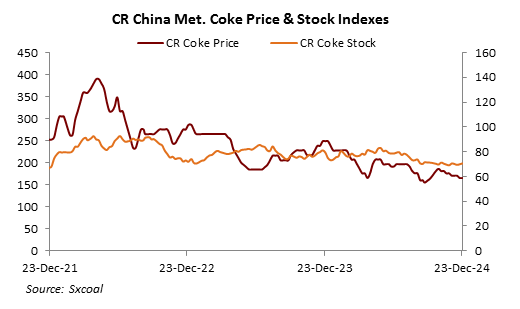
On December 23, the CR China Met Coke Price Index (CRMP) stood unchanged week on week at 165.54 points; the CR China Met Coke Stock Index (CRMS) ticked up 0.91% to 70.56 points on the same day.
Lately in the market
Coke-making profits picked up slightly at Chinese coking plants last week, thanks to price drops in some feed coal grades and stable coke prices. Nevertheless, a few coking plants still reported losses. A survey by Sxcoal of 100 coking plants showed an average profit of 53 yuan/t for the week ending December 18, expanding by 14 yuan/t from the preceding week.
Sustained margins encouraged most coke producers to maintain high production levels, though some reduced output due to losses or stricter regional environmental regulations. In Shandong, Shaanxi and Henan, coke makers scaled down production in response to winter environmental requirements.
The capacity utilization of surveyed coking plants slid 0.84 percentage point on the week to 81.09% over the week ended December 18, Sxcoal's data showed.
Relatively high molten iron production and increased replenishments at some steel mills helped coke destocking at coking plants. Producers in several regions observed coke stock pileups due to lower on-demand purchases and railway transport constraints related to adverse weather. As of December 18, the surveyed coking plants held 682,900 tonnes of coke stocks, falling 1.26% from the week prior and marking a two-week sequential decline.
However, the decline in coke stocks was constrained by weak demand growth, as the prevailing seasonal lull depressed finished steel transactions and prompted increased blast furnace maintenance. The capacity utilization of Sxcoal-surveyed steel mills was recorded at 79.63% as of December 20, down 0.92 pp week on week.
As most steelmakers purchased coke on a need-to basis, the coke inventory at Sxcoal-surveyed mills was enough to cover 12.14 days as of December 18, up 0.06 day from a week ago.
On December 20, Luliang Quasi Grade I met coke (0.7% sulfur, 13% ash, CSR 60) was assessed by Fenwei at 1,510 yuan/t, ex-plant with VAT, flat from the week prior; that of Jinzhong Grade II met coke (0.8% sulfur, 13.5% ash and CSR 55) at 1,390 yuan/t, also flat week on week.
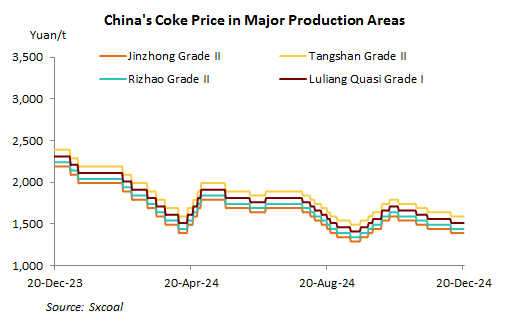
On the same day, Fenwei assessed the price of Grade II met coke (0.8% sulfur, 13.5% ash, CSR 55) at 1,590 yuan/t, DDP Tangshan with VAT, unchanged on the week. Grade II met coke of the same quality was assessed at 1,440 yuan/t in Rizhao, DDP basis with VAT, also unchanged from a week earlier.
Transfer ports
Coke prices dropped at eastern China ports as market participants turned to be bearish, given the scarce cargo availability and downward futures prices. Portside transactions stagnated since buyers made small inquiries and offered lower prices.
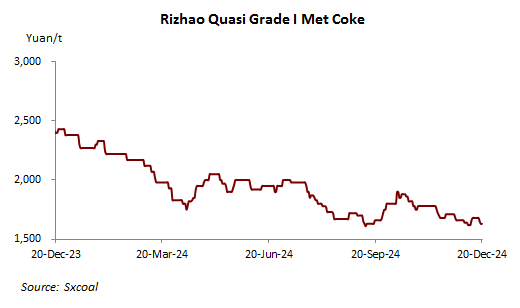
On December 20, Fenwei assessed Quasi Grade I coke at 1,630 yuan/t, FOB Rizhao port with VAT, down 50 yuan/t week on week.
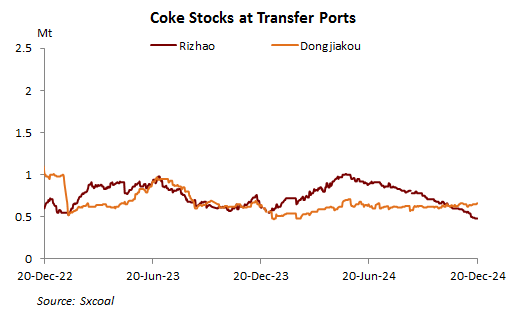
The combined coke stocks at Rizhao and Dongjiakou ports stood steady from a week ago at 1.14 million tonnes on December 20. That was 8.06% lower than the month-ago level and down 8.8% year on year, Sxcoal's data showed.
Downstream market
Steel prices trended downward last week, owing in part to concerns regarding domestic demand during the traditional off-peak season, coupled with diminishing cost support.
The price of Shanghai HRB 400 rebar (20 mm) stood at 3,370 yuan/t on December 20, down 60 yuan/t from a week ago, while Shanghai hot-rolled coil (3.0 mm) fell 50 yuan/t week on week to 3,530 yuan/t. The Tangshan billet price decreased 60 yuan/t on the week to 3,040 yuan/t.
The daily transaction of construction steel averaged 108,500 tonnes during the past week, falling 5.28% from the week prior and still lower than the year-ago level.
China's Ministry of Industry and Information Technology said at a press briefing last week that it is working with relevant departments to revise the steel capacity swap policy, as part of efforts to stabilize operations while accelerating transformation and upgrading in the steel industry.
Molten iron production is predicted to continue falling at a slow pace given that steel mills face limited inventory pressure amid existing margins. The steel market fundamentals are likely to remain lukewarm in the near term, owing to a lack of robust macroeconomic stimulus.
Forecast
China's metallurgical coke market is expected to remain weak due to weakness in both coking coal and downstream steel markets. Some market participants anticipate further coke price cuts in the coming weeks. Changes in coking coal prices and molten iron production should be closely monitored.


 No Content
