


Weekly: China's thermal coal prices range-bound as market awaits clues
- Price
- Production
- Profit
- Thermal Coal
- Coal
- Emissions
sxcoal.com1147 words52 reads


Last week, China's thermal coal market showed mixed trends last week. Prices stabilized at major transfer ports after a slight rebound earlier, thanks to strong cost support. Offers further declined at production bases, owing to sluggish purchasing by traders and non-power consumers.
Imported thermal coal prices stayed relatively flat during the same week. Although Chinese traders continued to press down prices to mitigate the gap between their costs and utilities' tender-awarding levels, foreign miners mostly held on prices,anticipating a rise in demand as winter approaches.
Fenwei CCI Index
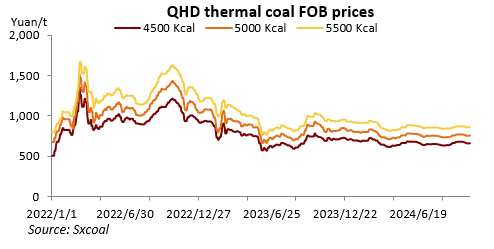
On October 25, the Fenwei CCI index for 5,500 Kcal/kg NAR domestic spot coal stood at 858 yuan/t FOB northern China ports with VAT, rebounding 1 yuan/t week on week. The CCI index for 5,000 Kcal/kg NAR domestic coal rose 2 yuan/t on the week to 758 yuan/t.
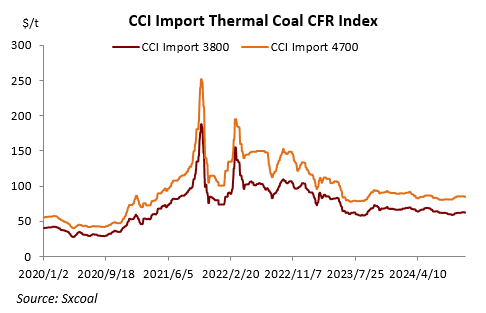
On the same day, the Fenwei CCI 5500 Import index stood at $105.8/t, CFR southern China ports, falling $0.5/t from the previous week. The Fenwei CCI 4700 Import index was down $1/t to $84.8/t CFR, while the Fenwei CCI 3800 Import index edged down $0.7/t to $62.3/t CFR.
Weekly Dynamics
Production areas Mine-mouth thermal coal prices remained on the downward trajectory during the past week. While some mines offering at competitive prices held on prices, some with weak sales continued to make downward corrections.
During the week ended October 23, 18% of the coal mines surveyed by Sxcoal in Shanxi, Shaanxi, and Inner Mongolia cut prices by an average of 14.6 yuan/t, while 6% raised prices by 16 yuan/t. The remaining 76% maintained prices flat, Sxcoal's survey data showed.
Thermal coal supply continued to increase during last week, as some mines in Shanxi and Shaanxi resumed production after longwall change, offsetting the production slowdown caused by rainfall at some opencast mines in Ordos, Inner Mongolia.
The overall capacity utilization of thermal coal mines surveyed by Sxcoal climbed by 0.58 percentage point week on week to 90.2% during the week ending October 23. Weekly output from these surveyed mines ascended by 0.65% week on week to 12.18 million tonnes, Sxcoal's data showed.
Inventory at the surveyed mines increased 0.75% week on week to 3.21 million tonnes as of October 23. That marked the third increase in a row, Sxcoal's tracking data showed.
Port-bound coal delivery via railway from production areas rebounded last week, partly driven by incentives of transportation discounts adopted by some railways.
Coal delivery climbed onthe busiest heavy-haul Daqin railway, which connects major production areas of Shanxi and the port of Qinhuangdao, after it completed autumn maintenance on October 24, two days earlier than schedule. Daily coal transportation averaged 1.06 million tonnes during the week ended October 25, rebounding 5.5% week on week.
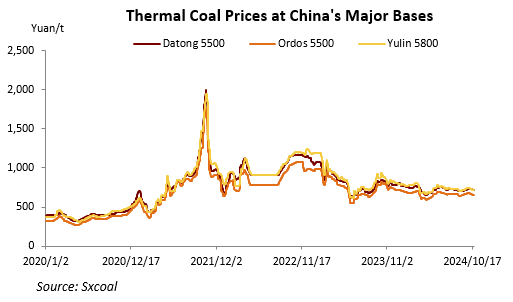
As of October 25, Fenwei assessed Yulin 5,800 Kcal/kg NAR thermal coal at 715 yuan/t, mine-mouth with VAT, falling 3 yuan/t from a week ago; Ordos 5,500 Kcal/kg NAR coal was assessed at 652 yuan/t, down 3 yuan/t week on week; and Shanxi Datong 5,500 Kcal/kg NAR coal was assessed at 718 yuan/t, declining 4 yuan/t during the same period.
Portside market Portside thermal coal prices edged upwards at the start of last week, driven by moderate inquiry growth and high costs. However, gains were short-lived as a leading miner's price cuts led to wait-and-see sentiment, causing prices to stagnate for the remainder of the week.
Coal consumption at power plants in inland provinces, which mainly source the fuel from domestic mines, fell 7.5% week on week and 10.0% month on month to 3.12 million tonnes on October 24. Their coal stocks, however, climbed by 2.2% and 12.5% respectively from the preceding week and month, data showed.
Buyers continued a cautious restocking pace, considering the increasing inventories at northern ports.
Coal stocks at Qinhuangdao port increased 4.96% week on week but dipped 1.04% month on month to 5.71 million tonnes on October 25. The level was 2.88% higher compared with the year-ago level, Sxcoal's data showed.
The overall coal inventory at major Bohai-rim ports (Qinhuangdao, Jingtang and Caofeidian) ascended by 3.89% week on week and 2.93% on the month to 23.26 million tonnes on the same day, although it was still 6.87% lower than the year-ago level, data showed.
The inventory increase was partly driven by discounted coal transportation on key rail routes and ongoing slow restocking by well-stocked end users.
Participants anticipated prices to remain stable in the short term. Factors such as resistance to price cuts, cost support, expected higher demand from cold waves, and seasonal declines in hydropower output would mitigate downside risks.
Water outflows of Three Gorges stood at 6,950 cu.m/s on October 25, down 8.4% and 52.4% respectively than the month-ago and year-ago levels, Sxcoal's tracking data showed.
However, ample power plant coal stocks, limited non-power coal demand, and stable power sector consumption would likely curb significant price increases.
Import market Imported thermal coal prices remained relatively stable last week. Foreign miners maintained their price stance amid replenishment to cover short position and and a positive outlook for Chinese demand, particularly low-CV coal.
Chinese power utilities showed less interest in tenders last week, only purchasing cargoes when prices met their expectations.
Coal burns of six coastal power groups averaged 803,700 tonnes as of October 25, down 0.39% week on week and 8.66% month on month. Their coal stocks stood at 14.79 million tonnes, up 0.03% week on week and 9.27% on the month.
Chinese traders bidding prices to domestic utility tenders for seaborne 3,800 Kcal/kg NAR coal still hovered at around 500 yuan/t last week, with the lowest level netting back to slightly above $54/t FOB Kalimantan on a Panamax basis.
As of October 25, Sxcoal assessed 3,800 Kcal/kg NAR tender winning prices at 496 yuan/t, CFR with VAT, down 3 yuan/t compared with the week-ago level of 499 yuan/t on October 18.
However, the awarded prices were comparatively lower compared with offers from Indonesian miners. Panamax cargo of high-quality Indonesian same-CV coal with November-December laycan was offered at $55-56/t FOB. That suggested a continued challenge for traders to source supplies profitably.
For mid- and high-CV grades, demand from China was comparatively weak, and some trader sources cautioned about potential downside risks due to a lack of demand and high offering levels.
Forecast
Thermal coal prices in China are expected to be range-bound in the near term, with a rough balance between positive factors led by winter replenishment and cost support and negative ones like tepid demand, high power plant stocks and port inventory buildup. The imported thermal coal market is also likely to move sideways, with foreign miners maintaining firm prices and potential winter heating season demand offering some support.


 No Content
