


Review: China Aug thermal coal imports' YoY growth contracts clearly
- Import
- Thermal Coal
- Coal
sxcoal.com656 words65 reads


China's thermal coal imports in August though still broke the record high for the same month, the year-on-year growth was clearly lower than the month-ago level.
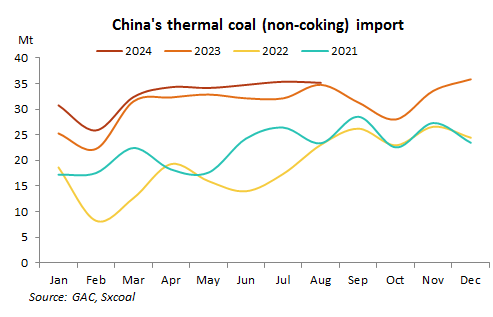
China imported 35.14 million tonnes of thermal coal (non-coking) in August, increasing 1.11% from 34.76 million tonnes a year ago yet dropping 0.63% from 35.37 million tonnes in July, the latest customs data showed.
Value of thermal coal imports totaled $2.76 billion during the given month, down 2.41% from the previous year and 2.68% from July. The average import price was calculated at $78.49/t, falling 3.48% year on year (YoY) and 2.06% month on month (MoM).
China sustained a strong appetite for imported thermal coal in August, hitting the third-highest monthly volume, only next to 35.83 million tonnes in December 2023 and 35.37 million tonnes in July 2024. This is mainly attributable to price edge of seaborne thermal coal, which attracted domestic power plants to continue purchases. The narrowed year-on-year growth is due to a relatively higher base a year ago.

A month-on-month reduction was also observed in August, mainly owing to sufficient stockpiles at power plants and remarkable increases in domestic coal production.
Accumulatively, China's thermal coal imports totaled 263 million tonnes over January to August, rising 8.01% YoY. Total import value amounted to $21.61 billion, down 12.69% YoY. That put the average import price at $82.26/t, decreasing 19.17% YoY.
Thermal coal imports in China have maintained year-on-year growth since December 12, and this year's overall imports are likely to surpass the record whole-year imports in 2023.
By type, other bituminous coal represented the largest share in August, reaching 14.72 million tonnes, up 11.28% YoY but down 5.49% MoM, which accounted for 32.11% of China's total coal imports. Lignite imports increased 11.28% YoY yet declined 5.49% MoM to 14.72 million tonnes, taking a share of 32.11% against the total coal imports.
Other coal imports were 4.25 million tonnes in August, up 27.35% YoY and 7.04% MoM. It represented 9.28% of the nation's total coal imports. China's August lignite imports stood at 1.34 million tonnes, decreasing 6.24% YoY but up 39.44% MoM.
Indonesia, Russia, Australia, Mongolia and Colombia were the top five coal suppliers in August, taking up 99% of China's total coal imports.
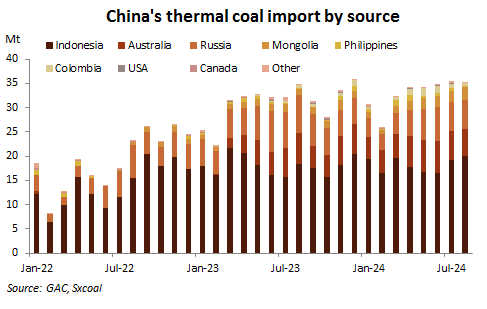
In August, China imported 19.99 million tonnes of thermal coal from Indonesia, up 9.24% YoY and 4.69% MoM, accounting for 56.9% of total thermal coal imports, higher than 54% a month ago.
In August, Indonesian miners that were impacted by rainfall have restored production and supplies. However, Indian miners made few inquiries amid thick sidelined sentiment, and some miners cut offer prices to spur sales.
This heightened price competitiveness of imported thermal coal, accordingly driving up domestic power plants' interests over cargoes with October-laycan.
Russia was still the second-largest supplier of thermal coal in August, with 5.91 million tonnes of coal shipping to China, falling 23.33% YoY and 2.89% MoM.
The sanctions against Russia and restrictions over the Far-East Railway capacity curbed Russian coal exports to China.
Despite economic sanctions from some western countries, the Russian government has agreed to prolong the duty-free period for exporting thermal coal and anthracite by three months until December 1, 2024. The scope is likely to be extended to coking coal also. The action will encourage Russian miners to export more and raise China-bound exports.
In August, thermal coal imports from Australia fell 13.64% YoY and 6.37% MoM to 5.63 million tonnes, while intakes from Mongolia soared 107.54% YoY and 21.14% MoM to 2.75 million tonnes. China imported 0.5 million tonnes of coal from Colombia, falling 20.84%YoY and 39.02% MoM.
In September, temperature cooled down and coal consumption at power plants declined, weakening demand for imported thermal coal.
Overall thermal coal market can gain some supports from advanced restocking before Mid-Autumn Festival and National Day holiday. Yet a slowdown in production activities during the holiday could bring downward pressure to imported coal market.


 No Content
