


China's Apr thermal power generation extends YoY rises
- Production
- Thermal Coal
- China
- Coal
- Power
sxcoal.com696 words155 reads


China's thermal power generation showed a faster year-on-year growth in April compared with the preceding month, but the rate was far lower than that in the same month last year.
Output of thermal power, mainly generated from coal burning, reached 457.87 TWh in April, up 1.3% year on year, which expanded by 0.8 percentage point from a month ago, the latest data from the National Bureau of Statistics showed.
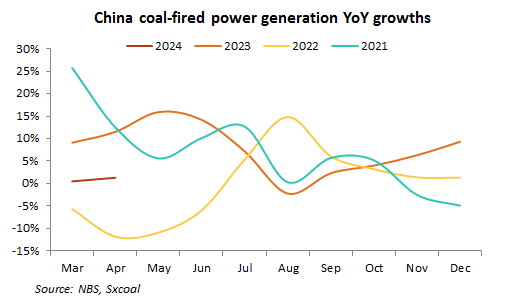
The growth, however, was well below 11.5% seen in April last year. The narrowed growth was partially attributed to the increase in power generation from renewable sources over March-April, especially in hydropower output.
The national precipitation fell short of normal levels and was unevenly distributed in the same month last year. Solar and wind sources played an unstable role in power generation.
However, the middle and lower reaches of the Yangtze River experienced heavy rainfalls several times since early April this year. Water inflow and outflow of the Three Gorges Dam continued to climb, with better upstream water inflow than year-ago levels. Ongoing rainfalls were conducive to the rise in water levels of rivers, lakes and reservoirs, further boosting hydropower output.
In April, power generation from solar and hydro sources jumped by 21.4% and 21% on the year, respectively, indicating a powerful upward momentum in the clean energy sector, which may persistently enhance the power generation capacity and further migrate the reliance on coal-fired power generation.
Nevertheless, southwestern regions of the nation that boasts concentrated hydropower installed capacity, particularly Yunnan province, still faced challenges such as high temperatures, uneven precipitation distribution and meteorological droughts. Yunnan made efforts to promote the commissioning of new energy projects by actively allocating resources and optimizing operations, guaranteeing stable electricity supply in an orderly manner.
Meanwhile, China's power consumption rose 7.0% year on year (YoY) to 741.2 TWh, slightly shrinking from March's growth, according to data from the National Energy Administration (NEA).
For the non-residential segment, the primary industries consumed 9.6 TWh in the same month, up 10.5% YoY; the secondary and tertiary industries consumed 517.1 TWh and 127.0 TWh, increasing 6.2% and 10.8% YoY, respectively.
The residential segment used 87.5 TWh of electricity during the period, up 5.9% YoY, NEA data showed.
Affected by muted demand during the seasonal lull, the cumulative year-on-year growth of electricity consumption over January-April also narrowed, falling from 9.8% in the first three months to 9.0%.
Over the first four months this year, China's thermal power generation reached 2,062.19 TWh, up 5.5% YoY.
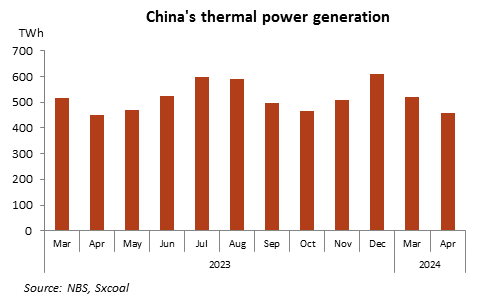
In April, Inner Mongolia, Guangdong, Jiangsu, Shandong and Xinjiang ranked the top five for thermal power generation, reaching 44.73 TWh (7.3% YoY), 41.20 TWh (7.3% YoY), 38.37 TWh (5.8% YoY), 37.14 TWh (0.8% YoY) and 28.66 TWh (0.4% YoY), respectively.
Leading provinces in cumulative electricity generation were Inner Mongolia, Shandong, Jiangsu, Guangdong, Xinjiang, and Shanxi, with outputs of 196.47 TWh, 163.49 TWh, 158.63 TWh, 150.26 TWh, 134.69 TWh, and 120.86 TWh, respectively, reflecting y-o-y changes of 11.1%, -0.5%, 9.7%, 9.7%, 2.5%, and 2.8%.
April saw 18 or 58% of the surveyed provinces and regions register year-on-year increases in thermal power generation. Notable growth rates were observed in Tibet (33.6%), Hainan (13.8%), Henan (10.4%), Inner Mongolia (7.3%), Guangdong (7.3%) and Jiangsu (5.8%).
Cumulatively, 23 provinces and regions reached y-o-y increases in thermal power generation during the first four months, constituting 74.2% of the total reporting regions. Fujian (19.9%), Hainan (12.8%), Shanghai (12.3%), Shaanxi (11.5%), Anhui (11.2%), and Inner Mongolia (11.1%) reported largest growth rates among these provinces.
In the full year of 2024, China's power consumption is expected to reach 9,800 TWh in a normal-weather scenario, up 6% from 2023's actual consumption, according to the quarterly report released by the China Electricity Council (CEC) on April 24.
For the forthcoming summer peak demand period, which typically starts from June to August, the CEC expected a tight balance between supply and demand.
CEC also forecasted that the country's power installations may grow about 12% to 3,250 GW by the end of 2024. Coal-fired power capacity would reach 1,200 GW, with the share down to 37%, while wind and solar capacity combined is projected to hit 13 GW, accounting for 40% of the total capacity.


 No Content
