


QHD port coal stocks slump as outflows rise amid low temperature
- Thermal Coal
- Qinhuangdao
- Caofeidian
- Coal
sxcoal.com435 words62 reads


Coal inventory experienced a steep decline at China's major transshipment port of Qinhuangdao last week, as outflows increased amid smoothened operations and improved demand from power plants while inflows were still subjected to transportation constraints in main production regions.
Qinhuangdao's coal stocks stood at 6.37 million tonnes on December 22, falling 13.33% week on week yet rising 0.47% month on month. The volume was 12.54% higher than the year-ago level, Sxcoal's data showed.
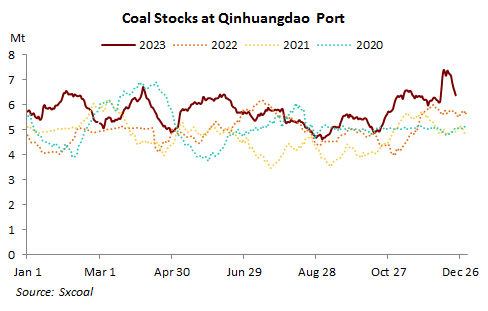
The inbound rail coal deliveries to Qinhuangdao averaged 340,714 tonnes each day in the week to December 22, down 26.9% from a week ago. Daily outflows were at 497,857 tonnes, soaring 74.8% from the preceding week.
The daily average of vessels waiting for loading at the port was down by 6 vessels from a week ago, and the expected arrivals decreased 2.14 vessels week on week.
Weather conditions improved notably during the past week, leading to smoother port transportation. Meanwhile, temperatures continued to decline in southern regions, resulting in increased daily coal consumption at power plants.
This, in turn, drove up the on-demand hauling for long-term contract coal and contributed to a noticeable increase in coal shipments from Qinhuangdao port compared to the previous week.
Despite rebounded demand from the downstream side, the port-bound shipments from production areas were still restricted to some extent due to snow, low temperatures, and freezing conditions.
Sxcoal's data showed that the coal transport volume via Daqin railway has decreased substantially from full capacity to around 900,000 tonnes.
With more cargoes going out than coming in, coal stockpiles at Qinhuangdao port experienced a drastic decrease, but remained relatively high, above 6 million tonnes.
The inventory trend at northern transfer ports was generally in line with that of Qinhuangdao port last week.
As of December 22, the three ports of Qinhuangdao, Caofeidian and Jingtang held 26.50 million tonnes of coal, down 6.31% compared with a week ago and 1.80% month on month. However, the inventory was still 25.0% higher year on year.
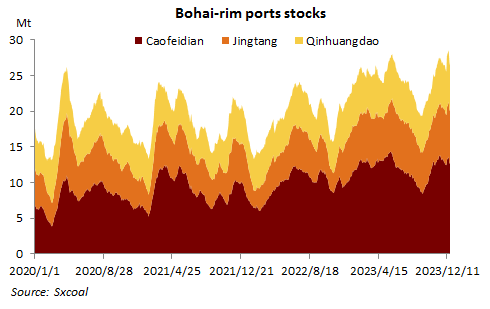
Inbound deliveries to these ports averaged 930,857 tonnes a day last week, dropping 24.8% week on week. Outflows, however, increased 40.1% on the week to 1.2 million tonnes, Sxcoal's data showed.
There were 112 vessels waiting for loading at the three ports on December 22, down 18 vessels week on week; 44 vessels were expected to arrive, unchanged week on week.
Given that the lower temperatures in southern regions are expected to persist and unfavorable factors affecting coal deliveries from production areas to diminish, both inflows and outflows are anticipated to show positive trends in the short term, leading to continued reduction of the port-side inventory.


 No Content
