


China's top 3 provinces Nov coal output up 2.6% MoM; Xinjiang registers notable growth
- Opinion
- Production
- China
- Coal
sxcoal.com639 words11 reads


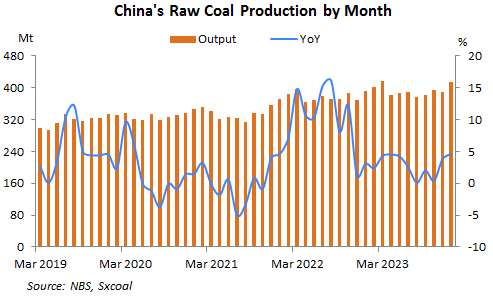
China's raw coal production posted both year-on-year and month-on-month growths in November, hitting the second-highest level just after March's 417 million tonnes, according to the National Bureau of Statistics (NBS).
The country churned out 414 million tonnes of raw coal last month, up 4.6% from the preceding year, which accelerated by 0.8 percentage point (pp) from October, the NBS data showed.
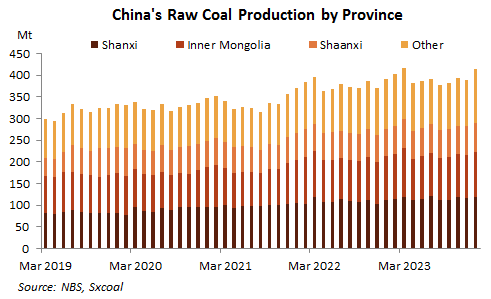
Shanxi, Inner Mongolia and Shaanxi, the top three coal production bases in China, produced 289.90 million tonnes of raw coal in November, accounting for 70.02% of China's total, according to the NBS. This represented an expansion of 2.69 pps compared to the previous month but a contraction of 0.66 pp from a year ago.
The combined output rose 2.56% or 7.23 million tonnes from the preceding month and 4.82% or 13.32 million tonnes from the previous year.
Shanxi still ranked first with 118.0 million tonnes of raw coal production in November, rising 4.5% from a year ago and 2.04% from October. Inner Mongolia followed with output down 0.6% year on year yet up 3.78% month on month to 104.46 million tonnes. The output from Shaanxi grew 5.6% on the year and 1.61% from a month ago to 67.44 million tonnes.
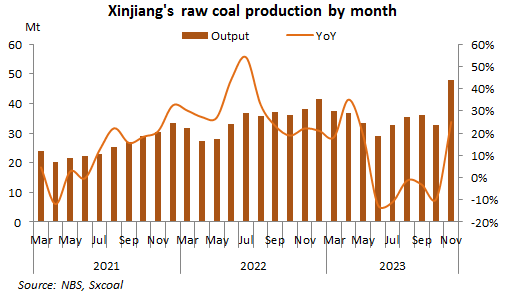
Xinjiang produced 47.85 million tonnes of raw coal in November, up 25% on the year and surging 45.93% on the month, ranking fourth in China.
On a year-on-year basis, Inner Mongolia registered an expanded decline rate in November, while Shanxi and Shaanxi observed contracted growths. Xinjiang reversed the previous month's yearly downtrend to an upward trajectory.
In terms of month-on-month changes, Inner Mongolia and Shaanxi maintained the increase over the month, while Shanxi and Xinjiang also shifted to an upward trend from a decline.
Xinjiang's raw coal production hit a historic high in November, growing 15.06 million tonnes compared to October, according to the NBS data.
The increment even exceeded the combined output of 12.10 million tonnes in the 11 provinces with lower rankings in November, namely Hebei, Liaoning, Sichuan, Jilin, Hunan, Qinghai, Jiangsu, Fujian, Guangxi, Jiangxi, and Hubei.
According to the NBS data, Xinjiang's coal production has experienced significant fluctuations this year, particularly in year-on-year trends.
Nationwide, there were only six provinces with sequential decreases in November, including secondary coal-producing areas such as Ningxia and Anhui. Hubei registered the largest growth rate, followed by Xinjiang.
There were still the major producing regions witnessing larger increments in raw coal production.
Despite coal mine accidents during the month, local coal production in Shanxi and Heilongjiang was not affected significantly.
From January to November, China produced a total 4.24 billion tonnes of coal, up 2.9% from the year before, retreating 0.2 pp compared with the first ten months.
Shanxi, Inner Mongolia and Shaanxi still grabbed the largest coal production. Shanxi churned out 1.25 billion tonnes of raw coal in January-November, taking 29.40% of the total and rising 3.8% from a year ago. Inner Mongolia followed with output up 0.6% year on year to 1.10 billion tonnes or 26.05% of the total. Output from Shaanxi grew 2.1% to 692.93 million tonnes or 16.35% of the total.
The top three bases produced a total 3.04 billion tonnes of raw coal during the first eleven months of this year, rising 3.32% or 97.91 million tonnes compared with the preceding year. That accounted for 72.80% of the country's total.
December typically sees relatively high production, and it is expected to be the case this year as well. As winter progresses and extreme weather events occur, there is a higher demand for stable supply and high fulfilment rate for long-term contract coal, which would keep coal output at high levels.
Furthermore, for some coal mines that have not been able to achieve their planned excavation targets for the year due to accidents and safety inspections, December will be their last opportunity for a final push.


 No Content
