


Review: S Korea's Aug coal imports hit 1-yr high; Australian coal tops again
- Opinion
- Import
- International
- South Korea
- Coal
sxcoal.com780 words5 reads


South Korea's coal imports in August extended the increase for four sequential months to notch a new high since September 2022. Australia outpaced Russia to become the largest supplier to South Korea.
The country imported a total 11.77 million tonnes of coal last month, falling 3.82% from the preceding year but up 10.04% from July, customs data showed.
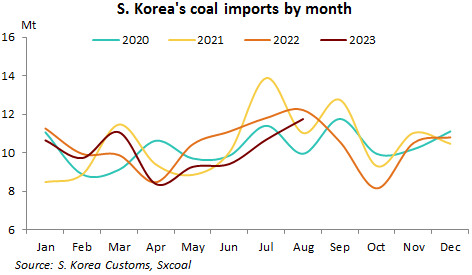
South Korea's coal imports remained low in August compared to the same month in previous years despite August's continuous growth.
However, the country's power demand during the month remained high. According to local power statistics system, operating power capacity reached 104.3 GW, a 2.02% rise month on month; peak electricity demand came in at 93.6 GW in August, up 7.56%.
Meanwhile, South Korea's import of Russian coal showed notable month-on-month and year-on-year declines, with Australia once again emerging as the country's largest source of coal imports.
This decrease can be attributed to the government's restrictions on state-owned power companies purchasing Russian coal in the spot market, which in turn drove the demand for coal intakes from other countries such as Australia.
Earlier this month, the South Korean Ministry of Trade, Industry, and Energy held a meeting with five state-owned power utilities, aiming to reduce their dependency on importing thermal coal from Russia.
It is understood that the government has set a quota for these five companies to import 13 million tonnes of power coal from Russia between September and December. Market participants stated that since the two parties have signed contracts to supply 14 million tonnes of coal by the end of 2023, the rest of 1 million tonnes of coal delivery had to be postponed to 2024.
The import value reached $1.72 billion in August, down 41.61% year on year but up 6.88% month on month. The average import price was calculated at $145.98/t, down 39.29% from the year prior and 2.88% on the month.
South Korea imported a total 81.01 million tonnes of coal during the first eight months of 2023, down 4.91% on the year, with value totaling $14.56 billion, down 26.46% year on year.
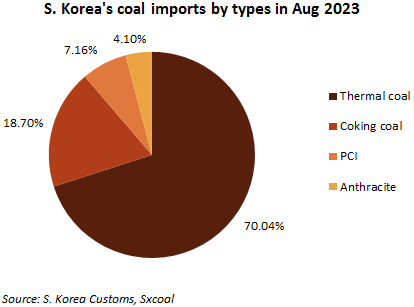
By type The country's thermal coal imports totaled 8.24 million tonnes in the month, down 7.08% from the previous year yet rising 2.35% from the month-ago level, accounting for 70.04% of the total, lower than 75.3% a month ago. Imports of coking coal reached 2.20 million tonnes, an uptick of 0.63% on the year and up 38.84% on the month, accounting for 18.7% of the total.
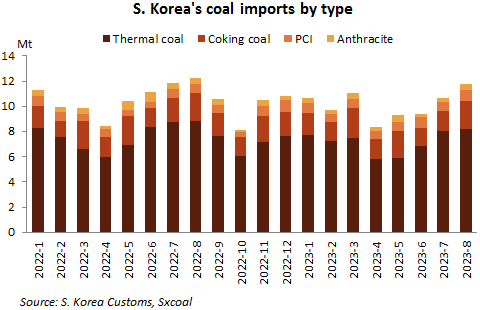
PCI coal imports totaled 842,100 tonnes in August, growing 21.69% year on year and 21.64% month on month, representing 7.16% of the total, and anthracite imports were 482,600 tonnes, dipping 0.66% YoY yet rising 32.91% MoM, making up 4.1%.
By source Australia, Russia, Indonesia, Colombia and Canada were the top five suppliers to South Korea in August, accounting for 85.1% of the total coal imports, unchanged from July.
South Korea imported the most coal from Australia in the month. The import volume was at 2.91 million tonnes, down 3.66% year on year yet up 4.5% month on month, accounting for 24.7% of the total, lower than 26.02% a month ago.
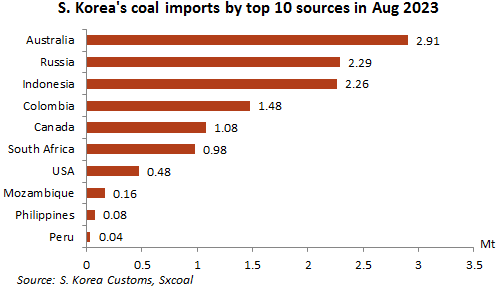
South Korea bought 2.29 million tonnes of coal from Russia in August, declining 12.62% on the year and 23.79% on the month, with its share down from 28.14% to 19.49%. Shipments from Indonesia fell 14.84% year on year but increased 16.69% month on month to 2.26 million tonnes.
Coal imports from Colombia and Canada respectively totaled 1.48 million tonnes (+372.45% YoY, +209.71% MoM) and 1.08 million tonnes (+22.34% YoY, +77.62% MoM).
Additionally, South Korea imported 21,500 tonnes of coke in August, down 23.49% from a year earlier but up 49.31% from the preceding month. South Korea spent $6.87 million for coke imports in the month, slumping 51.17% year on year yet increasing 40.65% month on month. The import price averaged $319.63/t, down 36.17% year on year and 5.8% month on month.
As South Korean power companies, especially state-owned power producers, gradually reduced their procurement of Russian coal, this prompted these buyers to increase their purchases of low-calorific value (CV) coal from other sources. The same trend was observed for high-CV coal, as South Korea's coal imports from Colombia, Canada, and South Africa significantly increased in August compared to the previous month.
It remains unclear to what extent the South Korean government aims to reduce the reliance of power companies on Russian coal. However, it is understood that one of the electricity firms has not placed any orders for Russian coal since the second quarter, resulting in a potentially declined proportion of Russian coal in South Korea's imports.


 No Content
