


Weekly China thermal coal market analysis and forecast
- Opinion
- Price
- Thermal Coal
- Coal
sxcoal.com1237 words96 reads


China's domestic thermal coal market dropped moderately for the second consecutive week, as utilities were still relying on long-term contract supply to replenish their stocks, while non-power end users continued to purchase the necessary amount of coal to cover their daily needs.
The domestic price decrease had a domino effect on the seaborne import market, with utilities awarding lower prices for front-month cargoes, causing Indonesian miners to reduce the prices for sales to Chinese traders.
Fenwei CCI Index
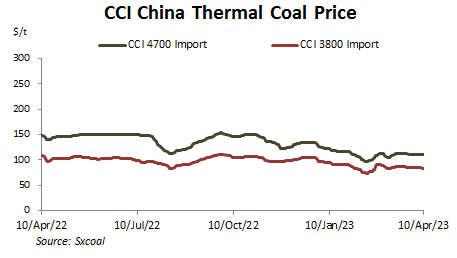
On April 10, the Fenwei CCI 4700 Import index stood at $109.5/t CFR, down $1/t from a week ago; the Fenwei CCI 3800 Import index was $83.0/t CFR, falling $2.5/t week on week.
Fenwei Survey
Fenwei's weekly survey on 100 thermal coal mines in Shanxi, Shaanxi and Inner Mongolia showed the weighted average capacity utilization stood at 87.8% last week, down from 88.8% a week earlier. Stockpiles at these surveyed mines increased 0.2% from a week ago and their profits were down 2.4%.
Weekly Dynamics
Last week, the overall supply remained steady with most mines running normally, while a few mines stopped operations due to change of mining conditions. Most coal mines still focused on long-term contract delivery, with not much left for the spot market.
End users such as metallurgical and chemical producers only procured necessary supplies, showing no eagerness to build up stocks. Utilities, on the other hand, depended on long-term contract supply to maintain their stocks with no intention to restock from the spot market. Wholesalers at rail stations ceased operations of stocking up from mines amid weakened sales at ports.
CHN Energy, or Shenhua, finally revised down its purchase prices of coal it buys from third-party suppliers. Previously, it had kept the purchase price of 5,500 Kcal/kg NAR coal unchanged at 902 yuan/t over April 4-11, but cut it by 72.5 yuan/t to 829.5 yuan/t from April 8 until April 11.
If without the price update, Shenhua could have maintained the 902 yuan/t unchanged for five weeks in a row. The drop swayed miners and traders to keep selling prices unchanged, which could lead to accelerated declines at mines and ports this week.
As of April 7, Fenwei assessed Yulin 5,800 Kcal/kg NAR thermal coal at 907 yuan/t, mine-mouth with VAT, down 3.5% from a week ago; Ordos 5,500 Kcal/kg NAR coal was assessed at 830 yuan/t, down 1.5% week on week; Shanxi Datong 5,500 Kcal/kg NAR coal was assessed at 880 yuan/t, a 2.5% fall from the week before.
At northern ports, traders cut offer prices moderately last week, especially for high-CV cargoes, due to loosened supply-demand fundamentals. A few end users issued tenders for prompt or front-month spot cargoes but depressed buying prices down to an extremely low level.
As of April 7, offer prices were generally around 1,050-1,060 yuan/t FOB northern ports with VAT for 5,500 Kcal/kg NAR, compared with 1,080-1,090 yuan/t FOB a week earlier; 5,000 Kcal/kg NAR offers stood at 910-930 yuan/t, largely unchanged from 920-925 yuan/t a week ago, and 4,500 Kcal/kg NAR offers were around 800-810 yuan/t, unchanged.
Cargoes of mid- and low-CV coals were traded actively relative to high-CVs, which led to slower decline in offer prices of 5,000 Kcal/kg NAR coal.
With stockpiles hovering around high levels and daily burn at low levels, utilities refrained from pre-summer restocking to pressure the market lower. And the steady supply made the market more likely to fall in the near term.
Qinhuangdao's coal inventory climbed to 6.57 million tonnes on April 7, rising 5.8% compared with the preceding week and up 21.22% from a month ago. The volume was 30.62% higher compared with a year ago.
Inbound rail coal deliveries to Qinhuangdao in the week to April 7 averaged 478,300 tonnes per day, down by 26,000 tonnes from a week ago. Daily outflows stood at 426,700 tonnes, down by 26,100 tonnes from the preceding week. The daily average of vessels loading at the port was up 13.86 from a week ago, and the expected arrivals were also down 3.43 week on week.
The Daqin railway went on its spring maintenance last week. Data showed its daily shipments to ports immediately fell to 1 million tonnes from previous 1.1-1.25 million tonnes. However, the market shrugged off the drop, with the bearish sentiment still dominating.
Utilities in southern China reported low running of generation capacity during the shoulder season. Moreover, the recent rainfall ramped up hydropower generation and further curbed coal consumption at power plants.
Sxcoal's data showed the daily coal burn by the six major coastal power groups stood at 732,100 tonnes as of April 9, sagging from 763,200 tonnes a week earlier. Their stockpiles rose to 12.74 million tonnes from 12.54 million a week ago, enough to cover 17.6 days of use.
For the seaborne thermal coal market, Indonesian coal prices softened during the week due to poor demand from China. As of April 10, tradable prices for Panamax 3,800 Kcal/kg NAR thermal coal were around $74.5-76/t FOB, down from $76-78/t a week ago.
Chinese utilities continued to float tenders for May-loading cargoes in the import market, but their buying prices had shrunk compared with a week ago, mainly owing to downward prices in China's domestic market.
Some state-owned utilities awarded Panamax cargoes of Indonesian 3,800 Kcal/kg NAR cargoes at prices net back to $75-75.5/t FOB Kalimantan.
Last week saw a rise in vessel shipping rates on the route of South Kalimantan-South China, with Panamaxes rising to $8.2/t from $7/t a week ago, and Supramaxes from $9.5/t to $10/t.
Indian buyers, anticipating a downward price correction in the near term, eased their overseas purchases. Still, Indian traders showed solid demand for mid-CV cargoes, especially those reselling coal to domestic end users at the west coast to make up for a structural balance.
Russian coal prices rose slightly in Asia-Pacific market last week, with the 6,000 Kcal/kg NAR offer prices up $2/t from a week ago to $131/t FOB Far East ports, and the 5,000 Kcal/kg NAR up about $3/t to $121-125/t FOB.
Australian coal prices were mixed, with 6,000 Kcal/kg NAR coal up about $16/t week on week to $194/t FOB, while 5,500 Kcal/kg NAR material fell $2/t at $120/t FOB.
Forecast
The bearish sentiment and low demand from end users are likely to drag down prices further this week, but participants expected the extent of decline not to be significant, partly cushioned by the ongoing maintenance to coal-dedicated Daqin line. Many utilities that have either no or insufficient long-term contracts still need restocking before the arrival of the summer peak demand.


 No Content
