


Monthly: China's coastal coal freight rates drop further as demand flags
- Seaborne Transport
- Thermal Coal
- Coal
- Logistics
- China
sxcoal.com556 words131 reads


China's coastal coal shipping market generally remained on the decline in December despite short-lived rebounds supported by cold waves. Power and non-power sectors presented sluggish restocking demand, which led to loose market fundamentals and kept freight rates in losing streak.
As of December 29, the China Coastal Coal Freight Composite dived down 11.3% from the month prior to 686.76 points. It was also 63.5 points or 8.46% lower than the year-ago level, according to the Shanghai Shipping Exchange.
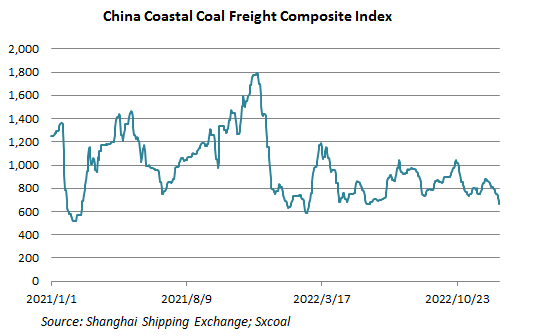
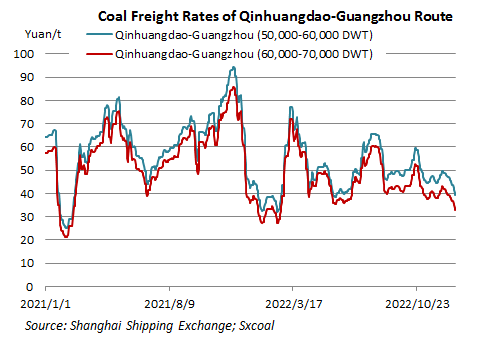
Freight rates of all shipping routes declined from the month-ago levels. The rate for Qinhuangdao-Guangzhou port logged a monthly drop of 12.06% to 40.1 yuan/t for 50,000-60,000 DWT vessel as of December 29, data showed.
The rates for the 30,000-40,000 DWT vessels from Qinhuangdao to Fuzhou port slip 8.25% month on month to 35.6 yuan/t, which was 7.53% lower than the year prior.
In early December, the strongest cold wave this winter has boosted coal burns at utilities, spurring their coal replenishments and demand for vessels.
The strong gales and fog alongside the cold snap have disturbed shipping activity on the sea, with vessels available decreasing amid long-time port closures. This caused a shortage of shipping capacity and offered further support to the market, with freight rates seeing a short-lived rebound.
Yet the market re-entered the downside track along with the fading of cold wave. Power utilities remained tepid in coal restocking as their stocks were ample to meet current low burning demand and they relied on term contract cargoes.
In the meantime, non-power sectors were still in recovery stage, which curbed their demand for the fuel and vessels.
Thus freight rates started falling down amid a surplus of shipping capacity and lack of demand, and the capacity glut was even aggravated amid favorable weathers for coastal shipment.
Data showed that the number of anchoring ships was firstly in large volatility in early December, and then slowed down after mid-December and fell down to less than 130 in end of the month. This was significantly lower than daily average of 200 ships in December 2021.
In international market, active iron ore market has supported freight rates of Capesize vessels and bolstered up the BDI readings in December. As of December 23, the BDI came in at 1,515 points, rising 160 points or 11.81% from end-November.
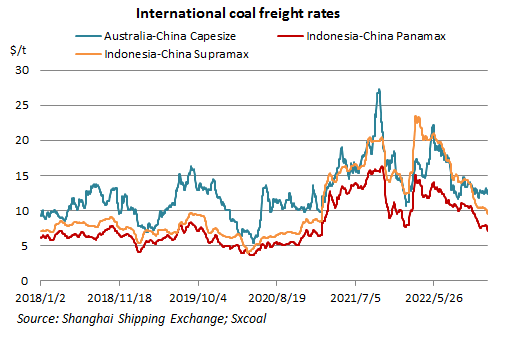
The international coal shipping rates were actually weighed down by the waned demand from main coal importers including China. Yet the decline was relatively small given some demand for winter coal storage to heat homes in the northern hemisphere.
As of December 29, the rate of 85,000 DWT vessels from Hay Point of Australia to Zhoushan of China dropped $0.13/t or 0.99% from a month ago to $13.01/t, while that of 50,000 DWT vessels from Taboneo of Indonesia to China's Guangzhou decreased 7.18% to $9.70/t.
China's coastal coal shipping market is likely to remain sluggish before the Spring Festival holidays, as the downstream demand for coal kept flagging in the run-up to the festival and many industrial firms have entered early holiday break.


 No Content
