


Weekly: China national CEA market trades review (Sep 14- Sep 18)
- Price
- Sales
- Carbon Offset
- Emissions Trading
- Carbon
sxcoal.com658 words8 reads


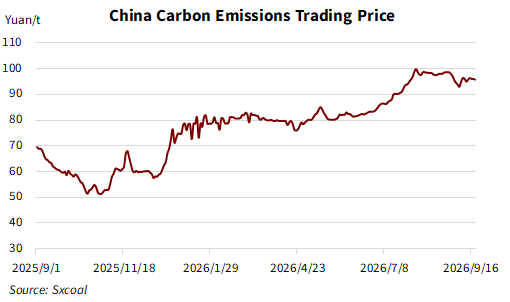
China's national carbon market held steady near 96 yuan/t during the week between September 14-18, with the carbon price fluctuating in a narrow range of 95-96 yuan/t, establishing a new price center. Trading activity declined from the previous week, though market sentiment stabilized, with neither buyers nor sellers rushing to close deals.
The national carbon market's composite price ranged from a high of 96.90 yuan/t to a low of 94.20 yuan/t during the week of September 14-18. The closing price on September 18 was 95.63 yuan/t, up 0.83% from 95.63 yuan/t on September 11, the last trading day of the previous week.
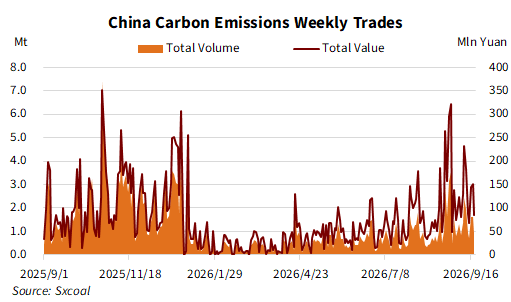
Total CEA turnover was 5.75 million tonnes, down 27.56% from the previous week. Listed contracts accounted for 1.72 million tonnes, down 25.52% week on week, while bulk contracts totaled 4.03 million tonnes, down 28.39%. No one-way bidding transactions were recorded.
Total CEA turnover value was 534 million yuan ($79.09 million), down 29.04% from the previous week. Listed contracts contributed 165 million yuan, down 24.80%, while bulk contracts accounted for 369 million yuan, down 30.79%.
September 15 saw the week's lowest daily turnover at 698,500 tonnes worth 67 million yuan, while September 17 recorded the highest at 1.61 million tonnes worth 151 million yuan.
From January 1 to September 18, 2026, cumulative CEA turnover on the national carbon market reached 113.28 million tonnes, with a total value of 9.67 billion yuan. As of September 18, 2026, cumulative CEA turnover since the market's launch stood at 978.15 million tonnes, valued at 67.33 billion yuan.
The CCER market saw a volume-driven decline during the week, with prices edging lower. The weekly high reached 95.18 yuan/t and the low was 90.76 yuan/t, with wide intraweek fluctuations. Turnover was lifted by occasional large orders on September 15 and 18, rising 160.40% from the previous week.
Policies in Focus
On the policy front, the 2026 China Carbon Market Conference was held in Wuhan, Hubei province, on September 15, where the Ministry of Ecology and Environment released the National Carbon Market Development Report (2026). The report showed that as of the end of August 2026, cumulative CEA turnover reached 961 million tonnes worth 65.70 billion yuan. During January-August 2026, turnover and turnover value rose 46.53% and 67.64% respectively from the same period a year earlier. The carbon market now covers four industries — power generation, steel, cement and aluminum smelting — with 3,680 key emitters included, covering approximately 8.3 billion tonnes of carbon dioxide emissions, or more than 65% of China's total. The carbon price mechanism, under which "emitting carbon carries a cost and reducing carbon brings returns", is gradually taking effect.
The European Parliament's chief negotiator for the Emissions Trading System (ETS) proposed that EU member states allocate 75% of ETS allowance auction revenue to green transition efforts for companies covered by the mechanism, higher than the 50% threshold initially proposed by the European Commission. The proposal aims to ease financial pressure on energy-intensive industries while supporting decarbonization of domestic manufacturing and the power sector.
On September 17, Shanghai Clearing House, under the guidance of the People's Bank of China, officially launched carbon emission allowance repurchase clearing services, which have already been implemented in the Hubei and Guangdong regional carbon markets. The service leverages the commodity spot clearing system and connects directly with regional carbon markets, creating a fully online closed loop covering application submission, qualification review, allowance transfer, fund clearing and maturity settlement. Carbon repo business had long faced challenges including offline operations, non-standardized processes and low institutional participation. The innovation brings mature experience from the interbank payment and clearing system into the carbon market. Several brokerages including Shenwan Hongyuan, Huatai Securities and CITIC Securities participated in the first batch of transactions.
Also on September 17, ExxonMobil's annual energy outlook warned that global carbon reduction progress may fall short of climate goals, with models showing coal demand will decline more slowly than previously expected.


 No Content
