


Weekly: China national CEA market trades review (Aug 24- Aug 28)
- Price
- Sales
- Carbon Offset
- Emissions Trading
- Carbon
sxcoal.com555 words25 reads


China's national carbon market saw wider price swings last week (Aug 24- Aug 28), with volumes more than doubling as the release of the formal quota allocation plan removed policy uncertainty and unleashed pent-up trading demand.
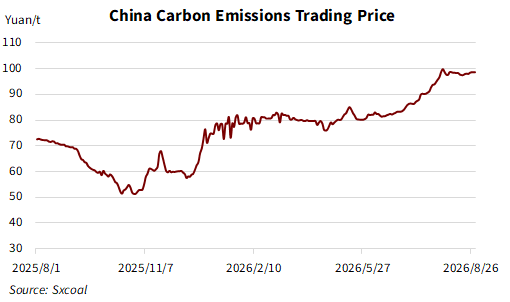
The benchmark CEA price touched a weekly low of 92 yuan/t and tested the 99 yuan resistance level, but again failed to break through the 100 yuan threshold. The market closed August 28 at 98.50 yuan/t, up 0.54% from the previous Friday's close of August 21.
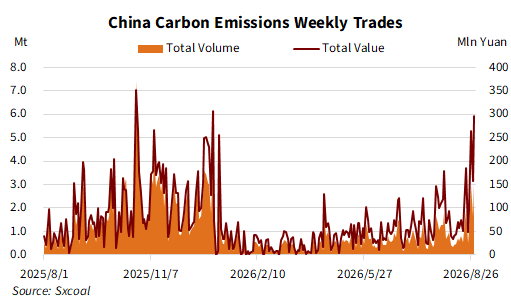
Total weekly CEA volume reached 9.28 million tonnes, up 93.18% from the prior week. Bulk agreement transactions surged 119.23% to 7.68 million tonnes, while listed agreement trades rose 22.92% to 1.60 million tonnes. No one-way bidding transactions were concluded.
Weekly turnover totaled 868 million yuan, up 86.18% week on week. Bulk agreement turnover jumped 109.49% to 711 million yuan, while listed agreement turnover rose 23.81% to 157 million yuan ($23.15 million).
Daily volumes ranged from a weekly low of 503,800 tonnes (49 million yuan) on August 24 to a weekly high of 3.16 million tonnes (296 million yuan) on August 28.
Cumulative CEA volume from January 1 to August 28 reached 92.28 million tonnes, with turnover of 7.71 billion yuan. Since the market's inception, cumulative volume stood at 957.15 million tonnes with turnover of 65.38 billion yuan as of August 28.
CCER prices remained broadly stable last week, holding at elevated levels in a narrow range while the spread with CEA widened again. Weekly highs reached 96.94 yuan/t with lows at 94.90 yuan/t, though volumes declined as buyers and sellers remained at a standoff, pushing the price center passively higher.
Policies in Focus
On August 24, the Ministry of Ecology and Environment approved the quota allocation plan for the power sector for 2025-2026 and for steel, cement and aluminum smelting for 2026. The plan, for the first time, unifies four major industries under a single quota document, cutting the preliminary allocation ratio from 70% to 50%, abolishing quota carryover and lowering the baseline value by 0.35% annually — signaling a marginal tightening of the system after sector expansion.
On August 25, Beijing released a policy document on advancing green and low-carbon transition and strengthening the national carbon market, targeting basic coverage of major industrial emitting sectors by 2027 and a fully established "total cap with combined free and paid allocation" market by 2030. The document also calls for gradually raising the share of paid allocation, halting new local carbon markets and allowing financial institutions to participate.
On August 26, the Ministry of Industry and Information Technology said at a press conference that 8,336 green factories were built during the 14th "Five-Year Plan" period, accounting for 22% of output value in the regulated manufacturing sector. During the 15th "Five-Year Plan" period, the ministry will deepen industrial carbon peaking efforts, cultivate 500 zero-carbon factories and promote raw material and fuel substitution alongside low-carbon technology integration in steel, nonferrous metals, petrochemicals and building materials.
On August 28, the European Commission's ETS reform proposal continued to advance, with plans to lower the linear reduction factor (3.7% for 2031-35 and 1.7% for 2036-40), extend free allowances to 2038 and allow use of up to 2% international carbon credits from 2036. Separately, ICE announced it would halt trading in 11 nature-based carbon credit futures contracts.


 No Content
