


China portside thermal coal sees sharp decline amid demand woes, stock pressure
- Opinion
- Price
- Consumption
- Stock
- Thermal Coal
- Coal
sxcoal.com547 words53 reads


China's domestic thermal coal market at northern ports faced significant downward pressure, with widespread pessimism, persistent sluggish demand, and rapidly accumulating inventories pointing to no immediate stabilization.
On December 9, the CCI Index for 5,500 Kcal/kg NAR coal stood at 782 yuan/t FOB with VAT, falling 8 yuan/t from the day prior. The index for 5,000 Kcal/kg NAR coal was at 680 yuan/t and 4,500 Kcal/kg NAR coal at 580 yuan/t, both down 8 yuan/t on the day.
Offers were largely offered at substantial discounts to the CCI benchmarks. Cargoes of 5,000 Kcal/kg NAR coal were consistently heard offered at 10-20 yuan/t below the CCI 5000 index, with some trades for specific low-sulfur varieties concluded even at index minus 20 yuan/t.
Fixed price offers for this grade ranged between 640-660 yuan/t, but buying interest from power plants remained virtually absent, sources told Sxcoal.
"The market is still terrible, we don't even know how to sell anymore," said a port-based trader source, reflecting the pervasive gloom.
One miner source in Inner Mongolia offered 5,000 Kcal/kg NAR coal at an index minus 7-9 yuan/t, but utilities ignored the offer, indicating a significant divide between sellers and buyers.
Weak fundamentals stood as the main factor behind the weakness. Coal stocks at Qinhuangdao, Caofeidian, Jingtang, and Huanghua ports reached 28.81 million tonnes on December 9, hitting the highest level since June 20, 2025. The figure marked a weekly rise of 5.6% and a month-on-month surge of 22%, Sxcoal's data showed.
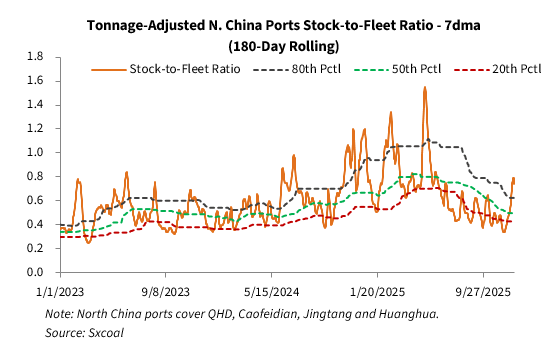
Sxcoal's assessment on the tonnage-adjusted stock-to-fleet ratio, a major gauge for on-sight supply at northern ports, climbed to nearly 0.8 on December 8, well exceeding the six-month rolling 80th percentile. That was close to the low level in early June when thermal coal prices were at multi-year lows.
Well-stocked power plants had muted appetite for spot replenishment, aggravating the ongoing supply-demand imbalance. Multiple utility sources reported high stockpiles, with one major Shandong-based plant having over 40 days of coverage and high contract availability. This has contributed to a widespread wait-and-see attitude.
Port traders found themselves in a difficult position, caught between the pain of selling at a loss and the pressure of moving cargoes in a stagnant market. Buying interest for 5,500 Kcal/kg NAR coal was heard at around 720-730 yuan/t, but sellers were reluctant to offer at such low levels.
Some non-power sector consumers, like cement producers, saw the current low prices as a procurement opportunity but were timing their moves cautiously.
While some anticipate a potential stabilization by late December, possibly influenced by anticipated cold weather and potential mine production cuts, the prevailing near-term view remains weak.
Some traders are shifting their attention to a major cold wave forecast by the China Meteorological Administration for December 10-13. This weather system is expected to bring significant temperature drops and widespread snow across some northern, central, and eastern regions.
Participants hope this could boost heating demand, disrupt regional coal supply, and potentially slow the price decline, providing much-needed psychological support to the beleaguered market.
However, they acknowledged that that the market's path to stability will heavily depend on a tangible drawdown in port inventories and a sustained increase in utility procurement fueled by colder weather.


 No Content
