


Weekly: China's thermal coal prices stay flat at ports but soften at mines
- Price
- Consumption
- Stock
- Thermal Coal
- Coal
sxcoal.com1391 words35 reads


China's domestic thermal coal prices stabilized at northern transshipment ports during the week ending October 31. High costs, continued low availability of premium low-sulfur grades, and winter demand expectations encouraged sellers to maintain firm prices. However, the mine-mouth market experienced a quick downward correction after earlier elevated prices made some end users unwilling to purchase.
The seaborne import market stayed broadly unchanged, but cautious sentiment grew among Chinese end users alongside the stabilized domestic market. Continued price advantage is expected to buoy seaborne prices once winter demand release accelerates.
Sxcoal CCI Index
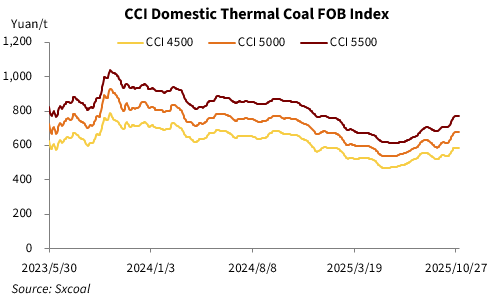
On October 31, the CCI index for 5,500 Kcal/kg NAR domestic spot coal stood at 773 yuan/t FOB with VAT northern China port with VAT, unchanged week on week. The CCI index for 5,000 Kcal/kg NAR domestic coal was also flat from a week earlier at 678 yuan/t.
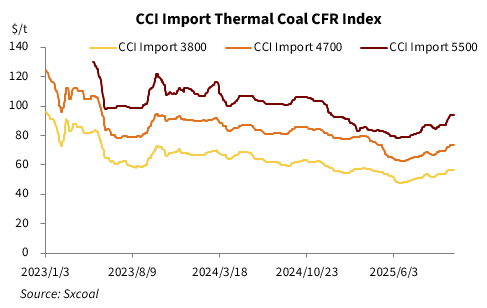
On the same day, the CCI 5500 Import index stood at $94.2/t, CFR southern China port, unchanged compared with the previous week. The CCI 4700 Import index was flat at $73.5/t, while the CCI 3800 Import index was also standing still at $56.6/t.
Weekly Dynamics
Production areas Thermal coal prices declined in main production areas last week before stabilizing at the end of the week. Increased railway freight rates following the cancellation of freight discounts in some sections, coupled with abated buying enthusiasm from some end users after price hikes, hindered coal sales at mines and pushed up mine-mouth inventories, imposing downward pressure on prices.
Sxcoal's survey of 160 thermal coal mines showed the overall coal stocks gained 2.26% week on week as of October 29, with mines in Inner Mongolia registered a faster 3.39% rise, partly as elevated rail coal shipping costs hindered outward deliveries. Data showed that China Railway Hohhot Group, which supervises the rail networks in central and western Inner Mongolia, approved 16 trains to transport coal each day on average last week, down 18 trains from a week earlier.
Supply from surveyed mines gained, with the combined capacity utilization rising 0.9 percentage point from the previous week to 89.1% and their output climbing 1.02% during the week ending October 29.
As a result, during the monitoring period, 19 mines raised prices by 34.8 yuan/t averagely, down significantly from 92 mines hiking prices by 39.1 yuan/t a week ago, while 45 mines cut prices by 25.9 yuan/t, compared with 2 mines lowering prices by 32.0 yuan/t. The remaining 96 mines kept prices flat.
As offer prices retreated, the economics of shipping coal from mines to ports marginally improved, attracting some traders to re-enter the market. Some mines supplying cost-effective coal reported increased truck arrivals for loading.
This, coupled with continued purchases from metallurgical and chemical plants to meet essential demand, drove regional price rises of 5-10 yuan/t approaching the end of the week, although some mines with high inventory continued price cuts to stimulate sales.
Additionally, reduced production at some mines at the end of the month after completing monthly targets also provided certain underlying support to prices.
However, the week-end price upticks were not enough to offset earlier corrections, leaving prices on a downward trend as a whole last week.
On October 31, Sxcoal assessed Yulin 5,800 Kcal/kg NAR thermal coal at 619 yuan/t, mine-mouth with VAT, falling 21 yuan/t from the preceding week; Ordos 5,500 Kcal/kg NAR coal dropped 22 yuan/t to 565 yuan/t; and Shanxi Datong 5,500 Kcal/kg NAR coal was assessed at 630 yuan/t, falling 8 yuan/t week on week.
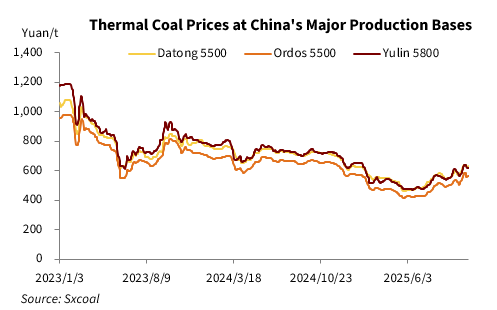
Participants expected the market to move within a narrow range in the short term, with potential for increases later as winter stockpiling demand gradually emerges.
Coal deliveries through Daqin railway, a major transport artery connecting production areas to northern ports, increased to 1.22 million tonnes during the week ended October 31, rebounding 21% week on week. Shipments at the end of the week reached full capacity around 1.30 million tonnes.
Portside market Prices stayed roughly flat at China's northern ports last week. Low coal stocks and still high costs of replenishment despite mine-mouth price retreats, together with a positive demand outlook, limited downward pressure, while cautious buying sentiment and retreated coal consumption at power plants capped a potential price rebound.
Rail coal deliveries on the Daqin railway recovered fast last week after completing maintenance on October 26, yet these increases have been offset by reduced deliveries on railways in Inner Mongolia due to elevated freight rates, resulting in a decline in coal stocks at ports.
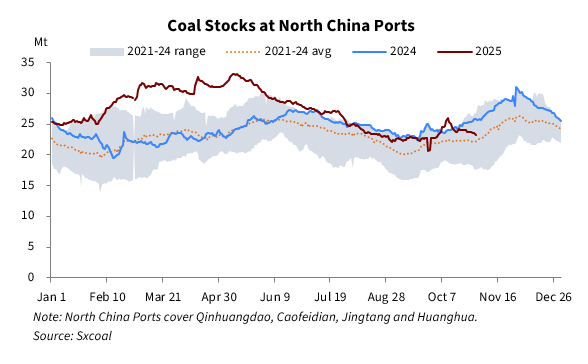
The combined inventories at Qinhuangdao, Jingtang, Caofeidian, and Huanghua ports totaled 23.17 million tonnes on October 31, falling 3.34% week on week yet still rising 2.12% on the month. The volume was also 10.54% lower than the year-ago level, Sxcoal's data showed.
It was understood that the supply of some high-quality cargoes remained tight, keeping seller offerings firm. Some traders even held back cargoes approaching the end of last week, citing difficulties in replenishing stocks at current selling levels and expectations of higher prices as mine-mouth prices showed signs of rebound, and cold air is forecast to intensify in northern China.
Trading liquidity stayed weak last week. Port vessels in anchorage were primarily loading long-term contract coal, while demand for spot supplies remained muted, and buyers consistently pressed down their buying levels amid reduced consumption.
Data showed that the average coal consumption at inland power plants on October 29 dropped 12.5% and 7.8% respectively from the preceding week and the previous month, and that at coastal power plants also fell by 4.2% and 17.2% during the same periods.
Hydropower generation declined further, offering certain relief to coal-fired power demand before peak season arrives. Sxcoal's data showed that water outflow through the Three Gorges dam, a key indicator of China's hydropower generation, stood at 13,400 cu.m/s on October 31, falling 14.6% from the week-ago level and 44.2% from the preceding month. It was, however, 92% higher compared with the preceding year.
Some participants expected portside prices to slightly rebound entering November if price increases extend further in production areas.
Import market The imported thermal coal prices stabilized last week. Some traders liquidated prompt cargoes to lock in profits, submitting slightly lower bids to domestic utility tenders, which pulled the overall bidding range down. However, seasonal rainfalls in Indonesia tightened supply and encouraged miners to hold prices.
Offers for Panamax cargoes of the most-liquid Indonesian 3,800 Kcal/kg NAR coal stood unchanged at $48.5-49/t FOB, while utility tenders hovered at 444-455 yuan/t CFR South China with VAT, translating to $46-$48/t FOB.
On October 31, Sxcoal assessed the utility tender-winning prices for 3,800 Kcal/kg NAR coal at 445 yuan/t CFR South China with VAT, falling 5 yuan/t compared with the preceding week.
Utilities slashed their tenders last week amid slowed coal burns. Data showed the average coal consumption at power plants under six coastal power groups dropped 5.78% week on week and 8.86% month on month on October 30.
Despite the current softness, most traders remained optimistic about the fourth quarter demand and presented higher reluctance to further lower bid prices to tenders.
Meanwhile, imported low-CV coal remained competitive and is prone to rise once heating demand release gathers pace. Sxcoal's calculation showed on October 31 that Indonesian 3,800 Kcal/kg NAR coal enjoyed a delivered-to-South China advantage of 70.1 yuan/t against domestic 4,500 Kcal/kg NAR coal on a CV-adjusted basis. That spread gained 1.20 yuan/t week on week and 37.31 yuan/t on the month.
On October 30, one southern utility reportedly bought a cargo of Indonesian 3,800 Kcal/kg NAR coal with November delivery at 444.6 yuan/t CFR China with VAT, translating to $46.45/t FOB East Kalimantan. The utility also bought a cargo of Indonesian 4,700 Kcal/kg NAR coal with December delivery laycan at 627 yuan/t CFR or about $69.09/t FOB.
Forecast
China's domestic thermal coal prices at northern ports are anticipated to slightly firm up in early November due to cost support, improved mine-mouth market, and potential increase in downstream demand as temperature falls. The import market may remain stable, with an upward bias thanks to extended price advantage and firm offers from miners.


 No Content
