


Weekly: China's thermal coal prices head south amid increased panic sales
- Sales
- Price
- Production
- Thermal Coal
- Coal
sxcoal.com1232 words45 reads


China's thermal coal prices continued to decline at production areas and transfer ports due to weak demand from power plants. More portside traders opted to cut prices to attract orders and reduce stocks, fearing further price drops as temperatures fall.
Prices for imported low-CV thermal coal decreased following a dip in traders' bids for utility tenders for 3,800 Kcal/kg NAR coal scheduled for September-October delivery. Overall trading activity remained low because of unprofitable import conditions and high coal inventories at domestic power plants and ports.
Fenwei CCI Index
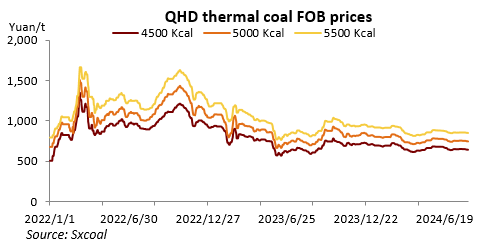
On August 12, the Fenwei CCI index for 5,500 Kcal/kg NAR domestic spot coal stood at 850 yuan/t FOB northern China ports with VAT, falling 5 yuan/t week on week. The CCI index for 5,000 Kcal/kg NAR domestic coal was at 748 yuan/t FOB, down 7 yuan/t.
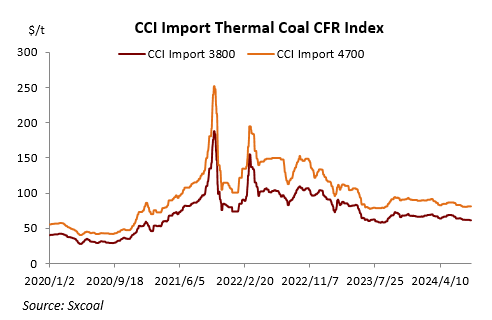
The Fenwei CCI 5500 Import index stood at $101.7/t, CFR southern China ports, flat week on week. The Fenwei CCI 4700 Import index was $81.5/t CFR, stable week on week, and the Fenwei CCI 3800 Import index was at $61.5/t CFR, down $0.5/t from a week earlier.
Weekly Dynamics
Production areas The mine-mouth thermal coal market declined last week, as rising inventories and lackluster sales prompted more miners to reduce prices.
During the week ended August 7, 10% of the 100 coal mines surveyed by Sxcoal in Shanxi, Shaanxi, and Inner Mongolia raised prices by an average of 11 yuan/t, 19% cut prices by averagely 21 yuan/t, while the rest 71% kept prices stable, Sxcoal's tracking data showed.
Supply in major production areas saw a slight rebound in early August as some miners resumed production to meet new monthly goals. However, this increase was partially countered by reduced output at several mines affected by heavy rain or environmental and safety inspections.
The capacity utilization of thermal coal mines surveyed by Sxcoal inched up 0.39 percentage point week on week to 86.66% during the week ending August 7. Output from these mines rebounded 0.43% week on week to 11.70 million tonnes during the week, Sxcoal's data showed.
Higher production and improved logistics after rainfalls led to high coal delivery mostly for term contract delivery on the Daqin railway, which connects major production areas of Shanxi and the port of Qinhuangdao. In the week to August 9, the daily coal shipment on the heavy-haul railway averaged 1.03 million tonnes, rebounding 12.8% week on week.
Demand from major downstream users continued to be lukewarm. Power plants were inactive in spot coal purchasing due to high stocks and sufficient supply of term contracts. Non-power sectors only maintained pockets of demand to meet essential needs. Traders and washing plants became even more cautious in restocking amid reselling pressure.
As a result, coal stocks increased at some mines, although the majority of mines still maintained a balance between production and sales due to steady term-contract fulfilments. The Sxcoal-surveyed thermal coal mines held 3.13 million tonnes of stocks as of August 7, rising 1.03% week on week.
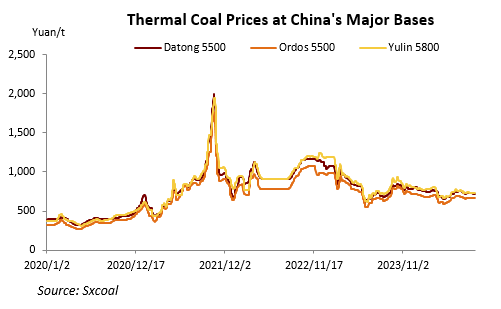
As of August 12, Fenwei assessed Yulin 5,800 Kcal/kg NAR thermal coal at 724 yuan/t, mine-mouth with VAT, falling 6 yuan/t from a week ago; Ordos 5,500 Kcal/kg NAR coal was assessed at 666 yuan/t, flat week on week; Shanxi Datong 5,500 Kcal/kg NAR coal was assessed at 718 yuan/t, decreasing 2 yuan/t.
Portside market The portside thermal coal market extended declines last week, with more traders reducing prices to boost sales despite ongoing heatwaves in parts of the southern and eastern regions.
Traders were increasingly looking to accelerate de-stocking, anticipating that temperatures will gradually decrease after mid-August as the country transitions into autumn.
The overall liquidities stayed at a relatively low level, as buyers adopted a cautious attitude and continued to push prices down.
Data indicated that coal consumption at power plants increased by 7.2% in inland provinces and 3.0% in coastal provinces as of August 7, driven by rising temperatures following the typhoon, which boosted cooling demand.
Power plants continued to use their existing stocks, showing little interest in restocking spot coal. Coal inventories at inland and coastal plants decreased by only 3.1% and 1.7% compared to the previous week, remaining relatively high. Stocks at inland plants were even 6.0% higher than last year.
Coal stocks at northern ports (Qinhuangdao, Jingtang and Caofeidian) continued to fall as high selling pressure restrained the improvement of inflows after rainfall interruption. Total stocks stood at 22.84 million tonnes on August 9, down 1.99% week on week and 10.04% month on month, Sxcoal's data showed.
Coal demand was also curbed by restrained thermal power demand amid high hydropower generation. Water outflows of the Three Gorge Dam stood at 27,700 cu.m/s on August 5, more than double the month-ago level and surging 64.9% year on year, although the figure was significantly lower after the peak in mid-July caused by the need for flood discharge.
Some participants grew increasingly bearish about the near-term market, anticipating limited support for the rest of August after demand fell short of expectations during July, a traditional peak consumption month. A few traders indicated they might lower prices further to alleviate inventory pressure.
Import market The import market also weakened last week, particularly for low-CV grades, following the continued decline in traders' bidding prices to Chinese utility tenders.
Southern utilities awarded tenders for September-October delivery of Panamax Indonesian 3,800 Kcal/kg NAR coal at 485-490 yuan/t DDP with VAT, netting back to about $52/t FOB Kalimantan. That marked a 10-15 yuan/t decline compared with the previous winning bids.
The prices were below the current offers at $52.5-54/t FOB from foreign miners for the same-CV coal with August- September laycan, making importers even more inactive in seeking cargoes due to limited arbitrage.
As of August 9, Sxcoal assessed 3,800 Kcal/kg NAR tender winning prices at 490 yuan/t, DDP with VAT, down 12 yuan/t compared with 502 yuan/t a week ago.
Offers of Panamax cargo of 3,800 Kcal/kg NAR coal were heard approximately $54/t FOB for August laycan late last week, while bids for reportedly at $52.5-53/t. A buying indication for same-CV coal on a geared vessel was heard at $51/t.
In the meantime, one southern Chinese power utility is expected to receive some Capesize cargoes of Australian thermal coal, mostly term contract supplies, in mid-to-late August. These cargoes were bought in July and postponed from the original delivery of early August.
One Panamax cargo of 3,800 Kcal/kg NAR coal was offered at approximately $53.2/t FOB for August loading. A selling attempt was heard at $52.5/t FOB for a Supramax cargo, with a bid reportedly at $51.3/t.
Supply from Indonesia was broadly stable, except for a few miners facing loading issues due to low water levels, sources said.
For higher-CV grades, inquiries from China remained lukewarm, with power plants mostly covering demand for August.
Forecast
China's thermal coal prices are expected to gradually decline in the near term, as high stock levels at ports and power plants, along with ample existing contracts, both domestic and imported, will limit new spot coal demand. Furthermore, the projected drop in temperatures from mid to late August may add to selling pressure.


 No Content
