


Weekly: int'l thermal coal market sentiment cools; prices under continued pressure
- Price
- International
- Indonesia
- India
- Thermal Coal
- Coal
sxcoal.com1521 words29 reads


The international thermal coal market continued to experience weak supply and demand dynamics in the past week. Several factors, like New Year's Day holiday, warmer-than-usual weather, and the seasonal slowdown in industrial activity, contributed to weakening demand. Inventories remained high, and spot procurement dwindled.
While supply remained relatively stable, logistical, weather, and policy factors caused disruptions in some regions, creating generally cautious market sentiment. Buyers took a wait-and-see approach, as the market awaited new drivers to emerge.
Overall, with low liquidity and high inventories at the end of the year, the international market lacked a clear direction, and trading sentiment was cool.
Supply Side
Indonesia Indonesian thermal coal prices faced continued pressure due to weak demand, seasonal slowdowns, and generally cautious market sentiment. However, the decline in shipping costs provided some buffer for prices, preventing any significant decrease in prices.
As of late last week, prevailing offers of Panamax Indonesian 3,800 Kcal/kg NAR coal were $47.5-48/t FOB, with January delivery laycan.
On December 26, the CCI index for Indonesian 3,800 Kcal/kg NAR coal stood at $44.5/t FOB, unchanged week on week but down $6 /t from the previous month; the CCI Import 4700 index stood at $67/t FOB, up $0.5/t from the prior week but down $4.9/t month on month.
Recently, major thermal coal importers of Indonesian coal, China and India, experienced relatively mild weather. Combined with high portside inventories and sufficient domestic supply, import demand significantly decreased.
Additionally, with the Christmas and New Year holidays, spot trading activity in the seaborne market was subdued. Even slightly decreased freight rates did not effectively stimulate new inquiries. The bearish sentiment in the Asian market remained strong.
Operational and political factors increased the uncertainty of Indonesia's supply. Heavy rainfall in South Kalimantan disrupted mining activities and barge loading, while a recent barge collision at the Mahakam Ulu Bridge in East Kalimantan triggered navigational alerts on key coal transport routes, raising concerns about short-term shipment delays. These factors supported miners' intention to firm up prices.
Uncertainties of annual production quotas and expectations of export tariffs early next year impacted market sentiment, with sellers adopting a cautious approach to sales.
While demand from Vietnam provided some support, trading volumes remained limited. In the short term, the Indonesian coal market may continue to face downward pressure from weather, logistical, and regulatory risks, and weak demand and ample inventories.
Russia Russian thermal coal CFR prices to major markets such as India slightly declined. Although lower shipping rates helped stabilize FOB prices to some extent, weak demand remained the main drag on prices.
On December 26, Sxcoal assessed Russian 5,000 Kcal/kg NAR thermal coal at $68.5/t FOB Far East ports, down $2/t from a week ago and $11/t month on month; Russian 5,500 Kcal/kg NAR coal was assessed at $77/t, falling $2/t week on week and $11/t from a month earlier.
In November, Russian coal production saw a slight recovery, with total output up 1.9% compared to October. This marked the highest level in 2025.
Since August, monthly coal production has been steadily recovering amid government support measures, including deferrals of mineral extraction taxes and insurance premium payments until February 2026. These measures have alleviated the financial pressure on mining companies. However, it is still expected that by the end of the year, Russia's coal sector will incur a loss exceeding 350 billion rubles ($4.5 billion), more than twice the loss in 2024.
Australia In the past week, Australian thermal coal prices weakened due to mild weather. As of December 24, 5,500 Kcal/kg NAR thermal coal at Newcastle port was at $70.31/t, down $4.35/t from the week before and $16.65/t from a month earlier. Prices of 6,000 Kcal/kg NAR coal dropped over $2/t to around $106/t.
Recently, Australia's coal export remained relatively stable, although parts of Queensland received weather warnings. No major disruptions were reported.
In Asia, market activity was constrained due to pre-holiday effects and high inventories. Spot transactions were sluggish, with market participants awaiting updates on Indonesia's Working Plan and Budget (RKAB) production quotas and potential restocking demand after the Chinese New Year to gauge the future market direction. The relatively stable supply and weak demand led to price softening.
South Africa As the year draws to a close, South Africa's coal market remained subdued. The holiday season suppressed demand from Asian buyers, resulting in mild pressure on prices.
As of December 24, 5,500 Kcal/kg NAR coal at the Richards Bay Coal Terminal (RBCT) fell to $73.26/t FOB, down $1.1/t from the week prior and $1.29/t month on month. The 6,000 Kcal/kg NAR materials declined $3/t.
With demand still weak, buyers adopted a cautious approach, aiming to avoid sharp price declines. Indian sponge iron and steel producers, facing higher input costs and ample inventories, remained largely sidelined.
However, South Africa's increased coal exports to Israel provided some support to the market. For Israel, in the context of supply disruptions in other regions, South Africa became a key alternative source.
Meanwhile, high coal inventories in China and mild winter weather kept market sentiment cautious. However, a slight decline in shipping rates enhanced South African coal's competitiveness in the South Asian market.
Demand Side
China China's imported thermal coal market remained subdued over the past week, as high stockpiles at major coastal power plants and ports continued to weigh on buying interest. Lower consumption and sufficient stockpiles reduced utilities' urgency to restock.
As of late last week, traders' lowest bidding prices to utility tenders of 3,800 Kcal/kg NAR coal fell to 413-423 yuan/t, CFR China with VAT, equivalent to $45.92-47.18/t on a Panamax basis.
On December 26, Sxcoal assessed 3,800 Kcal/kg NAR coal at $53/t CFR South China, unchanged from the week-ago level; the 4,700 Kcal/kg NAR coal was assessed at $72/t, falling $0.5/t week on week; and the 5,500 Kcal/kg NAR coal was assessed at $85/t, a $4.7/t fall.
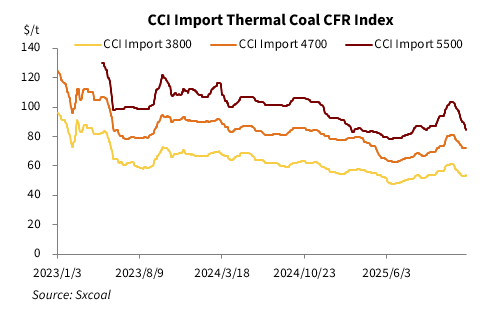
Toward the year-end, China's imported thermal coal market weakened further. Although international prices retreated rapidly, a steep decline in domestic coal prices narrowed the cost advantage of imported cargoes, significantly dampening demand for seaborne coal.
At the same time, inventories at major domestic ports continued to build, while power plants' stocks also remained high. Mild winter temperatures kept coal consumption largely stable, with heating demand below expectations, prompting most end users to withdraw from the spot market and rely instead on domestic coal, hydropower, and renewable energy.
As of December 28, daily coal burns at six major coastal power groups were 847,000 tonnes, up 5% from the previous week. Their coal stock stood at 13.37 million tonnes, a drop of 1.5% from the previous week, available for 16 days of consumption.
Chinese buyers were absent from the seaborne coal market. Offers and bids for Indonesian and Australian coal were scarce, while modest inquiries from other Asian buyers were insufficient to lift overall market sentiment. New Year's Day holiday and milder-than-usual temperatures across China further curtailed coal consumption, keeping near-term demand under pressure.
India India's coal market also remained weak around the end of the year, as ample supply and sluggish demand continued to curb procurement. Power utilities maintained rational inventory, while holidays further slowed industrial operations.
By December 27, Indian power plant coal inventories fell 1.16% from a week ago to 54.39 million tonnes, showed data from the Central Electricity Authority, which was available for 17.8 days of consumption. As of late last week, 14 plants operated at critical stock levels, up one from last week.
Despite the increase in seasonal electricity demand, most buyers opted to stay on the sidelines. Seaborne coal prices were largely stable, reflecting a balanced supply-demand situation and limited trading interest.
Supported by steady domestic production and reliable transportation, power generators continued to favor domestic coal. Meanwhile, coal demand from steel and sponge iron producers remained weak due to squeezed margins and elevated costs.
Europe European thermal coal demand also softened over the past week. Both coal and natural gas futures prices declined amid moderate demand and ample supply. Continued inflows of liquefied natural gas (LNG), particularly from the U.S., put further pressure on European gas prices.
Last week, 6,000 Kcal/kg NAR coal at ARA ports rose above $95/t, up $0.5/t from the previous week.
As of December 26, the gas futures contract for January 2026 delivery at the European benchmark TTF hub was closed at 28.095 euros/MWh, dipping 0.23% week on week.
Although winter demand remained relatively strong, rising LNG supply continued to cap gas price gains, keeping the European gas market under pressure. Improved supply expectations and ample availability eased concerns over potential shortages, dampening buying interest in both gas and coal futures.
In addition, weaker expectations for industrial and power demand added further pressure on coal prices.


 No Content

