


Coal stocks at China's power plants near historical highs, CEC
- Price
- Production
- Ports
- Cost
- Stock
- Trade
- China
- Thermal Coal
sxcoal.com650 words37 reads


China's thermal coal market still featured elevated inventories and weak consumption during the week ending December 18. As stocks at northern ports and power plants neared historical highs, utilities focused on fulfilling long-term contracts and maintained only need-based spot purchases, China Electricity Council (CEC) said in its latest weekly report.
Coal stocks at the CEC-monitored coal-fired power plants, which account for 67% of China's total installed coal power capacity, decreased 0.57% week on week (WoW) to 131.73 million tonnes as of December 18, marking the second-highest level so far in the year. Days of coal inventory coverage decreased 1.4 days WoW to 25.2 days, according to the CEC.
Meanwhile, daily power generation from these power plants increased 5.1% WoW while declined 5.2% year on year (YoY), the CEC data showed. Southern and northwestern China saw the steepest WoW increases in daily power generation, up 19.5% and 10.5% WoW, respectively.
Daily coal consumption at these power plants gained 5.5% WoW but dropped 4.1% YoY, said the CEC.
Snowfall temporarily disrupted production and logistics at open-pit mines across key mining hubs last week. Meanwhile, some mines halted or cut production for maintenance after completing their annual output targets. Despite tightened supply, sales pressure remained amid loose fundamentals. Weak market sentiment continued to weigh on prices, with miners in Yulin, Ordos, and Shanxi cutting prices by 20-30 yuan/t to attract sales.
As of December 23, Sxcoal assessed Ordos 5,500 Kcal/kg NAR thermal coal at 527 yuan/t mine-mouth with VAT, down 18 yuan/t WoW; Datong 5,500 Kcal/kg NAR coal dived 30 yuan/t to 555 yuan/t; Yulin 5,800 Kcal/kg NAR coal stood at 574 yuan/t, a 11 yuan/t decrease.
Trading activity remained tepid in the portside market amid relatively loose fundamentals. The number of anchored vessels stayed low at key ports, driven by sluggish demand. Participants maintained need-based procurement.
Holding a bearish outlook, non-power companies largely adopted a low-stock strategy, purchasing coal only as needed. This provided fragile support to the coal market.
As portside inventories hit a multi-year high, panic sentiment prevailed, prompting traders to offload cargoes, and resulting in a pullback in portside prices.
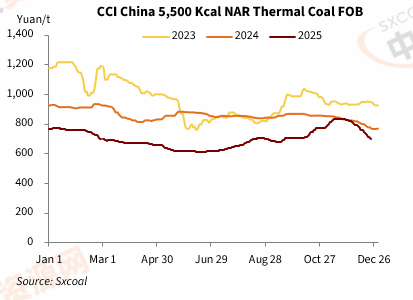
On December 23, the CCI index for domestic 5,500 Kcal/kg NAR coal traded at Qinhuangdao port decreased to 700 yuan/t FOB with VAT, down 41 yuan/t WoW. The price plunged 132 yuan/t month on month and 70 yuan/t YoY.
Sluggish domestic demand, coupled with a sharp drop in seaborne freight rates and appreciation of the Chinese yuan, significantly lowered CFR costs. Price declines in Australian and Russian high-CV coal were relatively slow due to winter restocking demand from Japan and South Korea, while Russian logistics were also impacted by severe winter conditions. Additionally , China's leading thermal coal supplier Indonesia plans to impose a 1-5% coal export duty starting January 1, 2026, which may potentially raise delivered costs to China and offer some support for domestic coal prices.
As year-end approaches, increased snow days may disrupt coal production and transportation in some northern provinces. However, the combined coal inventories at northern ports have exceeded 31 million tonnes, sitting at a comparatively high level compared with the same period in history, which is expected to offset supply shortfalls from mines. Despite fluctuating temperatures due to cold fronts, their limited intensity and short duration kept coal burns at power plants relatively low compared to previous years. Coupled with ample inventories at end-user facilities, this is unlikely to drive up demand.
Coal prices extended the sharp downward trend, especially following a leading miner's 40 yuan/t cut in purchase prices for third-party coal in a single day. Traders are expected to continue clearing cargoes amid growing panic sentiment.
The CEC expected that demand is unlikely to improve before coal stocks at most power plants decline. Prices are projected to soften further, though the pace of decline may slow.


 No Content

