


Review: nearly 60% of Chinese provs. post YoY drops in Nov coal imports
- Import
- China
- Coal
sxcoal.com558 words20 reads


China's coal imports continued to weaken in November, extending a year-on-year decline to a ninth consecutive month, as softer demand and high inventories weighed on buying appetite, according to customs data. Nearly 60% of provinces and regions recorded lower coal imports from a year earlier, underscoring the broad-based nature of the slowdown.
Coal imports into China were 44.05 million tonnes in November, decreasing 19.9% from 57.98 million tonnes a year ago but up 5.5% from October's 41.74 million tonnes, showed data from the General Administration of Customs.
Eastern and southern China were still the main coal-importing areas in November. Considerable distance and high transportation costs from the two regions to major production areas of Shanxi, Shaanxi and Inner Mongolia made it more economically viable for local power plants to import coal.
The decrease in imports came as China's domestic coal market faced high levels of inventory at power plants and ports. With adequate stockpiles in both power plants and port facilities, the urgency to import coal diminished. The lower consumption of coal for power generation in November, mild weather and slower-than-expected economic recovery reduced the need for imports.
From January to November, the total volume of imported coal in China reached 431.89 million tonnes, a fall of 11.9% compared with the same period of last year, expanding by 0.1 percentage point compared with the first ten months.
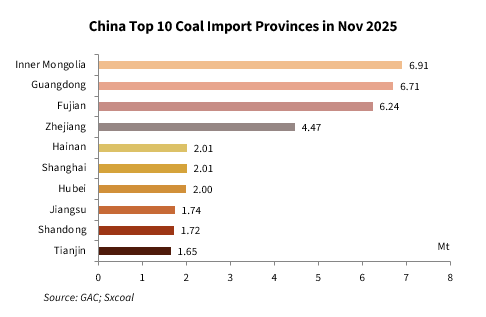
In November, China's top five coal importing provinces (regions or municipalities) –Inner Mongolia, Guangdong, Fujian, Zhejiang and Hainan – took 26.34 million tonnes of coal, down 22.07% on the year yet up 1.63% month on month, accounting for 59.8% of the country's total, down from 63% a month ago.
In November, Inner Mongolia imported 6.91 million tonnes of coal, up 9.4% YoY; Guangdong 6.71 million tonnes, down 12.7% YoY; Fujian 6.24 million tonnes, slumping 39.8% YoY; Zhejiang 4.47 million tonnes, down 20.3% YoY; and Hainan 2.01 million tonnes, diving 47.5% YoY.
Four of ten provinces that registered largest coal imports in November saw significant year-on-year increases, namely Tianjin (+701.5%YoY), Jiangsu (+32.7% YoY), Hubei (+18.6% YoY) and Inner Mongolia.
In the first eleven months, Fujian, Inner Mongolia, Guangdong, Zhejiang and Shandong imported a total 260.52 million tonnes of coal. The volume made up 60.3% of China's total, with Fujian accounting for 15.9% and Inner Mongolia 15.2%.
During this period, coal imports in these top five provinces were 68.47 million tonnes (-24% YoY), 65.55 million tonnes (+9.5% YoY), 57.7 million tonnes (-20.2% YoY), 46.18 million tonnes (+0.6% YoY) and 22.62 million tonnes (+8.7% YoY) respectively.
In November, 16 or 57.1% out of 28 provinces with coal imports in China registered a year-on-year decline.
Tianjin (1.65 Mt), Chongqing (496 Kt) and Xizang (160 Kt) were the top three provinces or provincial cities in terms of yearly increase in November, with their growth at 701.5%, 125.4% and 76.1%, respectively. The top three in year-on-year decline were Shaanxi (126 Kt), Liaoning (71 Kt) and Henan (164 Kt), with the rate of 91.4%, 88.6% and 65.6%.
In November, Inner Mongolia re-crowned as China's largest coal-importing region, at 6.91 million tonnes, up 9.4% YoY and 11.8% MoM. The daily passage of Mongolian coal at Ganqimaodu port averaged at 1,284.5 trucks, higher than 1,054.4 trucks in October. As of December 20, daily coal passage at the port was at 1,449.9 trucks, data showed.


 No Content

