


Weekly: int'l thermal coal prices continue to fall amid weak demand
- Price
- International
- Indonesia
- India
- South Africa
- Thermal Coal
- Coal
sxcoal.com1666 words45 reads


The international thermal coal prices continued to decline last week, while demand remained weak and supply showed no significant recovery. The market activity also slowed with the upcoming Christmas and New Year holidays.
Persistent rainfall in Indonesia and uncertainty over export duty policies dampened producer enthusiasm for exports. Australian coal prices remained under pressure due to weak demand from major buyer China. Russian coal producers continued to shift trade flows from Europe to Asia.
Falling domestic coal prices in China, high port and plant inventories stalled procurement of imported coal. Similarly, in India, strong stockpiles at power plants, lower-than-expected power consumption and the depreciation of the rupee resulted in stagnating import demand.
In Europe, while the onset of winter and colder temperatures led to some restocking demand, demand was weaker than in previous years. Additionally, restocking appetite was constrained by factors such as renewable power generation, natural gas prices, and carbon policies.
Supply Side
Indonesia Ongoing heavy rainfall in Indonesia disrupted mining and transportation operations in key coal-producing regions such as Sumatra and Kalimantan, tightening coal supply.
As of late last week, prevailing offers of Panamax Indonesian 3,800 Kcal/kg NAR coal were $48/t FOB, with January delivery laycan. Offers for 3,400 Kcal/kg NAR cargoes were around $39.5/t.
On December 19, the CCI index for Indonesian 3,800 Kcal/kg NAR coal stood at $44.5/t FOB, down $0.5/t week on week and $6.7/t from the previous month; the CCI Import 4700 index stood at $66.5/t FOB, falling $0.7/t from the prior week and $5.7/t month on month.
With domestic thermal coal prices in China on the decline and abundant stockpiles at power plants, Chinese importers only made sporadic purchases and invited bids with low prices. Indian buyers also slowed procurement because of sufficient stocks.
Besides heavy rainfall in regions like Sumatra, which led to interruptions and loading delays, policy uncertainties arouse as Indonesian producers still awaited government approval for the 2026 mining work plan (RKAB) quotas.
Furthermore, the Indonesian Ministry of Finance confirmed that it will implement an export tax on coal starting January 1, 2026, with rate ranging from 1% to 5%. While the tax aims to boost state revenue, it raised concerns across the industry.
The official details on how this will be implemented are still up in the air. Despite insufficient market supply, many producers opted to withhold sales due to low prices.
Russia Russian high-CV thermal coal prices at Far East ports edged lower last week due to declined freight rates, while that at northwestern and southern ports was largely unchanged. Warmer-than-usual weather across northeastern Asia curbed winter heating demand, and the supply of seaborne high-CV coal was abundant on the whole.
On December 19, Sxcoal assessed Russian 5,000 Kcal/kg NAR thermal coal at $70.5/t FOB Far East ports, down $4/t from a week ago and $9/t month on month; Russian 5,500 Kcal/kg NAR coal was assessed at $79/t, falling $4/t week on week and $9/t from a month earlier.
Russian exporters faced mounting logistics challenges. In the Far East, harsh winter weather slowed port operating efficiency, leading to cargo backlogs and vessel loading delays. At the same time, rising rail transport costs drew market attention and producers noted they were in discussions with the government on measures to ease logistics costs.
Production disruptions remained in some regions in Russia. Mezhegeyugol mine remained suspended since spring due to unfavorable market conditions. Separately, the Ust-Luga Container Terminal (ULCT) plans to fully halt coal transshipment from January 2026 on economic grounds, shifting its focus toward mineral fertilizer exports.
Some infrastructure developments offered long-term support. The Elga project is working to expand rail capacity, aiming to raise annual transport capacity to 30 million tonnes by 2026 to support coal exports via Cape Manorsky at Far East port.
Australia In the past week, Australia's coal export market continued to face pressure, primarily due to weak demand from Chinese buyers. As of December 19, 5,500 Kcal/kg NAR thermal coal at Newcastle port was at $72.45/t, down $2.21/t from the week before and $14.08/t from a month earlier. Prices of 6,000 Kcal/kg NAR coal dipped below $108/t.
Domestic downturns in China and ample inventory led buyers to adopt a cautious approach, putting pressure on spot prices at key Australian export ports such as Newcastle. Demand from other Asian countries, including South Korea, provided some support for high-CV coal prices.
In response to subdued demand for thermal coal, Australian coal suppliers adjusted sales strategies. Some producers shifted more towards metallurgical coal, which offers higher profit margins, as the thermal coal market remained weak.
South Africa South African high-CV thermal coal prices continued to decline last week, pressured by weak demand from Indian and European buyers, as well as falling coal prices in Europe.
As of December 19, 5,500 Kcal/kg NAR coal at the Richards Bay Coal Terminal (RBCT) fell to $73.24/t FOB, down $1.12/t from the week prior and $0.15/t month on month. The 6,000 Kcal/kg NAR materials declined $2/t to $88/t FOB.
Despite shorter supply, coal prices failed to rise significantly due to continued weakness in demand. Both the Asia-Pacific and European markets, key destinations for South African coal, underperformed.
India, the largest importer of South African coal, had high stocks at its power plants, leading to lower procurement activity. Market sources also indicated that India's sponge iron producers increasingly turned to cheaper domestic coal to reduce production costs, directly impacting demand for low-CV coal.
While South African miners actively exported high-CV coal to Europe, the region's coal demand remained below previous years' levels, keeping procurement and trading volumes limited.
Many market participants left the market for holidays around the end of the year, further dampening market activity. Consequently, although Richards Bay Coal Terminal (RBCT) inventory remained stable, supply-side disruptions failed to boost coal prices due to the lack of strong demand.
Demand Side
China China's imported thermal coal market remained quiet over the past week, weighed down by high inventories at major coastal power plants and ports and low consumption, which significantly reduced the urgency for large-scale restocking.
After a prolonged price drop, traders grew cautious about aggressive bids at low levels, narrowing further declines. As of late last week, traders' lowest bidding prices to utility tenders of 3,800 Kcal/kg NAR coal fell to 418-421 yuan/t, CFR China with VAT, equivalent to $45.33-45.76/t on a Panamax basis.
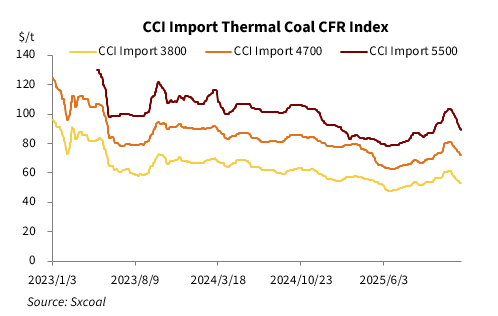
On December 19, Sxcoal assessed 3,800 Kcal/kg NAR coal at $53/t CFR South China, down $1.3/t from the week-ago level; the 4,700 Kcal/kg NAR coal was assessed at $72.5/t, falling $1.7/t week on week; and the 5,500 Kcal/kg NAR coal was assessed at $89.7/t, a $3.3/t fall.
As of December 21, daily coal burns at six major coastal power groups were 806,000 tonnes, down 3% from the previous week. Their coal stock stood at 13.58 million tonnes, a drop of 3.6% from the previous week, available for 17 days of consumption.
Although some coastal utilities launched tenders for January-delivery coal, bidding prices were not high amid ample inventories and bearish price expectations, with frequent tender abortions due to large offer/bid gaps.
Demand from non-power sectors also remained weak, as cement and building materials producers limited procurement due to environmental curbs and subdued market conditions.
Price edge of imported coal kept narrowing as domestic coal price drops accelerated. Traders faced increasing challenge in securing margins under pressure from buyers seeking lower prices, prompting many to stay on the sidelines. Some traders expected demand to improve around the New Year holiday. Most participants remained cautious, noting large-scale purchasing unlikely in the near term.
India India's demand remained largely stagnant last week, as power plants continued to hold high levels of inventory.
By December 21, Indian power plant coal inventories dipped 0.12% from a week ago to 55.18 million tonnes, showed data from the Central Electricity Authority, which was available for 18 days of consumption. As of late last week, 13 plants operated at critical stock levels, down one from last week.
Power consumption growth in India fell short of expectations, reducing the need for coal imports. Indian buyers were rather cautious, with bidding levels significantly lower than seller offers. The weakening of the Indian rupee against the U.S. dollar also added to cost pressures, discouraging buyers from purchasing at current prices.
Low sponge iron prices shifted producers' focus towards cost reduction rather than raw material quality, and therefore more companies turned to cheaper domestic coal. If this trend persists, it could have a medium- to long-term impact on imports from countries like South Africa.
Europe European thermal coal prices continued to move down last week amid lower natural gas prices, higher temperatures, and comfortable inventories at ARA (Amsterdam-Rotterdam-Antwerp) coal terminals. Additionally, ongoing peace talks between Russia and Ukraine put further pressure on energy commodities. Last week, 6,000 Kcal/kg NAR coal at ARA ports fell below $95/t, down nearly $2/t from the previous week.
The milder-than-expected weather and strong renewable power generation reduced peak demand for fossil fuels. Market participants generally expected that this winter's demand will be weaker than in previous years.
The high cost of carbon emissions and coal phase-out policies further suppressed coal's long-term role in Europe's energy mix. The EU's coal consumption is projected to continue declining in the coming years.
Furthermore, competition from alternative fuels remained intense, with relatively low natural gas prices and increasing LNG supply putting continued pressure on coal.
As of December 19, the gas futures contract for January 2026 delivery at the European benchmark TTF hub was closed at 28.161 euros/MWh, up 1.72% week on week.


 No Content

