


Weekly: N China port coal stocks range-bound as demand woes persist
- Stock
- China
- Qinhuangdao
- Jingtang
- Caofeidian
- Huanghua
- Coal
sxcoal.com411 words26 reads


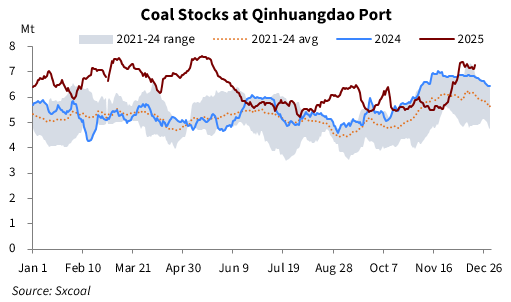
Coal stockpiles at Qinhuangdao, one major coal transshipment port in northern China, hovered high with minor fluctuations in the week ending December 19, as demand continued to be stagnant.
As of December 19, coal stockpiled at the port reached 7.28 million tonnes, slightly dropping 0.27% from the previous week. The stocks jumped 29.54% from a month earlier and 6.90% from the year-ago level.
Last week, most parts of China saw notably warmer temperatures, particularly in the south of the Yangtze River. Some areas even saw temperatures refresh record highs for the same period in history.
In this context, residential power demand stayed sluggish. As coal consumption grew marginally, power plants slowed restocking, leading to decreased outflows from Qinhuangdao port. The volume averaged 424,400 tonnes each day last week, declining 3.48% from a week ago.
Subdued demand and tepid market activities dampened enthusiasm for port-bound coal shipments from production areas, dragging daily deliveries on the Daqin railway below 1.2 million tonnes. As a result, the volume of coal shipped into the port dropped 17.06% on the week to 421,600 tonnes.
The daily average number of vessels waiting for coal loading at the port decreased 2.29 from a week ago, and the vessels expected to arrive also declined 2.14 on the week.
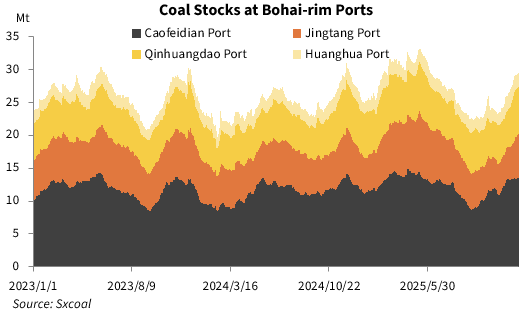
Coal stocks at the northern ports continued to build up last week, though with lower growth rate. As of December 19, the combined coal stocks of Qinhuangdao, Caofeidian, Jingtang and Huanghua ports stood at 29.65 million tonnes, rising 1.70% week on week, 14.87% month on month and 7.66% year on year.
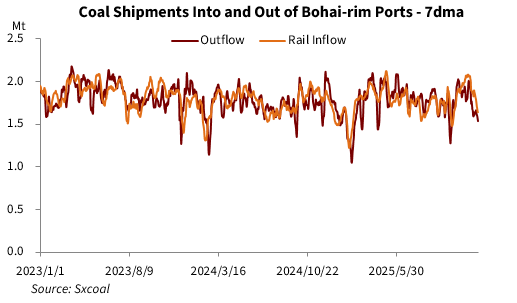
Low coal burns at power plants, weak market conditions, and a bearish outlook reduced end users' coal demand, cutting outbound shipments from northern ports by 6.24% to 1.53 million tonnes averagely each day for the week.
Meanwhile, as weakness persisted in the market, traders in producing areas continued to shun coal transportation to these ports, which averaged 1.64 million tonnes each day last week, 10.51% lower than a week prior.
A total of 72 vessels were waiting for loading at these ports on December 19, up three week on week; 31 vessels were expected to arrive, two more than the preceding week, as per Sxcoal data.
Looking ahead, despite new round of cold wave, the overall intensity remained limited. High likelihood of sluggish demand amid warm temperatures would continue to cap rail inflows and outbound shipments at northern ports, leaving coal stocks range-bound at high levels in the short term.


 No Content

