


Review: Inner Mongolia tops China in Nov raw coal output; Shaanxi hits record
- Production
- China
- Shanxi
- Shaanxi
- Inner Mongolia
- Coal
sxcoal.com512 words44 reads


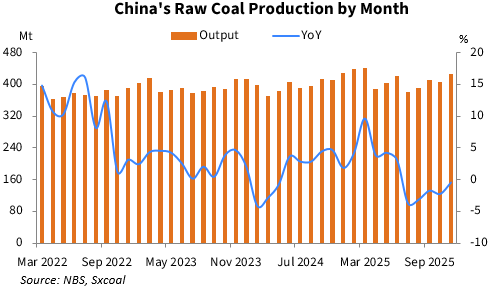
China produced 426.79 million tonnes of raw coal in November 2025, down 0.5% year on year (YoY) yet up 4.93% month on month (MoM), according to data released by the National Bureau of Statistics (NBS).
The output volume hit the second-highest level this year, second only to March's 440.58 million tonnes.
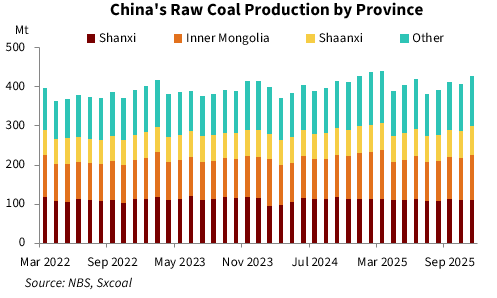
Inner Mongolia took the lead among major producing areas in November, with raw coal production reaching 115.18 million tonnes, the NBS data showed. The volume was the second intra-year high, dropping 2% YoY yet rising 7.79% MoM.
Shanxi ranked second with output of 111.55 million tonnes, down 3.3% YoY yet growing slightly by 0.15% MoM.
Shaanxi came in third with production of 72.93 million tonnes, notching a new monthly record. This was 4.6% higher YoY and up 5.15% MoM.
Total November raw coal output in the three key producing areas saw a MoM increase of 4.2%, compared with a 1.01% drop in October.
Additionally, Xinjiang's raw coal output reached 50.0 million tonnes, down 1.6% YoY yet up 11.57% MoM, taking fourth place.
Guizhou, ranking fifth, churned out 14.96 million tonnes, gaining 11.5% YoY and 10.16% MoM. The volume exceeded the 14-million-tonne threshold again following a near five-year hiatus and reached a new high since November 2017.
Seven provinces and regions saw MoM decreases in November raw coal output, in stark contrast to October seeing only six provinces grab increases. Provinces with significant growth included Hubei (393.78%), Liaoning (15.14%), Gansu (12.03%), Xinjiang (11.57%), and Guizhou (10.16%), while notable declines were observed in Jiangsu (34.84%), Jilin (16.81%), and Jiangxi (11.76%).
In terms of YoY changes, eight provinces and regions reported rises, with two provinces recording two-digit increases. Notable gains came from Guizhou (33.5%), Hebei (10%), Shandong (8.1%), Gansu (7.4%), and Fujian (7.2%). Jiangxi, Qinghai, Sichuan, Jilin, and Hunan witnessed obvious drops of 48.1%, 25.1%, 23.6%, 16.7%, and 16.6%, respectively.
In November, temperatures remained broadly warm despite minor declines. Sparse rainfalls, energy supply guarantee, and significant market price hikes prompted coal miners to ramp up raw coal production, compounded by overproduction checks and safety and environmental inspections.
Over the first eleven months this year, China produced 4.4 billion tonnes of raw coal, climbing 1.4% YoY, NBS data showed.
Shanxi, Inner Mongolia, and Shaanxi remained the top three producers over January-November. Shanxi churned out 1.2 billion tonnes of raw coal, up 2.4% YoY, accounting for 27.15% of the total output. Inner Mongolia contributed 26.49% or 1.17 billion tonnes of raw coal, down 1.2% YoY. The cumulative output of Shaanxi increased 2.6% YoY to 730.92 million tonnes, making up 16.61% of the total.
The three provinces combined produced 3.09 billion tonnes of coal during the first eleven months, rising 1.42% YoY and constituting 70.25% of China's total.
From January to November, Shanxi, Inner Mongolia, Shaanxi, Xinjiang, and Guizhou, each producing over 100 million tonnes, collectively supplied 3.73 billion tonnes or 84.75% of the national total, expanding 1.98% YoY.
Ten provinces and regions posted YoY increases in raw coal production over the same period. Heilongjiang exhibited the largest growth of 18.5%, followed by Yunnan, up 9.6%.


 No Content

