


QHD port coal stocks continue to dip; other N ports' destocking accelerates
- Stock
- Qinhuangdao
- Coal
sxcoal.com454 words27 reads


Coal stocks at Qinhuangdao, one major coal transshipment port in northern China, continued to decrease slightly last week. Stockpiles at other northern ports accelerated destocking amid further reducing inflows.
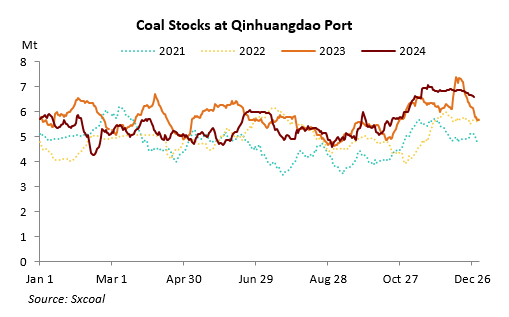
Qinhuangdao's coal stocks stood at 6.57 million tonnes on December 27, decreasing 2.81% from the previous week. The volume was down 3.24% from a month ago but 10.23% higher than the year-ago level, Sxcoal's data showed.
Inbound coal railings to Qinhuangdao averaged 429,600 tonnes each day in the week ended December 27, down 5.3% from a week ago, while daily outflows averaged 456,700 tonnes, decreasing 2.6% from the preceding week.
The daily average number of vessels waiting for coal loading at the port decreased by 0.14 from a week ago to 10.0, and the vessels expected to arrive reduced 0.29 week on week to 8.7.
Despite little change in supply and demand, inflows and outflows extended fall modestly at transfer ports, curbing cargo depletion.
Coal consumption at power plants hovered high alongside persistently falling temperatures, leading to a further decline in outflows at Qinhuangdao port.
As such, coal stocks at Qinhuangdao port were still at a high level of over 6.5 million tonnes and needed to be further cleared, judging from historical data.
Coal inventories at other northern ports extended the downtrend of the previous two weeks, albeit at a slower pace. As of December 27, three northern ports of Qinhuangdao, Caofeidian and Jingtang held 24.50 million tonnes of coal, a 4.00% fall from a week ago. The inventory was down 10.43% month on month and 2.41% year on year, data showed.
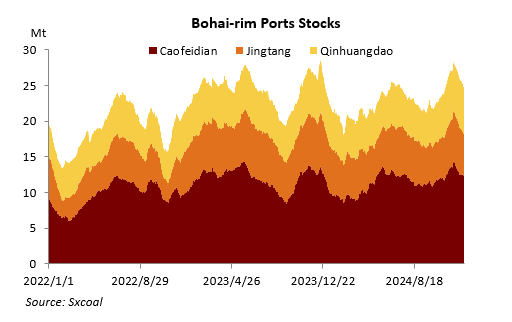
Inbound coal deliveries to these ports averaged 1.05 million tonnes a day last week, down 6.4% compared to the previous week. Outflows decreased by 0.9% on the week to 1.20 million tonnes, as per Sxcoal data.
A total of 16 vessels were waiting for loading at these northern ports on December 27, down one week on week; 34 vessels were expected to arrive, falling by six week on week.
The overall inventory reduction at northern ports last week was mainly due to further diminishing inflows. Despite easing cost pressure on port-bound shipments, spot traders still showed low enthusiasm given limited inquiries and sales difficulties. This led to a significant week-on-week decrease in port inflows, slightly accelerating inventory depletion.
The narrowing outflows could be attributed to the continued drop in temperatures and increased shipments from power plants. Also, spot prices have fallen below the long-term contract levels also played a part.
Looking ahead, although market prices show signs of stabilizations and rebounds, participants mostly hold a bearish outlook. Coupled with limited support from cold air, restocking needs at power utilities are hard to improve considerably. Stocks at transfer ports would largely hinge on inflows.


 No Content

