


China's 2024 coal production capacity review & 2025-29 forecast
- General
- Production
- China
- Coal
sxcoal.com636 words122 reads


As coal production capacity expansion faces growing challenges in China's major mining regions, transactions for coal exploration rights have surged, drawing unprecedented attention from industry insiders.
What can we expect for new capacity addition in 2025? How much room is left for further expansions? Will there be more increment in thermal coal or coking coal?
Capacity review
The coal industry operated steadily in 2024, with newly-added capacity reverting to normal levels. National capacity additions in the year reached 93.6 million tonnes per annum (Mtpa), compromising 26.7 Mtpa at operational mines and 66.9 Mtpa at under-construction mines, according to Sxcoal's capacity-tracking data.
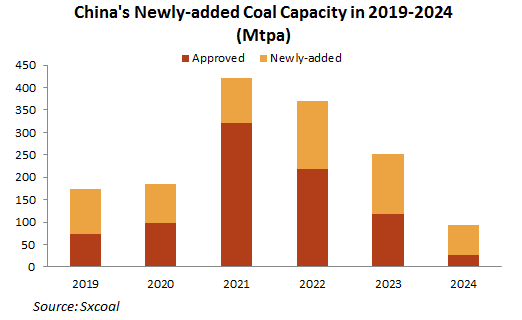
Capacity expansions at operational mines mainly stemmed from Xinjiang, Shanxi, and Guizhou. Among these, 23.1 Mtpa were allocated to thermal coal and 3.6 Mtpa to coking coal. The newly-operational mines were primarily situated in Shaanxi, Xinjiang, and Shanxi, with 52.95 Mtpa of thermal coal capacity and 13.95 Mtpa of coking coal.
Notably, Shaanxi and Xinjiang saw more newly-constructed mines, whereas Shanxi focused on expansion and renovation projects. Additionally, Yunnan and Guizhou in southwestern China also made significant contributions to new capacity, albeit with certain differences between them.
Despite decelerating capacity elimination efforts, capacities of 24.15 Mtpa were phased out in 2024, mainly at resource-depleted and long-term idle mines, and reductions at operational mines with official approvals.
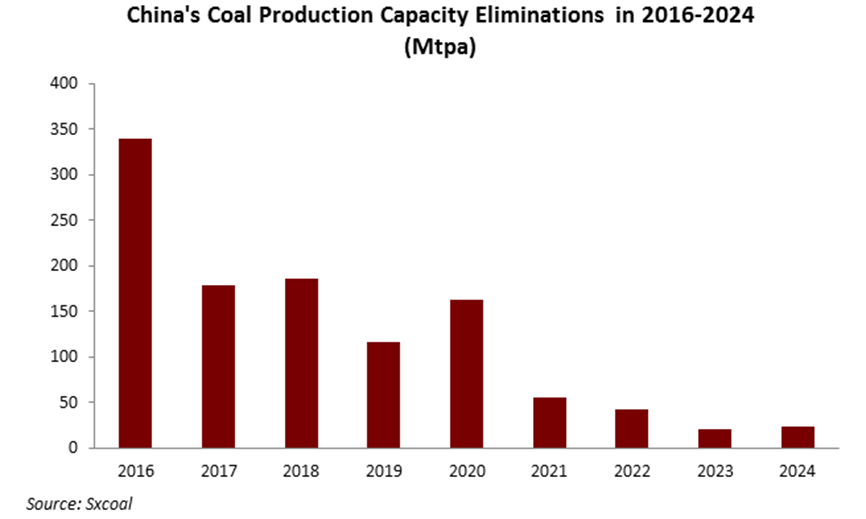
This dynamic shift led to changes in the overall effective capacity and capacity concentration across the country, as well as reductions in capacity utilization rates.
Capacity projections
Looking ahead, under the backdrop of "dual carbon" goals, Sxcoal forecasted the energy mix adjustments to expedite in 2025. Stricter policies controlling total coal consumption and intensity would further squeeze coal's share in primary energy consumption, leaving consistently shrinking room for coal output increments. This trend would compel the coal industry to transition away from relying on output increase, scale expansion, and price hikes toward high-quality development through advanced transformation and upgrading.
The coal industry faces a situation where overall capacity is relatively ample, but structural, grade-specific, and regional tensions persist. By 2030, China's coal capacity will primarily see net growth and subsequently witness policy-induced contractions alongside diminishing demand. The capacity constraints on coal output are expected to ease in the coming years, transforming from rigid to flexible.
Regarding new capacity additions, the proportion of coal consumption is anticipated to gradually decrease, as part of broader efforts to achieve carbon peak and neutrality, which may further depress investment enthusiasm and weaken the interest in constructing new mines.
Given the limited short-term available capacity from ongoing projects and the substantial depletion of expansion potential during 2021-2023, future new capacity additions are likely to be constrained.
Specifically, it is predicted that coal production capacity expansions and retirements will both show a gradual downward trend over 2025-2029, according to the Fenwei Coal Mine Database analysis, based on the current progress of mine construction, corporate development plans, and relevant national policies.
In recent years, China's domestic coal market has experienced great changes, and capacity fluctuations directly impact the balance between coal supply and demand. How will future capacity fluctuations affect the market in the next five years? To address these uncertainties, Fenwei, leveraging its own capacity database, has launched a new report titled "2024 China Coal Capacity Analysis and 2025-2029 Forecast".
This meticulously crafted report delves into policies such as advancing the approval and construction of advanced mines, expediting the commissioning of under-construction mines, and halting the construction of complex mines with capacity below 0.9 Mtpa, through multidimensional analysis by region, coal grade and status.
With a wealth of data and charts, alongside clear logic and distinct viewpoints, the report serves as a valuable reference for industry experts focusing on capacity changes and anticipating trends in the supply side. We sincerely invite you to subscribe, gaining deeper industry insights to better grasp the future market dynamics!


 No Content

