


Int'l thermal coal prices on continuous decline due to slack buys
- Opinion
- Price
- International
- Global
- Thermal Coal
- Coal
sxcoal.com1090 words55 reads


International thermal coal prices extended a weak run as overall demand remained subdued. Chinese and Indian buyers exhibited prudence in placing new orders, while only on-demand purchases were observed in Japan and South Korea.
Indonesian coal production and transportation remained disrupted by rainy weather, and coal stocks accumulated at South African major export terminals impacted by border closures.
Supply Side
Indonesia Offer prices for Indonesian thermal coal showed signs of ease earlier last week impacted by the falling Chinese domestic market and buyers' bearishness. Nevertheless, increasing short-covering demand and tight seaborne supplies of December-loading cargoes prompted Indonesian miners to hold prices firm.
As of late last week, Indonesian Panamax 3,800 Kcal/kg NAR coal was offered at $52.5/t FOB, with counter-offers lower at $51.5-52/t. Participants found it hard to strike deals and anticipated the near-term prices to be supported given the imminent Christmas holiday.
On December 20, the CCI index for Indonesian 3,800 Kcal/kg NAR coal stood at $50.5/t FOB, down $0.5/t from the week-ago level and $2.1/t from the previous month; the CCI Import 4700 index stood at $74/t FOB, flat on the week but down $2.8/t month on month.
Market supplies of Indonesian thermal coal stayed relatively ample despite limited availability as demand languished. An overseas trader source said some local miners planned to scale up production by year's end to achieve their annual work plan and budget (RKAB). Some producers had to postpone loading deliveries from Kalimantan by 7-9 days due to rainfall.
Similar to China, Indian buyers also slowed inquiries, waiting for further price declines of imported Indonesian coal. Some participants, however, expected potential demand support from Indian utilities with the approaching peak season for coal and electricity consumption.
Russia Russian thermal coal prices extended the downtrend at Far East ports last week with contracted decrements.
On December 20, Sxcoal assessed Russian 5,000 Kcal/kg NAR thermal coal at $75/t FOB Far East ports, down $3.5/t from a week ago and $10.5/t month on month; Russian 5,500 Kcal/kg NAR coal was assessed at $85/t, also down $3.5/t week on week and $10.5/t from a month earlier.
Australia Australian high-CV thermal coal prices dropped further below $123/t during the past week on weak demand among major consuming regions. As of December 20, Newcastle 6,000 Kcal/kg NAR thermal coal was at $122.8/t, down $5.6/t from the previous week and $18.2/t month on month. The price hit its lowest since late February this year.
South Korea reduced Australian coal procurements owing to higher import costs compared to other sources, which is predicted to continue till 2025.
South Africa South African thermal coal prices moved lower last week, hurt by negative dynamics in the European market, rising export port stocks and limited buying from India. As of December 20, the Richards Bay Coal Terminal (RBCT) thermal coal was priced at $100.8/t FOB, down $3.7/t week on week and $8.2/t from the previous month.
Winter restocking demand encouraged European buyers to increase seaborne coal purchases, and South African sellers witnessed growing margins to sell cargoes from RBCT to European ARA terminals. However, the price edge shrank as European port thermal coal prices decreased since last week.
As of November December 17, the inventory at RBCT reached 4.18 million tonnes, down 98,000 tonnes week on week yet much higher than the year-ago 3.6 million tonnes.
Sluggish Indian demand and reduced purchases in South Korea under competition stress from Colombian and Russian coal are likely to cause a further pileup of stocks at RBCT, participants said.
Demand Side
China China's imported thermal coal prices continued dropping, particularly for high-CV cargoes. Imported mid- and high-CV coals almost lost their price edge compared to domestic supplies late last week. Easing signs of offers from overseas miners also pushed traders to bid lower for Chinese utility tenders. As of late last week, the lowest winning bid for utility tenders of 3,800 Kcal/kg NAR coal fell to 464 yuan/t, CFR with VAT, notching a periodic low this year.
On December 20, Sxcoal assessed 3,800 Kcal/kg NAR coal at $58/t CFR South China, down $0.8/t from the week-ago level; the 4,700 Kcal/kg NAR coal was assessed at $80/t, down $0.5/t from a week earlier; 5,500 Kcal/kg NAR coal was assessed at $94/t, down $2/t week on week.
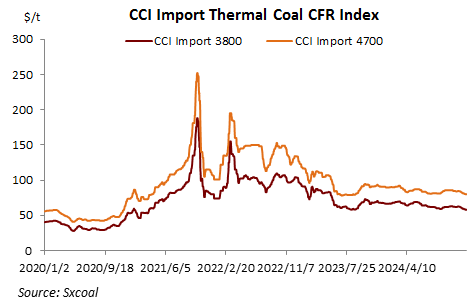
Widespread pessimism in the import market prompted traders to lower bidding levels of tendering, but overall transactions did not improve. Imported coal trading liquidity stagnated with little price competitiveness compared to domestic thermal coal.
Meanwhile, coal burns at coastal power plants were weaker than a year ago despite a seasonal rebound, while utility inventories stood 5.6% higher than the year before. Most coastal utilities floated tenders for cargoes with January- and February-loading laycans, which were reportedly supplied amply.
However, power plants showed buying prudence amid the mindset of "buying when prices are rising, not when falling".
India With the continuous rise in electricity demand, coal stocks at Indian power plants gradually accumulated. At the beginning of the current fiscal year 2024-25 (April 2024), coal stocks at Indian power plants stood at 47.78 million tonnes, increasing from 34.57 million tonnes in April 2023.
Sources said that the government aims to achieve 50 million tonnes of coal stocks by the beginning of the next fiscal and is currently focused on ramping up coal production to meet this target. Indian Railways has also enhanced rail capacity to ensure coal dispatches to power plants.
A recent report by the Institute for Energy Economics and Financial Analysis (IEEFA) indicated that renewable capacity reached a record 13.7 GW in the first quarter of this year, accounting for 71.5% of India's power mix, while the share of coal dropped below 50% for the first time since the 1960s.
Europe European thermal coal prices further slid below the support level of $110/t last week, under downward pressure from scant demand, lower gas and electricity prices and stable portside stocks. With a surge in solar and wind power generation, coal-fired electricity output in Germany plummeted by nearly 70% within a week.
As of December 20, gas futures for January delivery at the European benchmark TTF hub were closed at 44.13 euro/MWh, up 7.07% from a week earlier.


 No Content

