


Weekly: China's coking coal market weakens further on cautious sentiment (Dec 16, 2024)
- Price
- China
- Coking Coal
- Coal
sxcoal.com1285 words35 reads


China's coking coal market largely stabilized last week, yet with underlying weakness. Coking coal supply remained ample as most mines ran normally. However, shrinking coke-making profits after the fourth price cut dampened downstream buyers' purchasing interest during the traditional lull. They only made small essential purchases, constraining coking coal offtakes and pressuring prices. Online auctions faced high failure rates and more price drops.
The Index
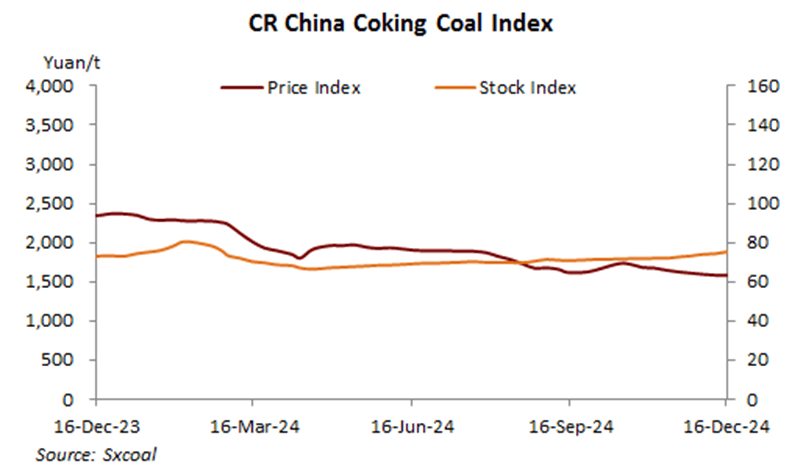
The CR China Coking Coal Price Index (CRCP) was 1,581.5 yuan/t on December 16, down 0.18% week on week. The CR China Coking Coal Stock Index (CRCS) was 75.3 points, 1.35% higher than the week-ago level.
Lately in the market
Some coking coal mines capped output approaching year-end due to various factors including mining accidents, nearing completion of annual production tasks, or underground issues. Yet, the overall coking coal supply remained at relatively high despite modest reductions. Raw coking coal output at Sxcoal-surveyed 227 mines dipped 0.44% from a week ago to 9.07 million tonnes in the week ending December 11. The capacity utilization at these mines averaged 89.79%, down 0.44 percentage point week on week.
With winter storage approaching, coking plants moderately increased purchases in the wake of recovering profits and expectations of coke prices to bottom out in the short run. As of December 11, coking coal stocks at 100 surveyed coking plants could sustain 7.69 days of usage, up 0.51 day from the previous week.
Amidst the current loose feed coal supply, coke and steel producers mostly showed increased buying interest, while middlemen remained on the sidelines. Most coking coal mines reported a rough sales-production balance or slight destocking. However, high-priced cargoes still struggled to find buyers, leading to notable stockpiling at some mines.
Sxcoal's data showed that raw coking coal stocks at surveyed mines reached 3.30 million tonnes as of December 11, up 2.48% on the week, while washed coal stocks increased by 4.17% from a week ago to 2.50 million tonnes.
Coking coal prices trended downwards in most parts of Shanxi. In Luliang, coking plants ran at high capacity utilization amid rational profits. Yet, they did not initiate large-scale restocking due to low finished steel consumption and sufficient feed coal supply. Most coke producers continued small replenishment. Some miners suffered from sustained stock accumulation, execrated by sluggish auction settlements. One miner wanted to auction off 30,000 tonnes of coking coal (A 11%, S 1.0%, GRI 85) on December 13, with only 3,000 tonnes concluded at 1,400 yuan/t.
In Linfen, prices for low-sulfur primary coking coal (S 0.5%, GRI 80-85) declined 10 yuan/t to 1,550 yuan/t. Coking plants actively sold cargoes and only restocked as needed, while middlemen, anticipating potential risks, avoided high-priced cargoes. Both online and offline markets encountered setbacks, weighing on coking coal prices in the near term.
The coking coal market weakened in Taiyuan. Low-sulfur coking coal (A 9.5%, S 0.45%, GRI 85) prices fell to 1,458 yuan/t last week. Macroeconomic policies provided limited support for spot demand, with low purchasing appetite among downstream buyers persisting. Mine-mouth coking coal prices continued to decline during the week, and online auctions by major mines experienced high abortion rates and more price reductions. One miner auctioned but failed to sell 10,000 tonnes of mid-sulfur coking coal (A 11%, S 1.3%, GRI 85) at 1,500 yuan/t on December 13.
In Jinzhong, most coking plants were slow to restock, and middlemen still adopted a wait-and-see approach. Macroeconomic positives helped ease market pessimism earlier the week, resulting in mixed online auctions. Local coking coal (A 12%, S 0.5%, GRI 90) was traded at 1,457 yuan/t on December 12, up 1-2 yuan/t from December 5. However, market sentiment worsened again amid fading macroeconomic stimulus, clouding near-term prices.
In Changzhi, increasing blast furnace maintenance curtailed raw material demand. Price disputes between coke and steel producers further fueled cautiousness in the market. Miners hence reported moderate sales, putting pressure on coking coal prices. Auction prices continued to slide. Low-sulfur lean coking coal (A 8%, S 0.5%, GRI 65) was traded at 1,525-1,535 yuan/t earlier the week, falling 20-25 yuan/t from December 3. With bearish sentiment prevailing, coking coal prices are likely to move lower in the short run due to a lack of demand.
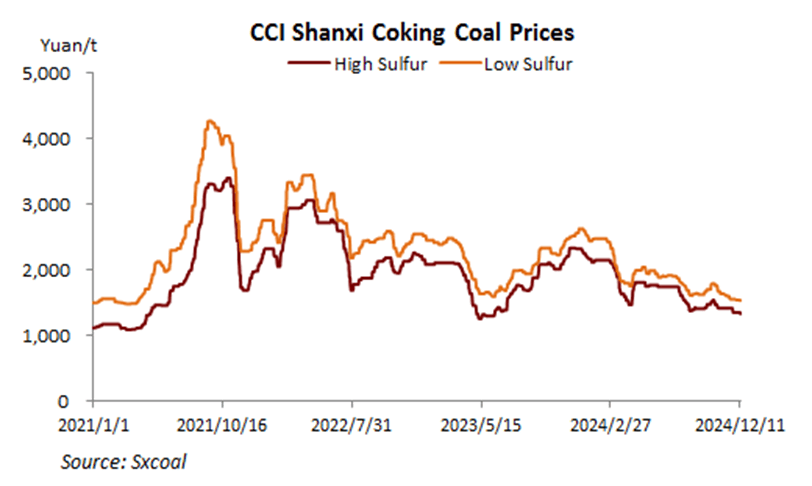
On December 13, the Fenwei CCI index for Shanxi low-sulfur primary coking coal was assessed at 1,540 yuan/t, ex-washplant with VAT, down 8 yuan/t week on week; the index for Shanxi high-sulfur coal declined 20 yuan/t week on week to 1,338 yuan/t.
Coking coal prices broadly stabilized in Wuhai, Inner Mongolia last week. Prices for high-sulfur fat coal (A 12%, S 2.5%, GRI 80) kept flat at 1,270 yuan/t on December 9. Coking coal price declines slowed down thanks to moderate restocking from downstream buyers. Yet, most participants still exercised caution in procurement.
The coking coal market trended downwards in Shandong. Most mines maintained normal operations to meet annual production targets. Tepid purchases and mounting inventories at mines forced miners to cut prices, with 1/3 fat coking coal prices down 80 yuan/t and washed gas coal down 60 yuan/t. Prices for washed gas coal (S 0.5%, GRI 75) were temporarily stable at 1,240 yuan/t. Coke producers showed low buying appetite and pressed for lower prices, further threatening feed coal prices.
Import market
Cargoes of Australian hard coking coal were sold to Indian buyers at $224.5-225/t CFR India on December 12, equivalent to about $209/t FOB Australia, rising $3.7/t week on week. This could translate to about 1,850 yuan/t CFR China with VAT, still higher than domestic similar-quality coal.
Futures prices fluctuated downwards, fueling cautious sentiment. This, coupled with sufficient feed coal supply, dampened coking plants' restocking efforts. Lukewarm spot transactions hence pushed down portside prices. Spot prices for Australian hard coking coal declined 20-50 yuan/t from a week ago to 1,550-1,600 yuan/t.
Daily customs clearance averaged 716 trucks at China's Ganqimaodu border crossing over December 9-12, down 251 trucks on the week. Coal stocks at supervision warehouses still hovered high earlier the week despite modest retreats.
Favorable macroeconomic policies cheered market confidence somewhat, but overall demand showed no substantial improvements during the traditional off-season. Sliding coke prices further depressed downstream buying interest. They only made on-demand purchases for Mongolian coking coal given relatively loose supply, intensifying inventory pressure at the border crossing and keeping prices temporarily stable. Prevailing prices for Mongolian 5# raw coal remained unchanged from the week prior at around 980-1,000 yuan/t, ex-stock Ganqimaodu with VAT.
Affected by the long-term weakening of the domestic market and significant price drops, Mongolian coking coal transactions stagnated at Ceke border port, contributing to continuous stock rise at supervision warehouses. Mongolian coal inflows at the border significantly declined for two consecutive weeks due to subdued purchases from traders caused by losses and sales difficulties. Mongolian coal transactions languished at the port. Spot prices for MAK A raw coal kept flat at 770-790 yuan/t, while South Gobi A raw coal remained unchanged at 800-850 yuan/t.
Daily throughput at Mandula port averaged 400 trucks over December 9-12, decreasing by 23 trucks week on week. Coke producers experienced narrowing profits after the fourth coke price cut materialized at the beginning of the week. Downstream buyers still took a prudent buying approach given ample feed coal supply. Some traders continued to adjust down offer prices to boost sales.
Forecast
China's coking coal market is anticipated to go down further this week, as coke and steel producers mostly eased feed coal purchases amid insufficient macroeconomic positives. Even moderate restocking efforts at coking plants for winter storage could still fail to reverse the overall downside trend.


 No Content

