


China thermal coal prices in 2024: to fall further or rebound?
- Opinion
- Price
- Thermal Coal
- Coal
sxcoal.com552 words202 reads


Thermal coal prices in China have experienced a generally downward trend this year, marked by volatility, extending the decline observed in the last quarter of 2022.
Even recent cold snaps have failed to provide a significant boost to thermal coal prices at ports and mines. This has raised questions over where prices may head in 2024 – will the downward trend continue or reverse into an uptrend?
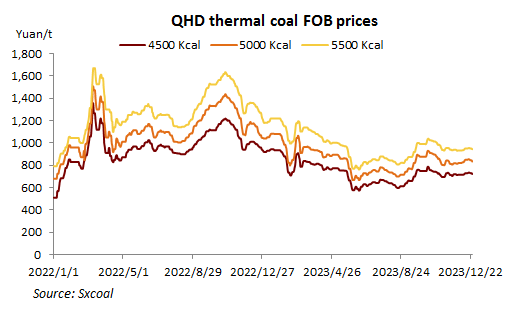
While many factors influence price movements, supply and demand ultimately play a decisive role. To forecast 2024 price trend, changes in supply and demand conditions must be examined.
On the supply side, while a consensus has been reached in the industry that the incremental supply gains have narrowed, the latest official statistics showed daily output in November still hit a record high, suggesting domestic supply would continue to be abundant.
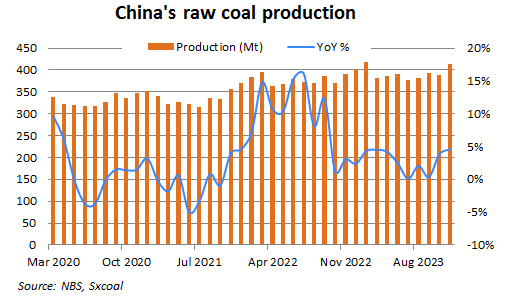
Government policies backing for the expansion of coal production capacity is expected to continue into the next year, although there may be a reduction in scope.
Insiders viewed Beijing may not extend the zero import tariff policy in 2024, but imports from key suppliers of Indonesia and Australia would be unscathed under free trade agreements. And coal and lignite are not included on the "preliminary import tariff list" recently announced, giving a leeway for possible adjustments if necessary.
Even if the previous import tariff is reinstated, the impact on coal import volume would be restricted to arrivals from Russia, Mongolia as well as some other non-major suppliers, yet they can still enjoy most-favored-nation tariffs.
Meanwhile, coal stockpiles at ports and power plants remain high at present, requiring time to deplete.
On the demand side, the deceleration in economic growth has restrained the increase in overall energy demand, with coal being no exception.
The industrial sector's struggle to achieve significant power consumption growth has had a dampening effect on their power demand, leading power plants to reduce fuel purchases, particularly from the spot market.
On the other hand, factors such as overcapacity, environmental requirements and lower profitability in some non-power industries have capped their needs for raw materials.
Continuous renewable installations would further squeeze coal-fired generation. Even hydropower, which has seen a significant decrease in output over the past two years, is expected to normalize next year, thanks to more scientific water storage and dispatch.
Coal demand may continue to increase next year, but the magnitude is expected to soften compared with 2022 and 2023.
Overall, coal supply is expected to edge higher next year, while demand growth will likely come to a stop. A balanced or mildly loose supply-demand balance is forecast for 2024.
Early this month, Tang Shemin, an official of the National Development and Reform Commission's Economic Operation Department, said on the sidelines of the 2024 National Coal Trade Fair that the country's coal supply and demand relation is expected to remain stable next year.
Market sources noted one of the key reasons behind recent spot trading weakness was that the central government has completed arrangements for 2024 medium- and long-term contract fulfillment.
With stable supply under term contracts, utilities have frequently put spot purchases on hold, leading sellers to reduce prices.
As of December 26, the 5,500 Kcal/kg NAR thermal coal traded at $950 yuan/t FOB or so, compared with around 1,100 yuan/t at the beginning of this year.


 No Content

