


China's Nov thermal power generation sees steady recovery on seasonal demand
- Production
- Thermal Power
- China
- Coal
- Power
sxcoal.com655 words55 reads


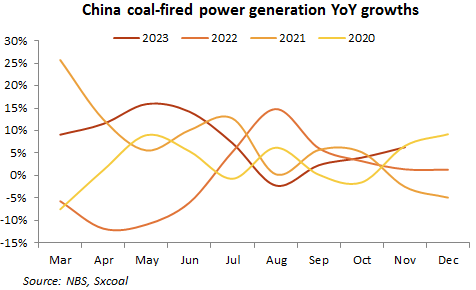
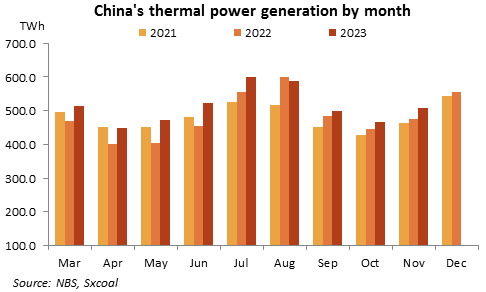
China's thermal power generation snapped a three-month sequential fall and shifted to a noticeable increase in November, thanks to rising seasonal demand, while the year-on-year output growth also extended its upward trend.
Output of thermal power, mainly generated from coal burning, reached 507.67 TWh in November, up 9.1% from a month earlier and 6.3% year on year, which expanded by 2.3 percentage points (pps) compared with a month ago, the latest data from the National Bureau of Statistics showed.
In November, China experienced warmer-than-usual temperatures overall. Except for the majority of northeastern China and eastern Inner Mongolia, which were colder than usual, the temperatures in most parts were near or above the normal levels during Novembers. The average temperature for the month was 0.6 degrees Celsius higher than usual.
However, most regions still experienced a significant drop in temperatures compared with October.
Meanwhile, although the national average precipitation in November was 11% above normal, the distribution of rainfall was uneven, with the northeastern region receiving the majority of the rainfall. Other areas, including the Yangtze River Basin and the southwestern region, had relatively less precipitation.
The decrease in hydropower output played a role in boosting thermal power generation during the month.
In the first eleven months, China's power consumption rose 6.3% from a year ago to 8,367.8 TWh, according to data from the National Energy Administration (NEA).
For the non-residential segment, the primary industries consumed 117.3 TWh over January-November, up 11.5% year on year; the secondary and tertiary industries consumed 5,517.9 TWh and 1,512.0 TWh, increasing 6.1% and 11.3% year on year, respectively.
The residential segment used 1,220.6 TWh of electricity during the period, up 1.1% over the year.
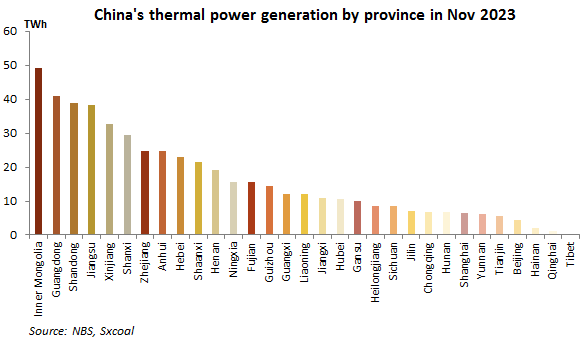
In November, Inner Mongolia, Guangdong, Shandong, Jiangsu and Xinjiang ranked the top five for thermal power generation, reaching 49.17 TWh (+12.5% YoY), 41.08 TWh (+13.7% YoY), 38.95 TWh (+0.6% YoY), 38.26 TWh (+4.4% YoY) and 32.7 TWh (+1.4% YoY), respectively.
From January to November this year, China's thermal power generation reached 5,617.79 TWh, representing a 5.7% y-o-y growth, flat compared to the January-October period.
Leading provinces in cumulative electricity generation were Inner Mongolia, Shandong, Guangdong, Jiangsu, Xinjiang, and Shanxi, with outputs of 536.24 TWh, 460.97 TWh, 450.24 TWh, 448.41 TWh, 340.27 TWh, and 333.09 TWh, respectively, reflecting y-o-y rises of 12.3%, 0.9%, 10.2%, 3.2%, 3.9%, and 3.0%.
November saw 25 provinces and regions register year-on-year increases in thermal power generation, accounting for 80% of the total reporting regions, which was higher than 65% a month ago. Notable growth rates were observed in Tibet (87.3%), Sichuan (60.1%), Yunnan (44.8%), Fujian (24.4%), Guangxi (16.1%), and Guangdong (13.7%).
Cumulatively, 28 provinces and regions reached y-o-y increases in thermal power generation during the first eleven months, with the number up by 2 compared with the previous month, constituting 90% of the total reporting regions. Yunnan (40.3% YoY), Guangxi (31.2% YoY), Tibet (28.9% YoY), Hainan (24.9% YoY), Guizhou (22.1% YoY), and Sichuan (14.4% YoY) reported largest growth rates among these provinces.
In the past two years, Yunnan, a major clean energy province, has witnessed a substantial decline in hydropower output due to reduced precipitation. To ensure stable electricity supply, Yunnan has expedited the development of thermal power projects.
According to data from the provincial authority, thermal power generation in Yunnan has notably increased since the beginning of this year. Particularly since April, the installed capacity of unified-dispatched thermal power plants has exceeded 10 GW, the highest level in recent years.
Thermal power remains its position as a mainstay for ensuring stable electricity supply during this critical period of rapid development of renewable energy and the transition towards a greener and low-carbon energy structure, as pointed out by Huaxi Securities Co., Ltd., a China-based company which is mainly engaged in securities business.
Fully utilizing the capacity of coal-fired power units is the most effective way for the safe operation of the new energy mix, the company added.


 No Content

