


Weekly: China's thermal coal prices stabilize before rising at end of week (Dec 11, 2023)
- Opinion
- Price
- Thermal Coal
- Coal
sxcoal.com974 words24 reads


China's domestic thermal coal prices remained stable for most days of last week but saw a slight increase on the final trading day. This uptick was fueled by optimistic sentiment among participants who anticipated a potential surge in coal consumption due to heavy snowfall and decline in temperatures.
Trading activity in the seaborne import thermal coal market remained lackluster as heightened freight rates subdued demand from China and India. End users were active in tender issuance for month-ahead arrivals, although they held harsh attitude in settling prices.
Fenwei CCI Index
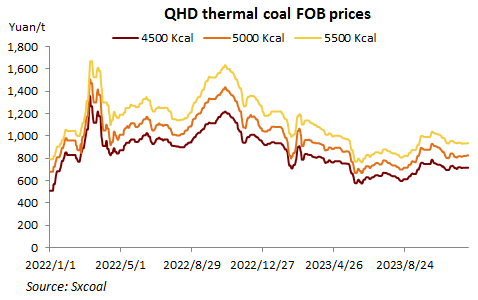
On December 11, the Fenwei CCI index for 5,500 Kcal/kg NAR domestic spot coal stood at 941 yuan/t FOB northern China ports with VAT, up 8 yuan/t week on week. The CCI index for 5,000 Kcal/kg NAR domestic coal was at 835 yuan/t FOB, up 15 yuan/t on the week.
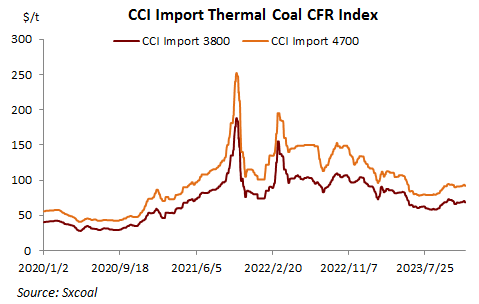
The Fenwei CCI 5500 Import index stood at $111.0/t, CFR southern China ports, down $1.0/t week on week. The Fenwei CCI 4700 Import index stood $2.0/t lower at $91.5/t CFR; the Fenwei CCI 3800 Import index was at $68.0/t CFR, a $2.5/t fall on the week.
Fenwei Survey
Fenwei's weekly survey on 100 thermal coal mines in Shanxi, Shaanxi and Inner Mongolia showed the weighted average capacity utilization stood at 89.19% in the week ending December 6, up from 87.32% a week prior. Their stockpiles totaled 3.20 million tonnes, up 1.47% week on week.
Weekly Dynamics
The overall market trend remained sideways in the last week despite minor fluctuations. The lingering safety checks curbed production at some mines, and some others suspended for longwall change or cut production as they completed production targets ahead of schedule, but most coal mines maintained normal operations.
Pithead coal prices showed varied trends. In Yulin, Shaanxi, prices remained generally stable with minor adjustments at a few mines; in Ordos, Inner Mongolia, coal prices were relatively stable; in northern Shanxi, prices rose slightly.
Market performance reflected weakness both on supply and demand ends, suggesting prices may maintain a narrow and oscillating trend.
However, the market may get uplifted from the heavy snowfall over the weekends, which would not only increase coal consumption at utilities, but also curb coal supply as many highways were temporarily suspended. However, how much it could support the market remains to be seen.
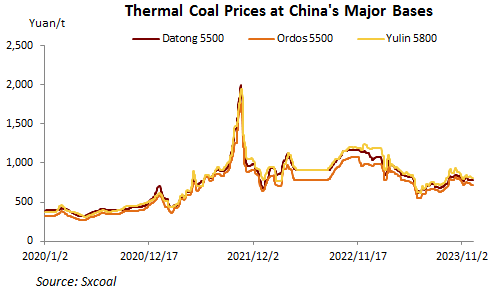
As of December 8, Fenwei assessed Yulin 5,800 Kcal/kg NAR thermal coal at 808 yuan/t, mine-mouth with VAT, down 1.8% from a week ago; Ordos 5,500 Kcal/kg NAR coal was assessed at 719 yuan/t, down 0.8% week on week; Shanxi Datong 5,500 Kcal/kg NAR coal was assessed stable at 787 yuan/t.
At northern ports, spot prices stabilized before picking up at the final trading day. As of late last week, 5,500 Kcal/kg NAR coal was mainly offered at 940-950 yuan/t FOB with VAT, down from 930-940 yuan/t in the previous week. Cargoes of 5,000 kcal/kg NAR saw offer prices rise to 830-840 yuan/t from 800-820 yuan/t.
Some buyers made proactive purchases as they expected prices to increase further in the wake of anticipated snowfall. Most end users remained resistant to high offer prices while sellers stood firmly on selling prices, resulting in difficulties in making deals.
Qinhuangdao's coal stocks stood at 6.08 million tonnes on December 8, falling 1.14% week on week and 2.25% month on month. The volume was still 5.01% higher from the year-ago level, Sxcoal's data showed. The inbound rail coal deliveries to Qinhuangdao averaged 495,571 tonnes each day in the week to December 8, falling 5% from a week ago. Daily outflows were at 505,571 tonnes, down 7.6% from the preceding week.
At Caofeidian port, where spot coal accounts for a higher share than that at Qinhuangdao, reached 12.50 million tonnes on December 8, a 3.35% fall from a week ago.
However, coal inventories at Qinhuangdao port have ballooned to a three-year peak of 7.1 million tonnes on December 11, due to prolonged vessel traffic restrictions amid extreme weather, Sxcoal's latest data showed.
Qinhuangdao port has been subject to transportation control since 8:50 p.m. on December 8 due to gales. The sailing suspension has now stretched into a third day, severely limiting vessel turnover at the port.
Meanwhile, the six major coastal power groups at eastern and southern China had 13.74 million tonnes of coal stockpiles as of December 10, down 3.64% week on week. That was enough for 16.8 days of use, down from 17.5 days a week ago, based on daily consumption of 815,500 tonnes, which increased 0.39% from the previous week.
The seaborne import market remained unchanged last week, with activity in stagnancy as India and China balked at elevated shipping rates, caused by the Panama Canal disruptions as well as growing demand for iron ore and grains.
Chinese traders took the back seat to covering their short positions, as their purchasing costs remained $1.5-2/t higher than tender-winning prices.
As of late last week, Indonesian 3,800 Kcal/kg NAR thermal coal was offered at $60.5/t FOB Panamax, and Australian 5,500 Kcal/kg NAR quoted at $94/t FOB.
The tender-winning prices for 3,800 Kcal/kg NAR cargoes were around 543-560/t DDP with VAT, netting back to around $58-59.5/t FOB.
Forecast
China's domestic thermal coal is likely to move upward this week due to widespread snowfall in the north. As there are two more cold snaps this week, potentially higher coal consumption will prompt utilities to accelerate purchases.
The seaborne import market may also witness an uptick as Chinese buyers may continue to buy as the shipping rates decline. Meanwhile, utilities may need to step up coal purchases as stocks have declined fast at coastal power plants.


 No Content

