


Monthly: China Nov PCI coal market extend decline amid cautious buys
- Opinion
- Price
- PCI
- China
- Coal
sxcoal.com724 words15 reads


China's PCI coal prices remained weak in November over prudent market sentiment and tepid purchases among steelmakers and middlemen.
Increased raw coal production at major producing areas brought sufficient supply, also weighing down the PCI coal market.
Oct supply-demand
The effective supply of anthracite and meager coal for PCI purposes reached 8.18 million tonnes in October, down 0.92% compared with a month earlier.
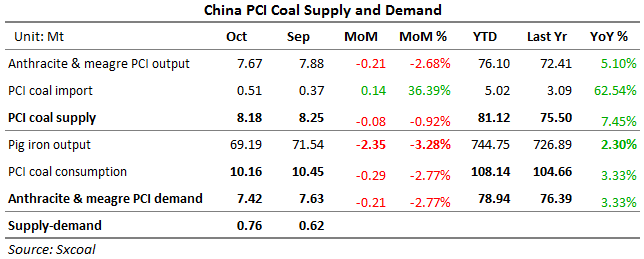
Total effective PCI supply of coal witnessed a year-on-year increase of 7.45% during January-October 2023, reaching 81.12 million tonnes, of which anthracite and meager coal output stood at 76.10 million tonnes, up 5.1% year on year.
Demand fell 2.77% month on month to 7.42 million tonnes in October. This contributed to a cumulative demand of 78.94 million tonnes in the first ten months, a 3.33% rise compared to the corresponding period last year.
In summary, the supply of PCI coal in October was 758,400 tonnes higher than the demand, further expanding from 623,500 tonnes in September.
Market overview in November
Key Producing Areas
By the end of the month, PCI coal prices in the four key producing cities — Yangquan and Lucheng in Shanxi province, and Yongcheng and Jiaozuo in Henan province — reported decreases compared to the previous month, sliding 66 yuan/t, 60 yuan/t, 71 yuan/t and 69 yuan/t, respectively, on a free-on-rail basis with VAT.
On a yearly basis, these four major producing areas all dropped by 603 yuan/t, 550 yuan/t, 650 yuan/t and 631 yuan/t, respectively.
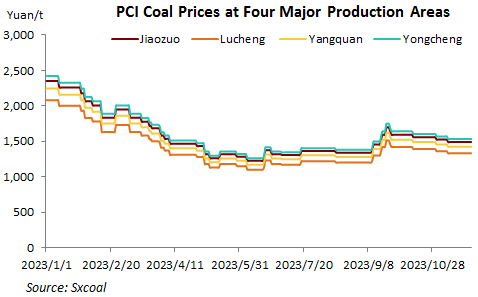
On November 30, the Fenwei CCI Met index for Yangquan PCI coal with 12% ash, 10% VM and 0.8% sulfur was assessed at 1,425 yuan/t, free-on-rail basis with VAT, down 66 yuan/t from a month ago. In Shanxi's Changzhi, Fenwei assessed PCI coal (S 0.5%, A 12% and VM 12%) at 1,300 yuan/t, down 60 yuan/t from the previous month.
In northwestern China's Ningxia, the ex-washplant price of Shizuishan PCI coal with 7,000 Kcal/kg NAR, 0.7% sulfur, 12% ash and 12% VM was at 1,410 yuan/t, unchanged compared to the preceding month. In Hancheng of Shaanxi, the free-on-rail price of PCI coal (CV 6,000 Kcal/kg NAR, S 0.5%, A 11% and VM 18%) stood at 1,290 yuan/t, down 60 yuan/t from October.
Key Consuming Areas
Steel prices trended higher in November with the continued depletion of steel stocks during the off-peak season thanks to favorable macroeconomic policies. As a result, steel mills saw improved profit margins and some of them resumed production, maintaining on-demand purchases for PCI coal.
Data showed the price of Shanghai HRB 400 rebar (20 mm) stood at 4,040 yuan/t on November 28, jumping 230 yuan/t from late October, while that of Shanghai hot-rolled coil (3.0 mm) rose 160 yuan/t to 4,050 yuan/t.
North China On November 27, the purchase price of Handan Iron & Steel Group for anthracite PCI coal with 6,500 Kcal/kg NAR, ash below 11%, VM below 11%, and sulfur less than 0.5% was 1,480 yuan/t with VAT, delivered basis, down 60 yuan/t compared with October.
The purchase price of Xingtai Iron & Steel Co., Ltd. was 1,450 yuan/t on November 30, on a delivered basis, also down 60 yuan/t from the preceding month.
East China On November 27, Laiwu Iron and Steel Group reported the delivered price for anthracite PCI coal with 12% ash, 12% VM and 0.8% sulfur at 1,602 yuan/t, decreasing 74 yuan/t compared with the month-ago level.
Southwest China On November 27, the purchase price of Shuigang Iron & Steel Group in Guizhou province for anthracite PCI coal with 13% ash, 11 VM and 0.6% sulfur was 1,350 yuan/t, delivered basis with VAT, flat month on month.
Forecast
The PCI coal market continued the downward trajectory in November amid cautious stance on the demand side.
The PCI coal prices may remain to be seen in the future. Winter restocking demand at steel mills would add cerntain support to the PCI coal market. Stricter safety inspections due to recent mine accidents, as well as eased year-end production zest among miners and increased heating demand, would tighten the coal supply, supporting the prices.
However, steel demand and output are likely be curbed by the slack season and production restriction for environmental protection, adding downside pressure on the PCI coal market.


 No Content

